Yes. Cold laser therapy is an effective, evidence-based treatment for many pain conditions, with 30% or greater pain reduction for most patients and meaningful improvement often showing up after 3 to 5 sessions when the diagnosis and treatment plan are right. It can be especially useful for TMJ-related muscle and joint pain, but its success depends on the specific condition being treated, the treatment settings, and the skill of the provider applying it.
If you're reading this with a sore jaw, morning headaches, ear pressure, facial muscle tightness, or pain that flares when you chew, talk, yawn, or clench, you're asking the right question. Patients with TMJ and orofacial pain often arrive after trying night guards, soft diets, anti-inflammatories, stretching, massage, or dental work, yet the joint and muscles still feel irritated. They don't want surgery, and they don't want another short-term fix.
Cold laser therapy deserves a careful answer, not hype. In clinical practice, it can be a very good tool for reducing inflammation, calming irritated nerves, and supporting tissue repair in the jaw system. But it isn't magic, and it isn't interchangeable with every other regenerative treatment. For some TMJ cases, photobiomodulation works well as a stand-alone option. For others, PRF or Prolotherapy makes more sense because the underlying problem is structural instability, not just inflamed tissue.
How Cold Laser Therapy Energizes Your Cells for Healing
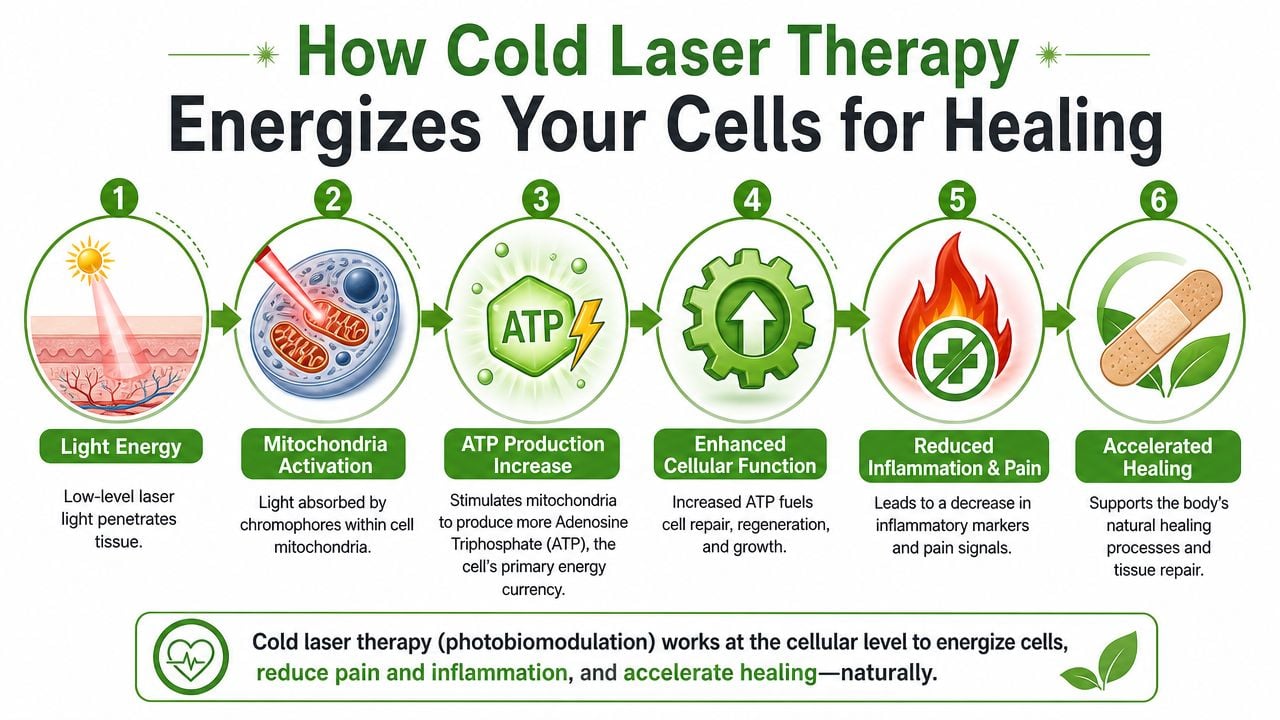
A patient with TMJ pain often asks some version of the same question during the first visit: if my jaw hurts because the muscles are tight, the joint is irritated, and the area feels inflamed, how can light make any real difference? The answer is that cold laser therapy, also called low-level laser therapy or photobiomodulation, affects how stressed tissue functions at a cellular level.
Cold laser uses specific wavelengths of light, often in the red to near-infrared range, to interact with tissue below the skin. Research published in the journal Laser Therapy describes how light in this range can be absorbed by cellular chromophores, particularly within mitochondria, and influence energy production and healing responses (mechanisms of photobiomodulation in tissue repair). For a patient with jaw pain, that matters because painful tissue usually has more than soreness. It has reduced local efficiency, ongoing inflammation, and a slower repair response.
What happens inside the tissue
At the cellular level, photobiomodulation is believed to act in part through cytochrome c oxidase in the mitochondria. That interaction can support ATP production, influence inflammatory signaling, and improve the local conditions needed for tissue repair. In practical terms, the treatment aims to help irritated tissue settle down and function more normally.
In TMJ and orofacial pain care, those effects can be useful when the pain source is muscular, inflammatory, or related to irritated soft tissue around the joint. I commonly consider it for masseter tenderness, temporalis overload, capsular irritation, tendon irritation, and some nerve-sensitive pain patterns. It is less likely to solve the whole problem if the main driver is joint instability, disc dysfunction, or ligament laxity.
That distinction matters in regenerative medicine. Cold laser helps tissue perform better. PRF and Prolotherapy are used more often when the goal is to stimulate a stronger healing response in tissue that has been structurally compromised. For the right TMJ patient, laser is the lower-force option. For the wrong TMJ patient, it can reduce symptoms without correcting the reason the joint keeps getting irritated.
Why settings and targeting matter
Results depend on more than the device itself. Wavelength, dose, treatment time, tissue depth, and accurate targeting all affect whether enough light reaches the intended structure. The World Association for Laser Therapy publishes treatment parameter guidance because underdosing and poor technique are common reasons patients conclude laser "didn't work," when the underlying problem was how it was applied (laser dosage recommendations from WALT).
This is especially important in the jaw. Treating the general cheek area is not the same as treating the masseter attachment, TMJ capsule, temporalis tendon, or a specific trigger point with a clear clinical purpose. Good outcomes depend on a proper exam first, then a treatment plan that matches the tissue involved.
If you want a patient-friendly overview of the broader benefits of PBM therapy, that resource gives useful context. If you're also curious what a professional device setup looks like in actual practice, this page on a cold laser therapy machine shows the kind of technology used clinically.
Evaluating the Evidence for Cold Laser Pain Relief
A patient with jaw pain often asks the same practical question. Is this likely to help my specific problem, or is it another treatment that sounds promising but does not change much? From a clinical standpoint, cold laser therapy can be useful, but its value depends on diagnosis, tissue target, and treatment goals.
The better studies on photobiomodulation show a consistent pattern. Pain relief is more likely when the source is localized and biologically plausible, such as a tendon, joint capsule, muscle trigger point, or superficial nerve irritation, than when pain is diffuse and poorly defined. A 2022 systematic review and meta-analysis in the Journal of Oral Rehabilitation found that low-level laser therapy improved pain and mouth opening in patients with temporomandibular disorders, although the authors also noted meaningful variation in protocols and study quality (systematic review of laser therapy for temporomandibular disorders).
That matches what I see in orofacial pain care.
Where the evidence is strongest
Laser therapy has the best support as a symptom-modifying treatment for inflammatory and myofascial pain states. In TMJ practice, that usually means a sore joint capsule, irritated chewing muscles, tendon attachment pain, or post-flare tenderness that is easy to reproduce on exam. A 2015 systematic review in Lasers in Medical Science concluded that low-level laser therapy can reduce pain in temporomandibular disorders, but also emphasized that treatment parameters differ widely across studies, which affects results (review of low-level laser therapy for temporomandibular disorders).
That distinction matters when patients compare options. Cold laser is low-force and noninvasive. PRF and Prolotherapy are regenerative procedures we use when the exam suggests a deeper structural driver, such as ligament laxity, recurrent joint irritation, or tissue that is not tolerating load well. Laser can calm a painful area. It does not tighten a loose ligament or stimulate the same repair response we aim for with an injection-based regenerative treatment.
For patients sorting through different laser terms online, it also helps to separate pain treatment from cosmetic devices. If that search has crossed into body contouring, this overview of how laser lipo works explains a different category of technology.
What this means for TMJ and orofacial pain
TMJ pain is not one diagnosis. It is a group of problems that can involve muscle, joint, tendon, nerve sensitization, disc mechanics, clenching behavior, or several of these at once.
Cold laser tends to make the most sense when the exam points to an irritated tissue that is accessible and inflamed, and when the goal is to reduce pain enough for the patient to chew more comfortably, open better, or tolerate corrective care. That is why it often works well as part of a broader cold laser therapy for pain relief plan rather than as a stand-alone fix.
In contrast, a patient with repeated jaw locking, clear joint instability, or longstanding overload from bite and airway issues may feel better with laser and still relapse. In that setting, the trade-off is straightforward. Laser is easier to tolerate and carries less procedural burden. PRF or Prolotherapy may be more appropriate if the goal is to address why the joint or supporting tissues keep getting irritated.
Where cold laser is less convincing
The evidence is less persuasive for nonspecific pain complaints where the pain generator is unclear. The American Academy of Orthopaedic Surgeons reviewed low-level laser therapy for low back pain and reported mixed results, with insufficient support for routine use in nonspecific cases and only small benefits in some studies (AAOS review of low-level laser therapy and low back pain).
That does not weaken the case for laser in the right patient. It sets the right expectation.
Cold laser works best when the diagnosis is narrow, the target tissue is identified, and the treatment is part of a plan that also addresses the cause of overload. For TMJ and orofacial pain, that may include muscle retraining, habit change, sleep and airway evaluation, bite-related load management, or a regenerative option when the exam points to a structural problem.
Your Cold Laser Therapy Journey From Start to Finish
You wake up with jaw pain, chew carefully through breakfast, and wonder whether this appointment will involve needles, downtime, or another treatment that feels harder than the problem itself. Cold laser therapy is usually much simpler than patients expect.

The first visit
A useful visit starts with the exam. For TMJ and orofacial pain, I want to know whether the pain is coming from the joint capsule, chewing muscles, tendon attachments, irritated nerves, clenching patterns, or a load problem tied to bite or airway function. Laser only helps when it is aimed at the right tissue.
Once the target is clear, the treatment itself is straightforward. Protective eyewear is used. The handpiece is placed over the painful area in a planned pattern, and the session is usually brief. General patient guidance from academic medical centers describes low-level laser therapy as a short, noninvasive treatment that often takes only minutes per area and does not require recovery time (Cleveland Clinic overview of low-level laser therapy).
For many jaw pain patients, the first surprise is how uneventful it feels. There is no incision, no sedation, and no post-procedure restriction beyond common-sense load management.
What you'll feel and when relief starts
During treatment, patients usually feel little to nothing, or a mild sense of warmth. Afterward, some notice easier opening, less muscle guarding, or less tenderness when they press on the sore area. Others feel no major change after the first session and improve over a series instead.
That pattern matters. In TMJ care, cold laser is often most useful as part of a plan, not as a stand-alone fix. If the tissue is inflamed but stable, a short series may calm the flare enough for stretching, bite management, breathing work, and sleep-related habit changes to start helping. If the joint or ligaments are unstable, laser may reduce pain but not hold the result. In that setting, patients sometimes do better with orthobiologic therapy options such as PRF or Prolotherapy, which are designed to create a stronger healing response.
Published clinical summaries on photobiomodulation for temporomandibular disorders describe improvement in pain and jaw function in many patients, but they also show what I see in practice. Response is not identical from one case to the next, and chronic cases usually need a series rather than a single visit (NIH StatPearls review of temporomandibular syndrome management).
A good treatment plan should tell you what tissue is being treated, how often you'll be seen, and what would count as progress within the first several visits.
This short video gives a helpful look at the treatment experience:
What happens after the session
Most patients stand up, test their jaw movement, and go back to the rest of their day.
The follow-through matters more than the recovery. You may be asked to stay with your home stretching program, avoid heavy chewing for the rest of the day, keep using an appliance if one was prescribed, and continue the airway or tongue posture work that supports lower jaw tension. That is how we keep short-term symptom relief from turning into another temporary reset.
A quick note if you came across regenerative treatments while researching other uses, including PRP hair restoration in Ashburn. Those treatments are in a different category from cold laser. They can all support healing, but they are used for different tissues, different goals, and different clinical problems.
Cold Laser Compared to Other Regenerative Treatments
Not every regenerative therapy solves the same problem. For TMJ and orofacial pain, the decision usually comes down to one clinical question: are we treating irritated tissue that needs metabolic support, or are we treating unstable tissue that needs a stronger regenerative stimulus?
Cold laser, PRF, and Prolotherapy can all play a role. They just do different jobs.
Where cold laser fits
Cold laser is the least invasive option of the three. It uses light energy to reduce inflammation, support cellular repair, and calm pain signaling without needles or downtime. That makes it appealing for patients with muscle-dominant TMJ pain, localized joint irritation, tendon soreness, and flare-driven facial pain.
PRF and Prolotherapy are injection-based treatments. They aren't interchangeable with laser, and they usually aren't first-line just because a patient wants something "stronger." The right choice depends on whether the tissues are inflamed, weakened, unstable, or not healing well on their own.
Comparison of Regenerative Therapies
| Therapy | Mechanism | Best For | Process | Patient Sensation |
|---|---|---|---|---|
| Cold Laser Therapy | Light-based photobiomodulation that supports cellular repair and helps reduce inflammation | TMJ muscle pain, localized soft tissue irritation, nerve sensitivity, patients who want a non-invasive option | External treatment over targeted tissue | Usually painless, sometimes mild warmth |
| PRF | Uses concentrated blood-derived healing components placed into the target area to support repair | Areas that may benefit from a stronger biologic healing signal, including selected joint or soft tissue problems | Blood draw followed by guided placement or injection | Involves needle-based treatment and post-procedure soreness can happen |
| Prolotherapy | Uses an irritant solution to trigger a controlled healing response in lax or injured connective tissue | Ligament laxity, tendon attachment problems, joint instability patterns | Injection-based treatment into the affected attachment or joint-supporting tissue | Temporary soreness is common because the treatment is designed to stimulate repair |
How I explain the trade-offs to patients
For a patient with jaw muscle tightness, clenching-related pain, and a tender but stable joint, cold laser often makes more sense than jumping to injections. For a patient with ligament laxity, recurrent joint irritation, or a history suggesting mechanical instability, PRF or Prolotherapy may address the root issue more directly.
This is also why combination care can be useful. A patient might use laser to calm an active flare and improve tissue tolerance, then move to an injection-based regenerative plan if the exam shows the joint still lacks stability.
If you're unfamiliar with biologic treatments beyond pain care, this overview of PRP hair restoration in Ashburn is a simple example of how platelet-based therapies are used in another setting to support tissue response. For jaw and facial pain, the clinical decision needs much tighter targeting.
A more complete look at injection-based options is available through this page on orthobiologic therapy, which outlines how regenerative treatments are selected based on tissue type and treatment goals.
Cold laser is often the easiest treatment to start with when the goal is to calm pain and improve healing without adding procedural stress. PRF and Prolotherapy become more compelling when the exam points to tissue weakness or instability.
Understanding the Safety Profile of Cold Laser Therapy
A common patient scenario is simple. Your jaw has been sore for weeks, chewing feels tiring, and the idea of an injection sounds like too much for a first step. In that setting, safety often becomes the deciding factor. Cold laser therapy appeals to many TMJ and orofacial pain patients because it is noninvasive, usually comfortable, and does not damage tissue when used appropriately.
That said, safety is not just about whether a treatment hurts during the visit. It also includes whether the treatment fits the diagnosis and whether it helps without delaying better-targeted care.
What patients usually experience
Cold laser uses light energy at therapeutic doses intended to support tissue recovery, reduce pain, and calm irritated muscles and joints without cutting or burning tissue. For patients with jaw muscle spasm, facial tenderness, or a pain flare around the TMJ, that lower-force approach is often easier to tolerate than needling or injection-based procedures.
Most sessions are brief. Patients typically notice little more than warmth or no sensation at all. Reviews of photobiomodulation safety describe a low rate of adverse effects when proper eye protection, dosing, and treatment selection are used (systematic review discussing adverse effects and safety considerations in photobiomodulation).
That does not make it universally appropriate.
When extra caution matters
A careful clinician screens for situations where laser should be avoided or used conservatively. Common examples include:
- Direct eye exposure, which is why wavelength-specific protective eyewear is required
- Known or suspected malignancy in the treatment area, because stimulating tissue in that setting is not appropriate
- Pregnancy-related precautions, especially over the abdomen or other sensitive treatment regions
- Impaired diagnosis, because even a gentle treatment can postpone the right intervention
The World Association for Photobiomodulation Therapy and related clinical guidance also emphasize proper dosing and training, since overtreatment or poorly targeted treatment can reduce benefit even when side effects remain limited (photobiomodulation therapy dosage and safety guidance).
For orofacial pain, diagnosis drives safety more than the device label does. A patient with masseter overuse from clenching may do well with laser. A patient with disc displacement, joint instability, fracture history, neuropathic pain, or a primary sleep-breathing problem may need a different plan or a broader workup.
Why provider judgment matters as much as the machine
A treatment's true safety lies in diagnostic accuracy. A painless therapy can still delay recovery if it distracts from the actual cause of the pain.
This matters in TMJ care because several conditions can feel similar at home but require different treatment paths in clinic. Muscle-driven jaw pain, inflamed joint tissues, cervical referral, trigeminal nerve irritation, and bite-related overload do not respond the same way. Cold laser is often the gentlest option we offer, but gentlest is not always the most corrective option.
That is where the comparison to PRF and Prolotherapy helps. Laser usually carries less procedural burden and fewer short-term downsides because there is no injection, blood draw, or post-procedure soreness from needle placement. PRF and Prolotherapy may be the better choice when the exam points to ligament laxity, recurrent joint irritation, or poor structural support. Those treatments ask more of the patient on treatment day, but in the right case they target the underlying mechanical problem more directly.
Good care starts with an exam that separates muscle pain from joint pain, screens for referred pain sources, reviews clenching and sleep patterns, and sets clear expectations about what laser can and cannot do. That is how safety should be judged in practice.
Finding a Qualified Cold Laser Therapy Specialist
A patient with jaw pain often arrives after trying the easy options first. A mouthguard bought online, a few massages, maybe a laser session at a spa. The pattern I watch for is simple: the pain keeps returning because no one has defined what tissue is driving it.
That is why the right specialist matters more than the brand of laser in the room.
For TMJ and orofacial pain, choose a provider who regularly evaluates jaw joints, chewing muscles, facial pain patterns, headaches, neck contribution, and sleep-related strain. A clinic can own a cold laser and still miss the diagnosis. In practice, that distinction affects results. Laser can calm an irritated muscle or sensitive soft tissue, but it will not correct every case of joint instability, ligament laxity, or bite-related overload. In those situations, PRF or Prolotherapy may deserve a closer look because they address tissue support in a different way.
What to look for
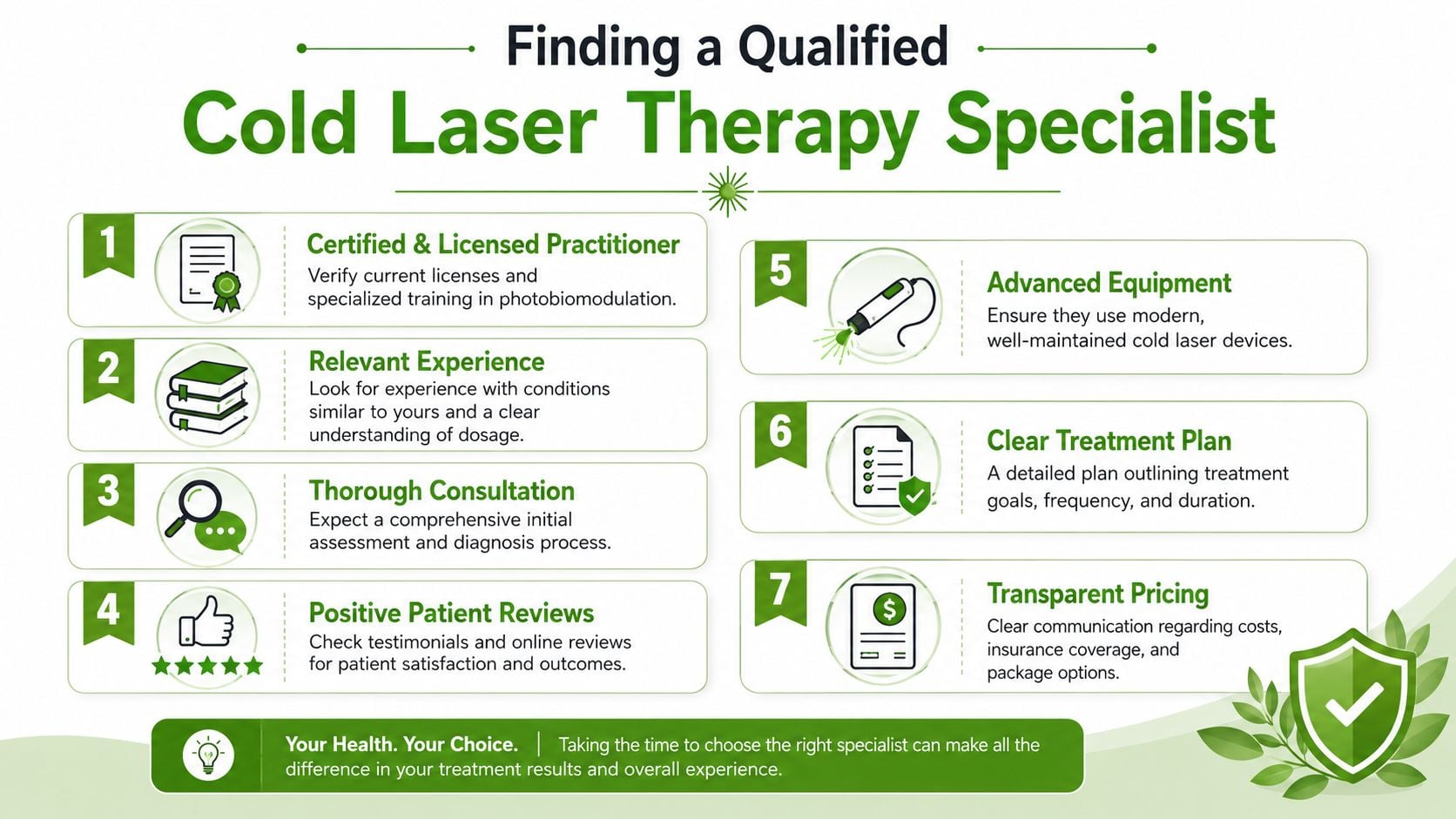
A good consultation should feel specific. You should hear a working diagnosis, the reason laser fits that diagnosis, the expected timeline for improvement, and the point at which the plan changes if progress stalls.
Use this checklist:
- Licensure and scope: Ask what professional license the provider holds and whether TMJ, facial pain, or musculoskeletal pain is a routine part of their practice.
- Diagnostic process: Ask how they separate muscle pain, joint inflammation, nerve irritation, cervical referral, and clenching-related overload.
- Treatment rationale: Ask how they choose the treatment area, settings, and frequency of visits for your case.
- Response checkpoint: Ask how many sessions they usually allow before deciding the treatment is helping enough to continue.
- Alternatives: Ask what they recommend if laser helps only partly, or if the exam suggests PRF, Prolotherapy, an appliance, or another therapy would address the cause more directly.
Questions worth asking directly
These questions usually tell you very quickly how thoughtful the care will be:
- What diagnosis are you treating with the laser?
- What findings on my exam support that diagnosis?
- How will you measure whether treatment is working?
- When would you decide laser is not the right primary treatment for me?
- How do you decide between laser, PRF, and Prolotherapy for TMJ or orofacial pain?
Pain and Sleep Therapy Center is an example of a practice model that evaluates TMJ pain, facial pain, sleep-breathing issues, and regenerative treatment options together rather than treating each complaint in isolation.
If a provider cannot explain the diagnosis, the target tissue, and the backup plan, keep looking.
Common Questions About Cold Laser Therapy
Does cold laser therapy hurt
Usually, no. Most patients feel little to nothing during treatment, aside from mild warmth in some settings. It isn't supposed to feel like a surgical procedure, and there shouldn't be cutting or burning.
Is this the same kind of laser used in surgery
No. Surgical lasers are designed to cut, ablate, or reshape tissue. Cold laser therapy is designed to stimulate healing without producing that kind of tissue damage.
Can cold laser therapy help TMJ pain
It can, especially when the pain is related to inflamed soft tissue, overworked jaw muscles, local joint irritation, or nerve sensitivity around the face and jaw. It tends to be less useful when a patient needs a different primary intervention for structural instability or another untreated driver of pain.
Can it be combined with other TMJ treatments
Yes. In practice, it's often paired with jaw exercises, bite appliances, breathing or myofunctional therapy, manual treatment, and in selected cases regenerative injections. Combining therapies usually makes more sense than expecting one tool to solve every layer of the problem.
Will insurance cover it
Coverage varies. Some plans may include it under broader therapy services, and others won't. The right step is to ask the treating office how they bill and what out-of-pocket costs to expect before starting care.
How do I know whether laser, PRF, or Prolotherapy is right for me
That depends on the exam. If the problem is mainly inflammation and tissue irritation, cold laser may be the best starting point. If the problem is unstable or weakened tissue that needs a stronger regenerative signal, PRF or Prolotherapy may be the better match.
What if cold laser doesn't work for me
That doesn't automatically mean the treatment is ineffective. It may mean the diagnosis was incomplete, the protocol wasn't well matched to the tissue, or your pain source needs a different intervention. In good care, a poor response leads to reassessment, not endless repeat sessions.
If you're dealing with TMJ pain, facial tension, headaches, or jaw symptoms that haven't responded to basic care, Pain and Sleep Therapy Center offers evaluation for root-cause treatment options including cold laser therapy, PRF, and Prolotherapy. The goal is to match the treatment to the actual pain generator so you can move toward lasting relief instead of temporary symptom control.