Most advice about snoring starts with the wrong assumption: that everyone can breathe comfortably through the nose. For mouth breathers, taping the lips shut or buying a generic anti-snoring device can be ineffective, uncomfortable, or unsafe if nasal airflow is limited. The right remedy depends on whether you have primary snoring, nasal obstruction, or a form of sleep-disordered breathing that needs diagnosis before treatment.
Mouth breathing often reflects an airway problem rather than a bad habit. The practical question isn't just how to keep your mouth closed. It's why your mouth opens during sleep, and whether closing it would improve airflow or hide a more serious obstruction.
Why Mouth Breathers Need a Different Approach to Snoring
Snoring happens when tissues in the upper airway vibrate as air moves through a narrowed passage. Mouth breathing changes that airflow pattern. It can dry and irritate the throat, alter tongue and soft-palate position, and allow the jaw to drop backward during sleep. Those changes may increase vibration, but they can also signal that the nose or throat isn't moving air efficiently.
That distinction matters. A person with occasional primary snoring may improve with side sleeping, nasal support, or a properly selected oral appliance. A person who snores while experiencing repeated breathing interruptions may have obstructive sleep apnea, where symptom suppression alone isn't enough.
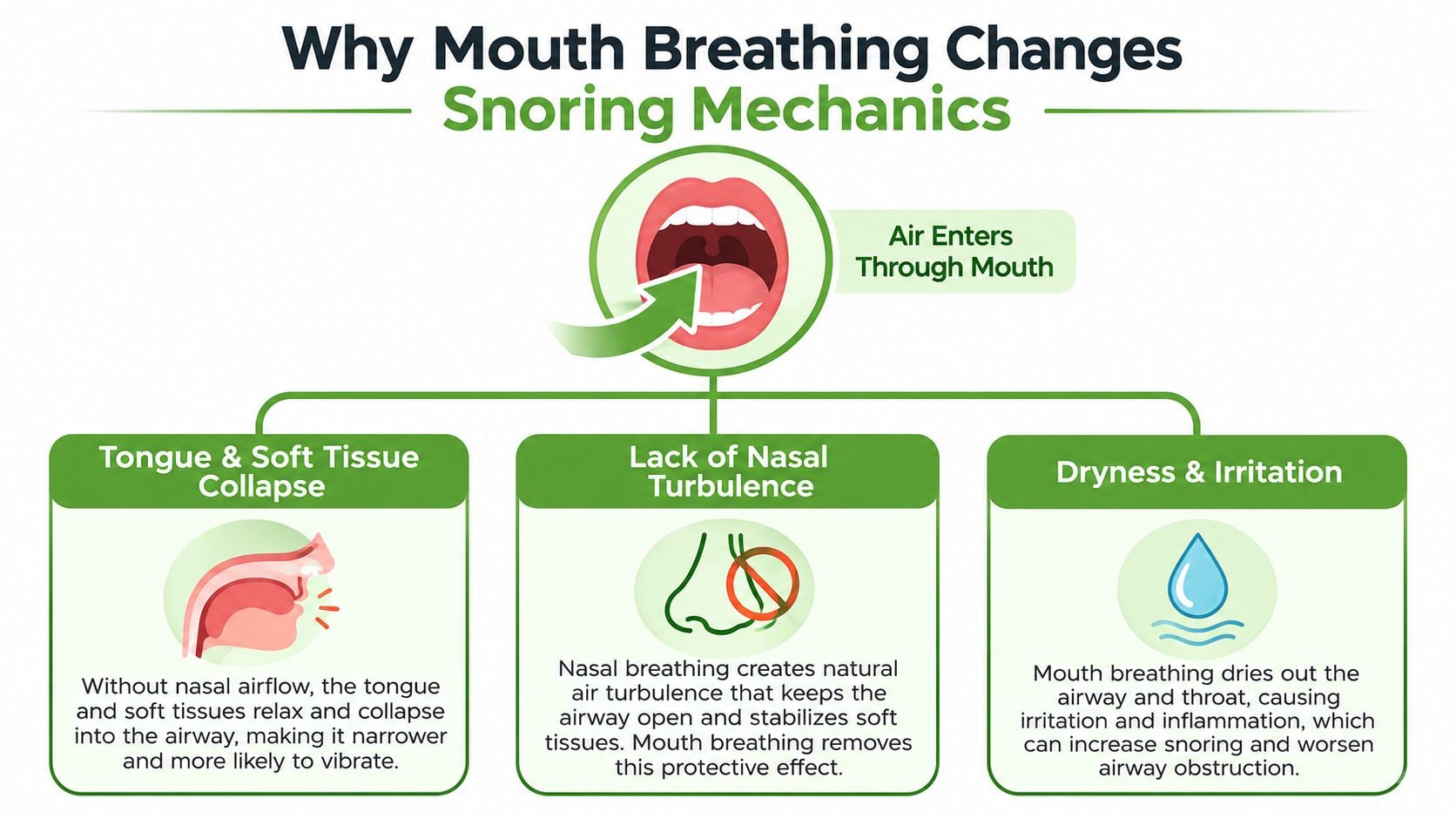
Mouth breathing can be a phenotype, not just a habit
Recent clinical work is examining mouth breathing in snorers as a distinct obstructive sleep apnea phenotype. A 2024 study found that adding a mouth shield to oral appliance therapy significantly reduced mouth breathing over time, and a clinical trial is evaluating combined oral appliance and mouth-shield treatment in confirmed mouth breathers who snore or have obstructive sleep apnea. The Frontiers in Sleep review and study discussion highlight the central issue: reducing mouth opening may help, but it doesn't necessarily correct the reason the airway collapses.
A dry mouth, sore throat, restless sleep, morning headache, or waking with a gasp deserves more attention than a noisy bedroom. So does habitual open-mouth sleep when nasal congestion, allergies, structural blockage, or jaw-related airway narrowing is present.
Clinical rule: Treat the airway driver first. Mouth closure is only reasonable when nasal breathing is already comfortable and sleep apnea has been considered.
Generic products often fail because they target the sound rather than the mechanism. A nasal strip cannot advance the jaw. A mouth tape cannot stabilize a collapsing throat. A soft chin strap may keep the lips closer together while the tongue still falls backward. Selecting a remedy starts with identifying which part of the breathing system is failing.
Immediate At-Home Measures You Can Try Tonight
Start with measures that improve airflow without forcing the mouth closed. Sleep on your side, use a body pillow to reduce rolling onto your back, and consider modest head elevation with a wedge pillow. These changes may reduce positional airway narrowing, but they won't reliably control snoring caused by significant obstruction.
Before bed, address nasal resistance. A saline rinse can clear mucus and irritants for some people, while an external nasal dilator such as Breathe Right strips or an internal dilator such as Mute may widen the nasal passage mechanically. These products can help when the nose is the upstream problem, but they won't treat obstruction deeper in the throat.
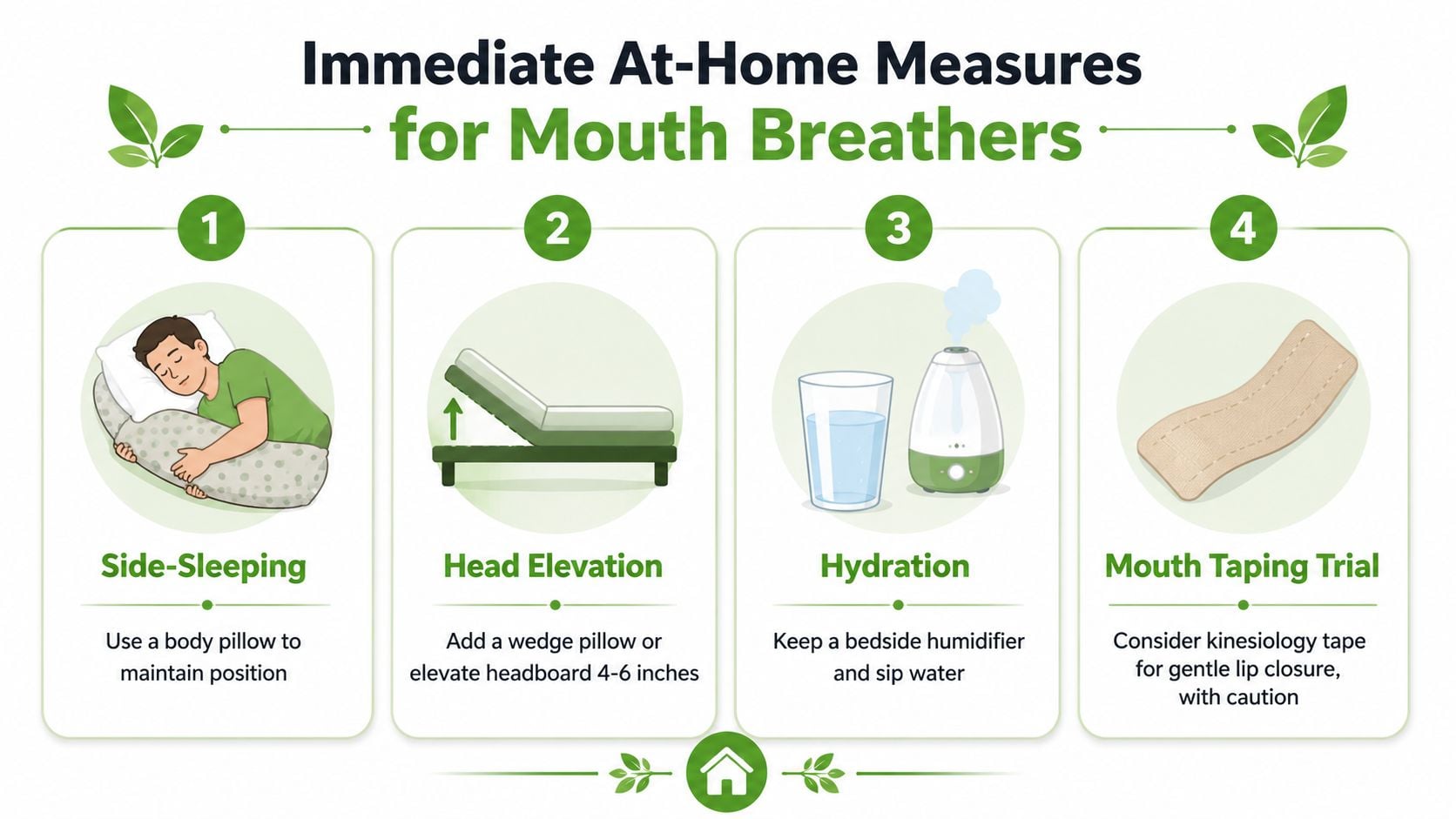
Use mouth taping only after a nasal airflow check
Mouth taping is the most popular suggestion in this category, and the one most often oversold. A 2025 systematic review summarized in recent coverage included 10 studies involving 213 patients, finding minor benefits in a narrow subgroup of healthy adults without nasal obstruction, while most studies showed no meaningful improvement and several raised safety concerns when nasal blockage was present. The review summary on mouth taping supports a cautious, selective approach rather than universal use.
Do not tape your mouth if you have nasal congestion, suspected sleep apnea, significant reflux with nighttime choking, vomiting risk, severe anxiety about restricted breathing, or difficulty breathing through your nose. Don't use tape on a child without direct medical guidance.
If a clinician has ruled out concerning breathing problems and your nose is clear, test nasal breathing while awake. Close your lips gently and breathe through your nose comfortably for several minutes. If you feel air hunger, resistance, panic, or the need to open your mouth, stop. That test doesn't prove that taping is safe during sleep, but failure clearly means you shouldn't use a mouth-closure device.
For broader practical ideas, Seven Oaks Dentistry and Sleep Medicine offers Wesley Chapel snoring relief tips that include conservative positional and breathing considerations. Readers working on nasal breathing can also review this guide to breathe through your nose during the day.
Keep expectations realistic. Saline, nasal dilators, side sleeping, and humidification may reduce dryness or noise when nasal resistance or position drives the problem. They won't make witnessed apneas safe to ignore.
Breathing Retraining and Orofacial Exercises for Long-Term Change
Breathing retraining works best when the person can move air through the nose but has developed an open-mouth pattern. It isn't a substitute for treating a blocked nose or diagnosing obstructive sleep apnea. The aim is to make nasal breathing, relaxed lip closure, and a supported tongue posture familiar before sleep begins.
A simple daytime practice is to keep the tongue resting broadly against the palate, with the tip just behind the upper front teeth, while the lips rest together and the teeth remain slightly apart. Breathe through the nose without deliberately taking large breaths. If the nose feels blocked, resolve that problem rather than forcing the exercise.
A practical breathing routine
Buteyko-style practice emphasizes quiet nasal breathing, reduced breathing volume, and gradual comfort with normal carbon dioxide levels. Begin seated and relaxed. Take a normal nasal breath, exhale gently, then pause briefly only if it feels comfortable. Resume quiet nasal breathing and repeat without straining, dizziness, or air hunger.
During the day, add short walking intervals with nasal breathing. Keep the pace easy enough that you can maintain nasal airflow. The moment you need to gasp through the mouth, slow down. This develops awareness and control, not endurance competition.
Orofacial exercises should target the structures that support lip seal and airway stability:
- Tongue posture: Press the entire tongue gently against the palate, hold briefly, relax, and repeat. Avoid pushing against the teeth.
- Lip control: Hold a thin card lightly between closed lips without clenching the teeth. Stop if the jaw tightens.
- Swallow pattern: Practice swallowing with the tongue kept raised and the lips relaxed. A therapist can correct compensatory facial movements.
- Soft-palate and throat work: Use clinician-guided exercises such as controlled oral sounds or sustained vowels when appropriate. Technique matters more than force.
Many programs require consistent practice over 8 to 12 weeks, but that timeframe comes from the treatment plan rather than a guarantee of snoring resolution. Track morning dryness, partner-reported noise, nasal comfort, awakenings, and daytime alertness. A phone recording may document sound, but it can't determine whether breathing pauses or oxygen problems occurred.
For targeted support with tongue posture, lip seal, and swallowing, see the information on myofunctional therapy for mouth breathing. Exercises are most useful when they complement, rather than postpone, evaluation of a persistently obstructed airway.
Comparing Device Options for Mouth-Breathing Snorers
Devices solve different problems. Nasal dilators support the entrance of the airway. Oral patches and mouth tape reduce oral airflow. Mandibular advancement devices move the lower jaw forward. Tongue-retaining devices hold the tongue forward without changing jaw position.
A 2022 peer-reviewed study in mouth breathers with mild obstructive sleep apnea found that mouth taping during sleep improved snoring and sleep-apnea severity, with both the apnea-hypopnea index and snoring index reduced by about half. The same paper reported a pilot study of porous oral patches in habitual mouth breathers with mild OSA. Median apnea-hypopnea index fell from 12.0 to 7.8 events per hour, median snoring intensity fell from 49.1 dB to 41.1 dB, and the snoring index fell from 146.7 to 40.0 per hour. These findings apply to selected patients, not every mouth breather. Read the 2022 study and its oral-patch data.
| Device Type | How It Works | Best For | Professional Fitting Needed |
|---|---|---|---|
| Mouth tape or oral patch | Encourages lip closure and nasal airflow | Carefully selected adults with clear nasal breathing and no concerning apnea symptoms | No, but medical screening is prudent |
| External or internal nasal dilator | Widens or supports the nasal passage | Nasal valve narrowing or mild nasal resistance | Usually no |
| Mandibular advancement device | Advances the lower jaw to improve airway patency | Primary snoring and selected mild-to-moderate OSA patients | Yes for a custom titratable device |
| Tongue-retaining device | Holds the tongue forward during sleep | People who can't tolerate jaw advancement or have dental limitations | Clinical guidance is recommended |
Custom mandibular advancement devices have stronger clinical support than consumer mouth-closure products. The 2015 joint guideline from the American Academy of Sleep Medicine and American Academy of Dental Sleep Medicine recommended oral appliance therapy for adults requesting treatment of primary snoring, and custom, titratable appliances for adults with obstructive sleep apnea who don't tolerate or prefer not to use CPAP. The guideline also emphasized dental oversight and follow-up sleep testing. Review the AASM and AADSM guideline.
A device may reduce noise without fully controlling apnea. The comparison between an oral appliance and CPAP for sleep apnea is therefore a medical decision, not a shopping decision. Jaw discomfort, bite changes, loose teeth, insufficient retention, and limited response all deserve monitoring.
When to Seek Clinical Evaluation and Professional Treatment
Not every mouth breather needs an immediate sleep study, but certain symptoms change the priority. Ask a bed partner whether they see breathing pauses. Pay attention to gasping, choking, severe daytime fatigue, morning headaches, or high blood pressure. These signs increase concern for obstructive sleep apnea, particularly when snoring is loud and persistent.
A home remedy shouldn't be your first experiment when those red flags are present. Mouth taping may make the sound less obvious while leaving the obstruction untouched. Even an oral appliance should follow an appropriate diagnosis or clinical assessment when apnea is suspected.
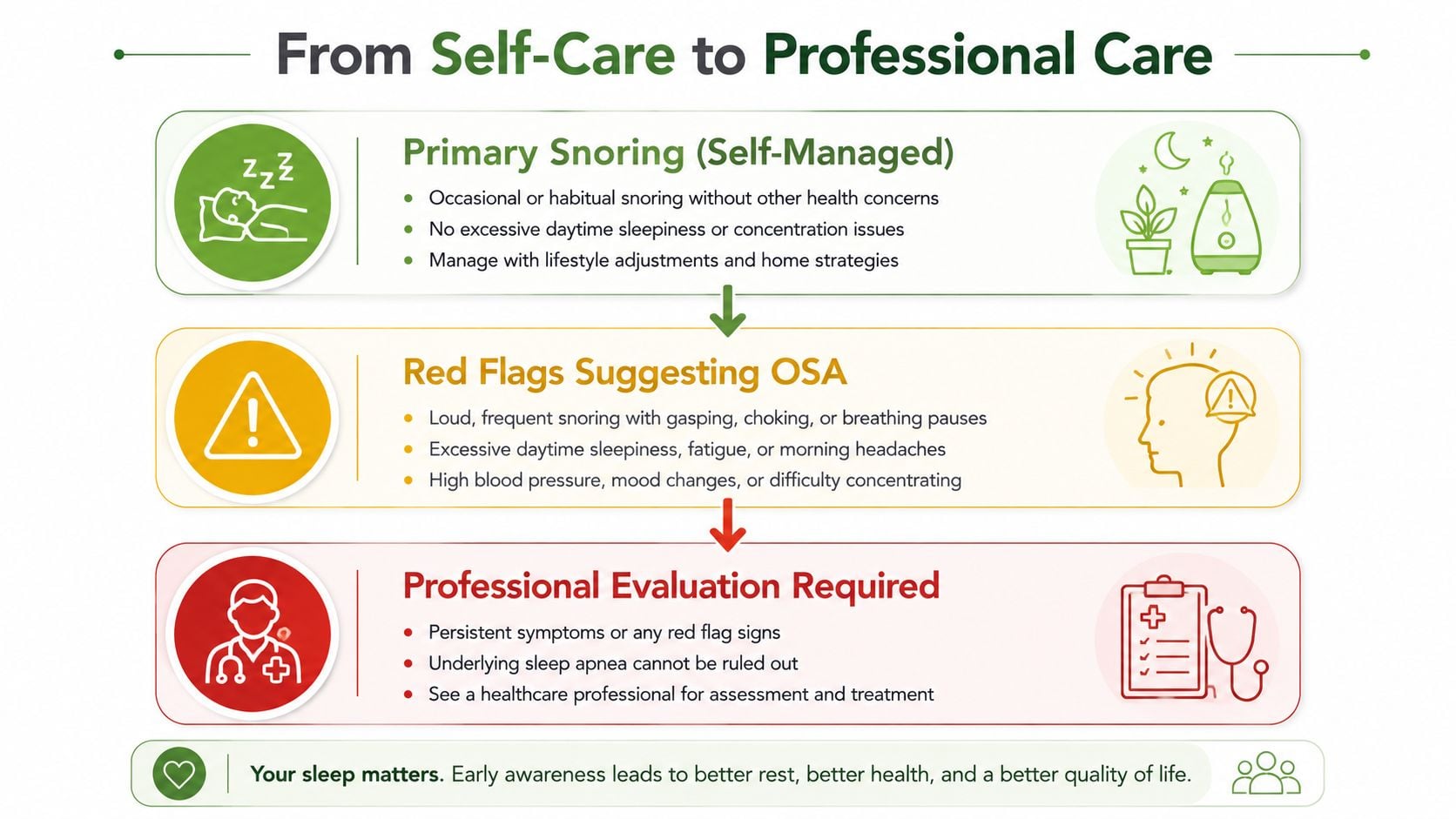
What professional care adds
A sleep medicine evaluation considers symptoms, medical history, airway anatomy, nasal airflow, jaw position, and sleep-study results. An ENT may assess nasal obstruction. A qualified dental sleep clinician evaluates teeth, jaw joints, bite, and appliance suitability. A myofunctional therapist examines tongue posture, lip seal, swallowing, and muscle coordination.
For nasal obstruction and OSA, treating the nose can be a meaningful first-line lever. In a randomized crossover study of 10 patients with nasal obstruction and OSA, active nasal decongestant plus external nasal dilation produced a 30% absolute reduction in the oral fraction of ventilation during sleep and a modest AHI improvement of 12 events per hour, but it did not fully resolve OSA. Review the nasal decongestion and dilation study.
Custom oral appliances can be useful for primary snoring and selected OSA patients, but they're not equivalent to CPAP for every outcome and not everyone responds. Follow-up sleep testing confirms whether the device improves breathing rather than merely reducing bedroom noise. Dental follow-up also helps identify side effects before they become persistent.
Treatment may include supervised orofacial myofunctional therapy, medical management of nasal inflammation, regenerative therapies for selected airway or facial pain concerns, or surgery when anatomy creates a significant obstruction. A resource describing snoring therapy at Spa Black may help readers compare service categories, but any treatment should begin with an appropriate clinical assessment.
Building Your Personalized Snoring Reduction Plan
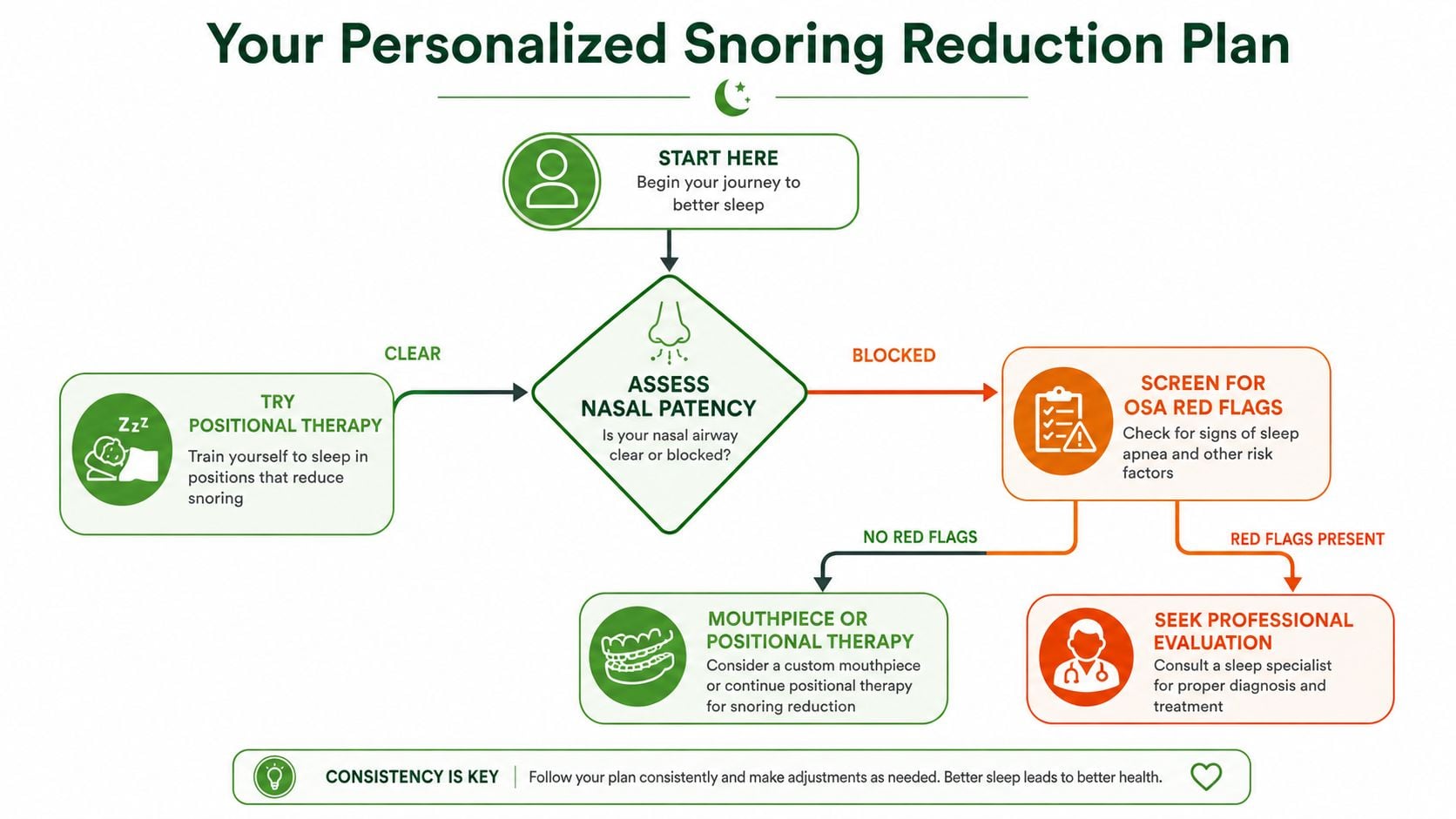
Use this order rather than trying every product at once.
- Assess nasal patency. Try a saline rinse or nasal dilator, then confirm that you can breathe comfortably through your nose while awake. If one-sided blockage or persistent congestion remains, arrange medical evaluation instead of taping your mouth.
- Screen for red flags. Witnessed pauses, gasping, major daytime sleepiness, morning headaches, or high blood pressure justify sleep evaluation before a mouth-closure device.
- Choose the lowest-risk matching remedy. Clear nose and no red flags? Start with side sleeping, head elevation, nasal support, and breathing retraining. Persistent primary snoring may justify a professionally fitted oral appliance.
- Review the response. Track snoring, dry mouth, awakenings, and daytime function over the next month. If symptoms persist, worsen, or include breathing pauses, escalate care.
Stress can also make people obsess over every sound and sensation at bedtime. If worry is keeping you awake while you work through a breathing problem, this guide to how to stop overthinking offers a separate set of coping tools, but it shouldn't replace airway assessment.
A targeted plan usually works better than a universal remedy. Nasal obstruction calls for nasal care, uncomplicated primary snoring may respond to positional and oral strategies, and suspected sleep apnea requires diagnosis before symptom suppression.
If mouth breathing, snoring, dry mouth, fatigue, or jaw tension are affecting your sleep, schedule an airway-focused assessment with Pain and Sleep Therapy Center. The Charlotte team can evaluate nasal breathing, jaw function, sleep-disordered breathing, and orofacial muscle patterns, then recommend appropriate therapy, appliance care, or referral rather than asking you to rely on an unsafe one-size-fits-all fix.