When the familiar, vise-like grip of a tension headache tightens around your head, your first instinct is to find anything that will make it stop. And fast.
While it’s tempting to reach for a pill bottle, a powerful toolkit of natural, immediate strategies can provide quick and effective relief without medication. These methods work by directly addressing the physical triggers—muscle constriction and inflammation—that are causing the pain in the first place.
This simple, three-step flow is my go-to recommendation for patients: compress, massage, and relax.
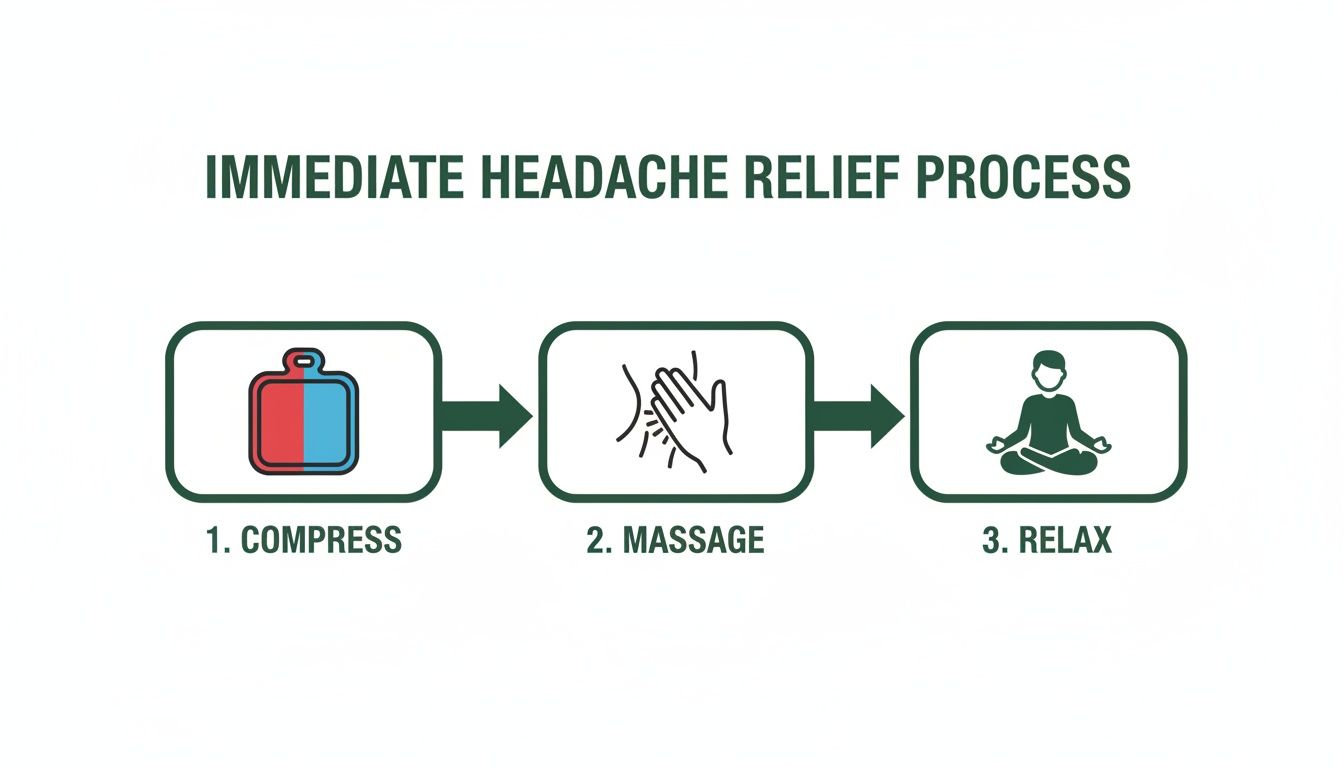
Combining these three actions creates a much more complete response to headache pain than just tackling one method alone.
Harnessing Hot and Cold Therapy
The strategic use of temperature is one of the most effective first-aid responses to a tension headache. It's not just about placing a pack somewhere and hoping for the best; it’s about applying the right temperature to the right area.
-
For Your Forehead and Temples (Cold Therapy): Grab a cold compress or gel pack, wrap it in a thin towel, and apply it directly to your forehead and temples. The cold works to constrict blood vessels and reduce inflammation, which helps numb that sharp, aching sensation. I recommend using it in 15-minute intervals to avoid skin irritation.
-
For Your Neck and Shoulders (Heat Therapy): Now, use a heating pad or a warm, damp towel on the back of your neck and across your shoulders. Heat is crucial for relaxing the tense suboccipital and trapezius muscles—often the primary culprits behind the headache. This warmth increases blood flow, helping to ease the muscle tightness that radiates pain right up into your head.
Targeted Self-Massage Techniques
You don’t need a professional to find relief. A few simple, targeted self-massage techniques can release the specific muscle knots that trigger and sustain tension headaches. One of the most effective is the suboccipital release.
How to Perform a Suboccipital Release:
- Lie on your back with your knees bent and feet flat on the floor.
- Place two tennis balls (or a specialized tool like a Peanut) right at the base of your skull, where your neck muscles meet your head.
- Let the weight of your head sink into the balls, applying gentle but firm pressure to the tight muscles in this area.
- Just breathe deeply and hold this position for 1-2 minutes. For an even deeper release, try adding a gentle chin tuck, slowly nodding your head "yes."
This technique directly targets those small, tight muscles responsible for "tech neck" and postural strain. The sense of release can be profound and often diminishes headache intensity almost immediately.
Another simple yet powerful technique is a gentle jaw massage. Using your fingertips, apply slow, circular pressure to the muscles near your ears where your jaw hinges. Unconscious clenching creates immense tension that travels directly to your temples.
The Power of Progressive Muscle Relaxation
Beyond direct intervention, calming your entire nervous system is key. Progressive muscle relaxation (PMR) is a practice where you systematically tense and then relax different muscle groups. This process actually teaches you to recognize and release physical tension before it escalates into a full-blown headache.
In fact, studies have shown that PMR can reduce headache frequency by up to 50% in chronic sufferers after just a few weeks of consistent practice. You can explore more on these findings on PMC.
When you're hit with a tension headache, having a few go-to techniques can make all the difference. This table summarizes the immediate actions you can take to regain control.
Quick-Reference Guide for Immediate Headache Relief
Use these actionable techniques at the first sign of a tension headache to alleviate pain and discomfort.
| Technique | How It Helps | Simple Application Guide |
|---|---|---|
| Cold Compress | Numbs pain and reduces inflammation in the forehead and temples. | Apply a gel pack wrapped in a towel to your forehead for 15 minutes. |
| Warm Compress | Relaxes tight muscles in the neck and shoulders, increasing blood flow. | Place a heating pad on the base of your neck and shoulders for 15-20 minutes. |
| Suboccipital Release | Releases deep muscle knots at the base of the skull that cause referred pain. | Lie down with two tennis balls under the base of your skull for 1-2 minutes. |
| Jaw Massage | Eases tension from unconscious jaw clenching that radiates to the temples. | Use fingertips to gently massage the jaw joint near your ears in a circular motion. |
Combining these immediate physical interventions—temperature therapy, self-massage, and relaxation—gives you a reliable plan to push back the moment a headache begins.
Uncovering Your Personal Headache Triggers

While having a few tricks for immediate relief is great, the real path to freedom from tension headaches isn’t about just treating the pain. It’s about understanding why it’s happening in the first place.
Think of yourself as a detective. Your headaches aren't random events; they are signals from your body pointing to specific triggers in your daily life. The first, most critical step in any effective natural treatment plan is to learn what those signals mean.
Common Yet Overlooked Triggers
When people hear "tension headache," they immediately think of emotional stress. And while that's a big piece of the puzzle, the physical culprits are often just as significant—and far easier to miss.
I’m talking about the small, repetitive habits that build up strain throughout the day, eventually tightening that familiar band of pressure around your head. In my practice, these are the sneaky triggers I see most often:
- Unconscious Jaw Clenching: Ever notice your teeth are clenched while you’re concentrating on a report or sitting in traffic? That constant tension in your jaw muscles is a major cause of pain that radiates right into your temples and forehead.
- Subtle Dehydration: You don't need to feel parched to be dehydrated enough for a headache. For many, that dull, late-afternoon ache is simply their body asking for more water.
- Shallow "Chest" Breathing: When we're stressed or focused, we tend to breathe from our chest instead of our diaphragm. This inefficient breathing pattern keeps your neck and shoulder muscles in a constant state of low-grade tension.
- Prolonged Screen Time: It's more than just "tech neck." Staring at a screen for hours on end not only causes eye strain but also encourages a forward head posture that puts a massive load on the tiny muscles at the base of your skull.
Figuring out the link between these habits and your pain is the breakthrough moment for many patients. If you suspect jaw tension is a major factor, our guide on how to stop jaw pain is a great place to dig deeper.
The Power of a Headache Diary
The single best tool for connecting the dots is a headache diary. This doesn't have to be a big production. A simple notebook or even the notes app on your phone will do the trick. The goal is to spot correlations you would otherwise never notice.
For just one week, every time a headache starts, take a minute to jot down a few details:
- Time of Day: Does it always seem to start in the afternoon? Or right when you wake up?
- Pain Intensity: Give it a quick rating on a scale of 1-10.
- Activities: What were you just doing? (e.g., sitting at your desk, after a long drive, post-workout).
- Food and Drink: What have you eaten or had to drink in the last couple of hours? Any coffee? How much water?
- Sleep Quality: How did you sleep the night before?
After a few days, you'll likely start to see clear patterns emerge. Maybe your headaches only show up on days you skip lunch or after back-to-back Zoom calls. This data is pure gold—it tells you exactly where to focus your energy.
By tracking these simple variables, you transform vague discomfort into actionable information. You're no longer just treating a headache; you're preventing the next one by addressing its specific cause.
Knowing the Red Flags
While most tension headaches are nothing to worry about, it’s absolutely critical to know when head pain might signal something more serious. Your safety always comes first.
Seek immediate medical attention if your headache comes with any of these "red flag" symptoms:
- A sudden, severe "thunderclap" headache that feels like the worst pain of your life.
- A headache accompanied by a fever, stiff neck, confusion, or seizures.
- Pain that gets progressively worse after a head injury.
- A new type of headache that develops after the age of 50.
Understanding these distinctions allows you to move forward with natural treatments confidently, knowing you're on the right track for managing your specific condition safely and effectively.
Laying the Groundwork: Posture and Ergonomics
That nagging ache at the base of your skull rarely just shows up out of the blue. Far more often, it’s the quiet result of how you hold your head and body all day long, especially when you’re staring at a screen. Getting your posture right isn't about sitting like a board-straight robot; it’s about setting up your environment so your muscles can do their job without getting overworked.
When your head drifts forward, the strain on your neck skyrockets. For every single inch your head moves forward from its neutral spot, it adds about 10 pounds of weight for your cervical spine to handle. This constant load on your suboccipital and trapezius muscles is a direct line to a tension headache.
This is exactly why just telling yourself to "sit up straight" never seems to stick. Real change happens when you intentionally fix your environment and start retraining your body’s muscle memory.
Your Workspace Headache Audit
Whether you’re in a corner office or at the kitchen counter, a few smart ergonomic tweaks can make a massive difference. The goal is simple: create a setup that lets your spine stay neutral and takes the load off your muscles.
Let’s do a quick audit of your workspace right now. As you’re sitting, run through this checklist:
- Monitor Height: Is the top third of your screen at or just below your eye level? You shouldn't have to tilt your chin down or crane your neck up to see.
- Keyboard and Mouse: Are they close enough that your elbows stay relaxed at your sides, bent at about a 90-degree angle? Reaching forward is a one-way ticket to shoulder and upper back strain.
- Chair Support: Can you feel your lower back being supported by the chair? If not, a small rolled-up towel or a dedicated lumbar pillow is a great stand-in to stop you from slouching.
- Feet on the Floor: Are both of your feet resting flat on the floor or a footrest? This small thing stabilizes your entire pelvis, which is the foundation for the rest of your spine.
So many people get hung up on the chair, but the screen's position is probably the single most important factor for preventing that dreaded 'tech neck.' A laptop sitting flat on a desk is almost always too low, forcing you straight into a headache-causing forward head posture.
An external monitor or even just a stack of books under your laptop is a non-negotiable fix.
Corrective Stretches to Undo the "Sit"
Even in a perfect setup, holding any one position for too long leads to muscle fatigue. The solution is to break up the stillness with regular movement and targeted stretches that push back against the effects of sitting. Think of these less as "stretches" and more as essential maintenance for the muscles holding your head up.
These moves are simple enough to do right at your desk and take less than five minutes.
1. The Chin Tuck
If you do only one exercise for forward head posture, make it this one.
- Sit or stand tall, looking straight ahead.
- Gently glide your chin straight back, like you’re trying to make a double chin. Don't tilt your head down.
- You should feel a gentle stretch at the base of your skull.
- Hold for 5 seconds, then release. Aim for 10 reps.
2. The Scapular Squeeze
This wakes up the forgotten muscles in your upper back that get lazy from hunching.
- Sit with your arms relaxed by your sides.
- Gently squeeze your shoulder blades together, imagining you're holding a pencil between them.
- Be sure to keep your shoulders down, away from your ears.
- Hold for 5-10 seconds, then relax. Do this 10-15 times.
3. The Doorway Chest Stretch
This is the perfect antidote for tight chest muscles that pull your shoulders forward.
- Stand in a doorway and place your forearms on the frame, with your elbows just a bit below shoulder height.
- Take a small step forward with one foot until you feel a comfortable stretch across your chest.
- Hold for 20-30 seconds while taking deep breaths.
Building these tiny habits—tweaking your space and moving your body—creates a powerful defense against tension headaches. You’re not just chasing the pain away; you’re dismantling the physical stress that was causing it to begin with.
Retraining Your Body with Breathing and Myofunctional Exercises
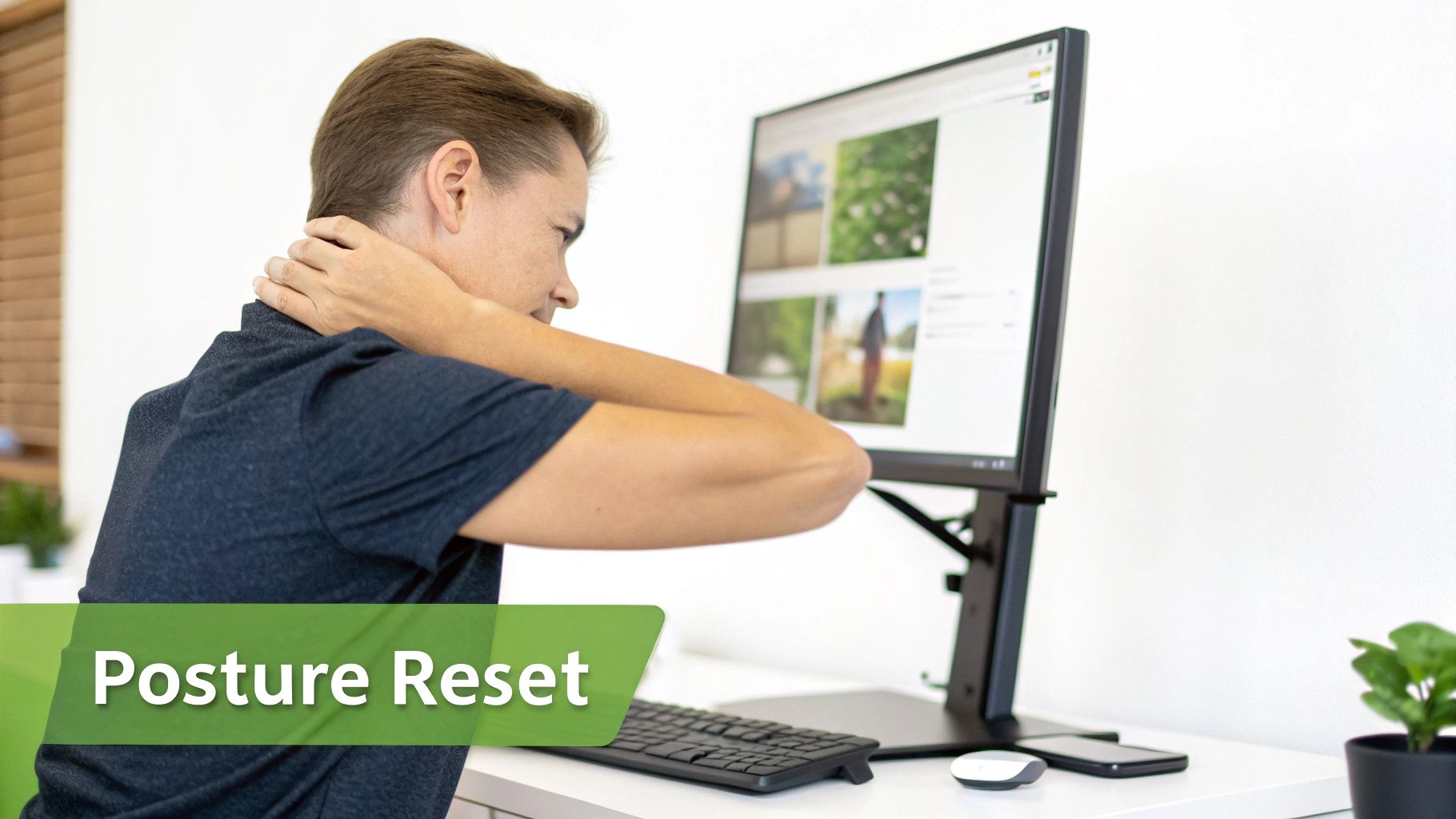
While improving posture and stretching are huge steps forward, we often find a deeper layer of tension hiding in plain sight—in our most basic habits like breathing and swallowing. When these foundational functions are off-kilter, they create a constant, low-grade strain on the very muscles that love to trigger tension headaches.
This is where we move beyond just managing symptoms and start retraining the body from the inside out. By addressing dysfunctional breathing patterns and the way your oral muscles behave, you can finally dismantle the root causes of that nagging headache pain.
The Overlooked Power of Nasal Breathing
Most of us are "chest breathers," taking shallow, quick breaths through our mouths, especially when we're stressed or focused. This pattern keeps your nervous system stuck in a low-level fight-or-flight mode and forces the muscles in your neck and shoulders to work overtime just to help you breathe.
Switching to slow, quiet, nasal breathing sends a powerful "relax" signal to your brain. It engages the diaphragm, your body's main breathing muscle, which finally allows the overworked muscles in your neck and shoulders to let go.
Try This Simple Nasal Breathing Reset:
- Find a comfortable, supported seat and gently close your mouth.
- Place one hand on your chest and the other on your belly.
- Breathe in slowly and quietly through your nose for a count of four. You should feel your belly expand while your chest stays relatively still.
- Exhale just as slowly through your nose for a count of six.
- Repeat this for just 2-3 minutes, focusing on the feeling of calm that washes over you.
This simple shift does more than relax your muscles. It improves oxygenation, calms your entire nervous system, and encourages a more relaxed jaw position, directly counteracting common tension headache triggers.
Introducing Orofacial Myofunctional Therapy
Do you catch yourself clenching your jaw? Does your tongue rest against your teeth, or do you often breathe through your mouth? If so, you likely have what we call dysfunctional oral muscle patterns. Orofacial Myofunctional Therapy (OMT) is essentially physical therapy for your mouth, tongue, and face, using targeted exercises to correct these harmful habits.
These exercises retrain your facial and oral muscles to function the way they were designed to, promoting correct tongue posture, a proper lip seal, and consistent nasal breathing. By restoring this natural balance, OMT can alleviate the immense strain on your jaw and temporomandibular joint (TMJ) that so often radiates out as headache pain.
The research backs this up. A major meta-analysis in 2020 found that OMT could reduce headache days by an average of 37%. Even more impressive, 68% of patients reported over a 30% improvement without any medication, which speaks volumes about its power to address the core muscular issues behind tension headaches.
Foundational Myofunctional Exercises You Can Start Today
While a full OMT program needs professional guidance, you can start building awareness and retraining these muscles with a few simple exercises. The key here is consistency—it's how you build new muscle memory.
1. Mastering Tongue Posture: The "Spot"
The goal is to teach your tongue where it should rest naturally: on the roof of your mouth, not pushing against your teeth.
- How to Do It: Gently close your lips and let your teeth lightly touch. Now, place the tip of your tongue on the bumpy ridge right behind your upper front teeth. Lightly suction the rest of your tongue flat against the roof of your mouth.
- Practice: Try to return to this "spot" throughout the day. Set a reminder on your phone or computer to check your tongue posture every hour.
2. The Tongue Click
This simple exercise strengthens the tongue muscles needed to maintain that proper posture.
- How to Do It: Place the tip of your tongue firmly on "the spot" and create a strong suction with your entire tongue against the roof of your mouth. Then, sharply pull your tongue down to make a loud "click" sound.
- Practice: Aim for a set of 15-20 clicks, a couple of times per day.
This isn't just about your tongue; it's about the entire chain of command. A properly positioned tongue supports the jaw, which in turn reduces strain on the neck and head muscles. It’s a subtle but profound shift that can be the missing piece in solving chronic tension headaches.
By integrating both conscious breathing and myofunctional exercises into your daily routine, you're actively rewiring your body's default patterns. For those interested in a structured approach, you can learn more about what Orofacial Myofunctional Therapy entails in our detailed guide. This path moves you from temporarily relieving pain to creating a system of function that prevents it from starting.
Exploring Advanced Non-Surgical Treatment Options

While self-care is the bedrock for managing tension headaches, sometimes even the most consistent effort isn't enough. If your headaches persist, get worse, or show up with friends like jaw clicking, poor sleep, or chronic facial pain, that's a clear signal it's time to bring in a professional.
What feels like a simple tension headache can easily be a symptom of a bigger underlying issue, like a temporomandibular joint (TMJ) disorder or sleep-disordered breathing. A board-certified specialist can look beyond the surface-level pain to find the real root cause.
It's a huge issue. Globally, in high-income regions like North America, the prevalence of tension-type headaches tops 34,000 per 100,000 people. This highlights the widespread need for clinics that offer effective, non-surgical treatments. You can read the full research on headache prevalence and impact to see just how common this is.
What a Comprehensive Evaluation Involves
A specialized evaluation goes way beyond a standard check-up. The goal is to uncover the intricate connections between your jaw, airway, and muscular system—mapping out your unique pain puzzle instead of just treating the headache.
A thorough assessment usually includes:
- A Deep Dive into Your History: We’ll talk through your symptoms, lifestyle, sleep quality, and what you’ve tried before to spot patterns and contributing factors.
- Hands-On Physical Exam: This involves a careful evaluation of your jaw's range of motion, muscle tenderness in your head, neck, and face, and your overall posture.
- Advanced Diagnostics: We might use technology like 3D imaging to get a crystal-clear picture of your jaw joint and airway, which helps confirm or rule out underlying structural problems.
This detailed approach ensures your treatment plan is built on an accurate diagnosis, targeting the specific dysfunctions driving your pain.
The key takeaway here is that chronic tension headaches are rarely just about "tension." More often than not, they are the end of a chain reaction that might start with a misaligned bite, a restricted airway during sleep, or dysfunctional oral muscle patterns.
Regenerative Therapies That Promote Natural Healing
For many people, the core issue is weakened or damaged connective tissues in the jaw and neck. When the ligaments supporting your TMJ get lax or injured, the surrounding muscles have to overcompensate, leading straight to chronic strain and headache pain.
Regenerative therapies get to the source by stimulating your body's own powerful healing mechanisms. These aren't quick fixes or pain-masking injections; they are designed to repair and strengthen the very structures causing the problem. This is a critical step in learning how to treat tension headaches naturally for good.
Prolotherapy
This is a targeted injection technique where we introduce a natural solution (usually a dextrose mixture) into weakened ligaments and tendons around your jaw and neck. It creates a mild, controlled inflammatory response, which is the body's signal to send growth factors and repair cells to the area. Over a series of treatments, this process strengthens and tightens the tissues, bringing stability back to the joint.
Platelet-Rich Fibrin (PRF)
PRF therapy takes this concept even further by using a concentrate of your own blood. We take a small blood sample and spin it in a centrifuge to isolate platelets and white blood cells, which are packed with growth factors. This powerful healing matrix is then injected into the target area. Because it’s made from your own biological material, PRF is an incredibly safe way to speed up tissue repair and calm inflammation.
These professional, non-surgical options offer a path to lasting relief when self-care alone just won't cut it. By working with a specialist, you get the diagnostic clarity and treatments needed to fix the root cause of your pain. You can learn more about these approaches in our detailed guide on TMJ treatment options.
Common Questions About Natural Headache Relief
As you start moving from just reacting to headache pain to actually addressing what's causing it, a lot of questions pop up. It’s completely normal to wonder about how long things take, what's safe to try, and what certain symptoms really mean. Let's clear up a few of the most common uncertainties so you can move forward confidently.
How Long Until Natural Treatments Start Working?
This is usually the first thing people want to know, and the honest answer is: it depends on what you’re doing. The results really exist on a spectrum, from things that help right now to changes that prevent pain down the road.
-
Immediate Relief (Minutes to Hours): Simple techniques like a cold compress on your forehead or a heating pad on your neck can start to take the edge off within 15-30 minutes. A targeted self-massage, like a suboccipital release, can also bring almost instant relief by getting a specific trigger point to let go.
-
Short-Term Improvement (Days to Weeks): When you get serious about correcting your posture, fixing your desk setup, and doing your stretches every day, you're actively retraining your body. Most people feel a real difference in how often and how badly their head hurts within just a few weeks as their muscles learn to stop carrying so much tension.
-
Long-Term Correction (Months): Deeper work that tackles ingrained habits—like Orofacial Myofunctional Therapy or dedicated breathing retraining—takes more time and consistency. You’ll likely see significant, lasting improvements emerge within 8-12 weeks as you build new, healthier muscle memory and correct the underlying issues.
The goal here isn't a quick fix like a pill; it's about building sustainable relief by fixing the root cause.
Can Jaw Problems Really Cause Tension Headaches?
Absolutely. In fact, this is one of the most overlooked connections when it comes to headaches. Your temporomandibular joint (TMJ) is a seriously complex hinge connecting your jaw to your skull, and it's surrounded by a powerful network of muscles.
When those muscles get overworked from things you might not even realize you're doing—like clenching your teeth, grinding at night, or even just holding your tongue in the wrong position—the strain has to go somewhere. That tension is a primary driver of tension-type headaches, and the pain often travels from the jaw right up to the temples, across the forehead, and even into the back of your neck. For many people stuck in a cycle of chronic headaches, realizing their TMJ is the problem is the missing piece of the puzzle.
How Do I Know If I Have a Tension Headache or a Migraine?
Telling these two apart is critical because they have different triggers and need very different treatment plans.
| Symptom | Tension Headache | Migraine |
|---|---|---|
| Pain Feel | Dull, aching pressure; feels like a tight band | Severe, throbbing, or pulsing pain |
| Location | Typically on both sides of the head | Often localized to one side of the head |
| Other Signs | Usually none; maybe mild neck/shoulder tenderness | Nausea, vomiting, visual aura, extreme sensitivity to light & sound |
A tension headache can ruin your day, but a migraine is often completely debilitating. If your symptoms line up with the migraine side of the chart, it's really important to see a healthcare professional for a proper diagnosis and specialized care.
Are These Natural Methods Safe to Try at Home?
For the most part, yes. The self-care strategies we've talked about—gentle stretching, hot/cold therapy, and becoming more aware of your posture—are very safe for most people. The number one rule is to listen to your body.
If any stretch, exercise, or technique causes a sharp pain or makes your headache feel worse, stop right away. Pain is a signal to back off, not to push through it.
While the foundational exercises are safe to explore on your own, more advanced interventions need a bit more precision. For specific Orofacial Myofunctional Therapy exercises, for example, getting guidance from a trained professional is a very good idea. An expert can make sure you’re doing the movements correctly for your specific situation, which helps you get the best results safely.
At the Pain and Sleep Therapy Center, we specialize in diagnosing the root causes of chronic head and facial pain. If self-care isn't providing the relief you need, our team is here to help you find lasting solutions. Learn more about our non-surgical, evidence-based approach at https://pscharlotte.com.