

Lasting TMJ pain relief starts with a simple but crucial realization: your jaw pain is rarely just about the jaw. It's usually the final distress signal from a system that's been thrown off balance by things like stress, teeth grinding, or a bite that doesn't quite line up.
Decoding the Real Causes of Your Jaw Pain

Let's clear up a common mix-up right away. People often say they "have TMJ," but the TMJ (temporomandibular joint) is just the name of the joint itself. The actual condition causing the pain is a Temporomandibular Disorder, or TMD. It's a small distinction, but an important one.
Think of your jaw joints as a pair of high-performance hinges on a door. When they’re perfectly aligned and working smoothly, the door opens and closes without a sound. But if one hinge gets rusty or bent, the whole door starts to creak, stick, and strain. That’s a great way to picture what’s happening with TMD.
When Balance Is Lost
This delicate system can be disrupted by a handful of common culprits. Any one of them can set off a chain reaction, leading not just to pain in your jaw, but to a whole host of other symptoms you might not think are related.
Common triggers for TMD include:
- Bruxism (Teeth Grinding): Constantly clenching and grinding—especially while you sleep—puts a tremendous amount of force on your jaw joints and muscles. Eventually, they get fatigued and inflamed.
- Misaligned Bite (Malocclusion): If your teeth don't fit together correctly, it forces your jaw into an awkward position thousands of times a day. That constant strain adds up.
- Stress and Muscle Tension: Emotional stress has to go somewhere, and for many of us, it goes straight to our jaw muscles. This constant clenching can create painful trigger points that exhaust the whole system.
- Injury or Trauma: A direct hit to the jaw or face can knock the joint's internal disc out of place or damage the ligaments around it, disrupting its smooth function.
TMD isn't just a local problem; it's a systemic one. The pain you feel in your jaw is often a signal that the entire system is under duress, which is why symptoms can pop up in the most unexpected places. You can explore the wide range of potential symptoms of temporomandibular joint dysfunction in our detailed guide.
The Widespread Impact of a Small Joint
Because the TMJ is so intricately wired to the nerves and muscles in your head and neck, a problem there can easily send pain signals elsewhere. This explains why so many people with TMD also struggle with chronic headaches, nagging earaches, a stiff neck, and even dizziness. The pain is very real—it's just being referred from the overworked joint and muscles.
This isn't a rare issue, either. Globally, TMD affects an estimated 34% of the population, and that number is projected to climb toward 44% by 2050. It’s a massive, and growing, problem. Digging in to find your specific cause is the only real path to finding lasting relief.
Immediate Pain Relief You Can Start at Home

When a TMJ flare-up strikes, you can’t just wait for a doctor's appointment. You need relief, and you need it now. The good news is there are practical, effective things you can do right away to ease the pain.
These at-home strategies are all about tackling the two main culprits behind a flare-up: muscle tension and joint inflammation. Your first job is to calm them both down.
Soothe Muscles and Reduce Swelling
One of the simplest yet most powerful things you can do is alternate between moist heat and a cold pack. It’s a classic technique for a reason.
- Moist Heat: Grab a warm, damp towel and hold it against the side of your face for about 15-20 minutes. The heat works wonders for relaxing those tight, spasming jaw muscles and increasing blood flow to ease that deep ache.
- Cold Packs: Next, switch to an ice pack (wrapped in a thin towel) for 10-15 minutes. The cold is your go-to for inflammation. It helps reduce swelling around the joint and provides a welcome numbing effect for any sharp, throbbing pain.
Think of it as a one-two punch that gives your jaw the break it desperately needs to start healing.
By using heat to relax the muscles and cold to calm the joint, you’re creating the perfect environment for recovery. You're not just masking the pain—you're actively helping your body begin to heal itself.
Gentle Movement and Mindful Relaxation
It might sound counterintuitive to move something that hurts, but gentle, controlled movement is your friend. The idea isn’t to push through the pain, but to carefully release tension and improve your jaw’s range of motion. We’ve put together a guide with safe and effective TMJ pain relief exercises that you can follow along with.
Just as important is what’s going on in your head. Stress is a massive trigger for TMJ pain because it often leads to unconscious clenching and grinding. You can start breaking that habit today with a simple mindfulness check-in.
Give this a try:
- Set a few reminders on your phone throughout the day.
- When an alarm goes off, stop and notice your jaw.
- Are your teeth clamped together? Is your jaw tight?
- Consciously relax your facial muscles, letting your teeth part slightly. The goal is "lips together, teeth apart."
- Take a few deep, slow breaths.
This simple act helps retrain your muscles to find a healthier, more relaxed resting position.
Give Your Jaw a Rest
Sometimes the best tmj pain relief is just giving the joint a vacation. And the easiest way to do that is by changing what you eat, at least for a little while.
For the next few days, stick to a soft-food diet to reduce the workload on your jaw:
- Smoothies, yogurt, and applesauce
- Soups and creamy broths
- Mashed potatoes
- Scrambled eggs and oatmeal
Steer clear of anything hard, chewy, or crunchy—think steak, crusty bread, raw veggies, or chewing gum. Taking that mechanical stress off the TMJ allows the inflammation to go down and gives those overworked muscles a real chance to recover.
To make things even easier, here's a quick reference guide for these immediate relief techniques.
At-Home TMJ Relief Techniques Quick Guide
| Technique | Primary Benefit | How-To Tip |
|---|---|---|
| Moist Heat | Relaxes tight jaw muscles | Apply a warm, damp cloth for 15-20 minutes to ease stiffness. |
| Cold Pack | Reduces joint inflammation & swelling | Use an ice pack wrapped in a towel for 10-15 minutes to numb pain. |
| Gentle Stretching | Improves range of motion | Follow guided exercises; never force a movement that causes sharp pain. |
| Mindfulness Check-In | Breaks the clenching habit | Set reminders to check if your teeth are apart and your jaw is relaxed. |
| Soft-Food Diet | Reduces mechanical stress | Stick to foods like smoothies, soups, and eggs during a flare-up. |
Using these strategies together can provide significant comfort while you figure out the next steps in your treatment journey. They empower you to take control when pain feels overwhelming.
The Foundations of Professional TMJ Care
While at-home remedies are a great first-aid kit for jaw pain, getting real, lasting TMJ pain relief usually means bringing in a professional. This is the moment a clear diagnosis closes the gap between temporary comfort and true, long-term recovery.
Making the move from self-care to professional guidance isn't giving up; it’s taking a smart, proactive step toward a treatment plan that’s actually built for you.
A professional evaluation is like flipping on the lights in a dark room. Instead of fumbling around and guessing what’s wrong, an expert can pinpoint the exact factors causing your pain—whether it's muscular, joint-related, or a mix of both. This foundational understanding is why professional treatments are so much more effective than the trial-and-error cycle at home.
The journey starts with a personalized strategy that gets to the root cause of your symptoms. This isn't about a one-size-fits-all fix. It’s about putting together the right blend of conservative, non-invasive therapies that form the bedrock of successful TMD management.
Physical Therapy for Jaw Function and Strength
One of the cornerstones of professional TMJ care is physical therapy. You can think of a physical therapist as a personal trainer for your jaw. Their job is to retrain the muscles, improve joint mobility, and get everything working in harmony again, just like a trainer helps an athlete bounce back from an injury.
A specialized physical therapist looks at the bigger picture. They understand the intricate connections between your jaw, neck, and posture. A typical treatment plan often includes:
- Manual Therapy: Hands-on techniques used to gently release tight, knotted-up muscles and improve the mobility of the temporomandibular joint.
- Targeted Exercises: Specific movements designed to strengthen weak supporting muscles and improve coordination, making sure the jaw opens and closes smoothly.
- Postural Correction: Real-world guidance on how to improve your head and neck alignment, which can take a massive amount of strain off your jaw joints all day long.
This approach works so well because it actively fixes the mechanical issues causing the pain, not just masks the symptoms. It gives you the tools and knowledge to maintain a healthy, happy jaw long after your sessions are over.
The Role of Custom Oral Appliances
Another critical tool in the professional toolkit is a custom-fitted oral appliance, often called a splint or a night guard. While you can grab a guard at any pharmacy, it’s a completely different world from a professionally crafted device. A store-bought guard is like buying generic shoe inserts; a custom appliance is like getting a prescription orthotic designed by a podiatrist.
The problem with over-the-counter options is that they’re often made of a soft, chewy material that can actually encourage nighttime grinding, making your jaw muscles work even harder. In some cases, a poor fit can slowly shift your bite over time and create entirely new problems.
A custom-fabricated oral appliance, made from precise molds of your teeth, does far more than just create a barrier. It stabilizes your bite, allows overworked muscles to deactivate, and protects your teeth and joints from the incredible forces of clenching and grinding.
These devices are meticulously adjusted by a specialist to put your jaw in a comfortable, stable position, giving inflamed muscles and joints the chance to finally rest and heal. That level of precision is something a boil-and-bite guard just can’t deliver.
The need for this kind of precise care is huge. In the United States, TMD affects about 1 in 12 people—that’s roughly 12% of the population or 35 million Americans. And the numbers show these disorders are four times more common in women than in men. Even then, the official stats are probably much lower than the reality because so many cases go undiagnosed. You can find more statistics on TMJ prevalence in the United States at Balfour Dental.
By combining professional guidance with physical therapy and custom-designed oral appliances, you build a powerful foundation for recovery. These conservative treatments work together to tackle the root causes of your pain, setting the stage for true, sustainable relief.
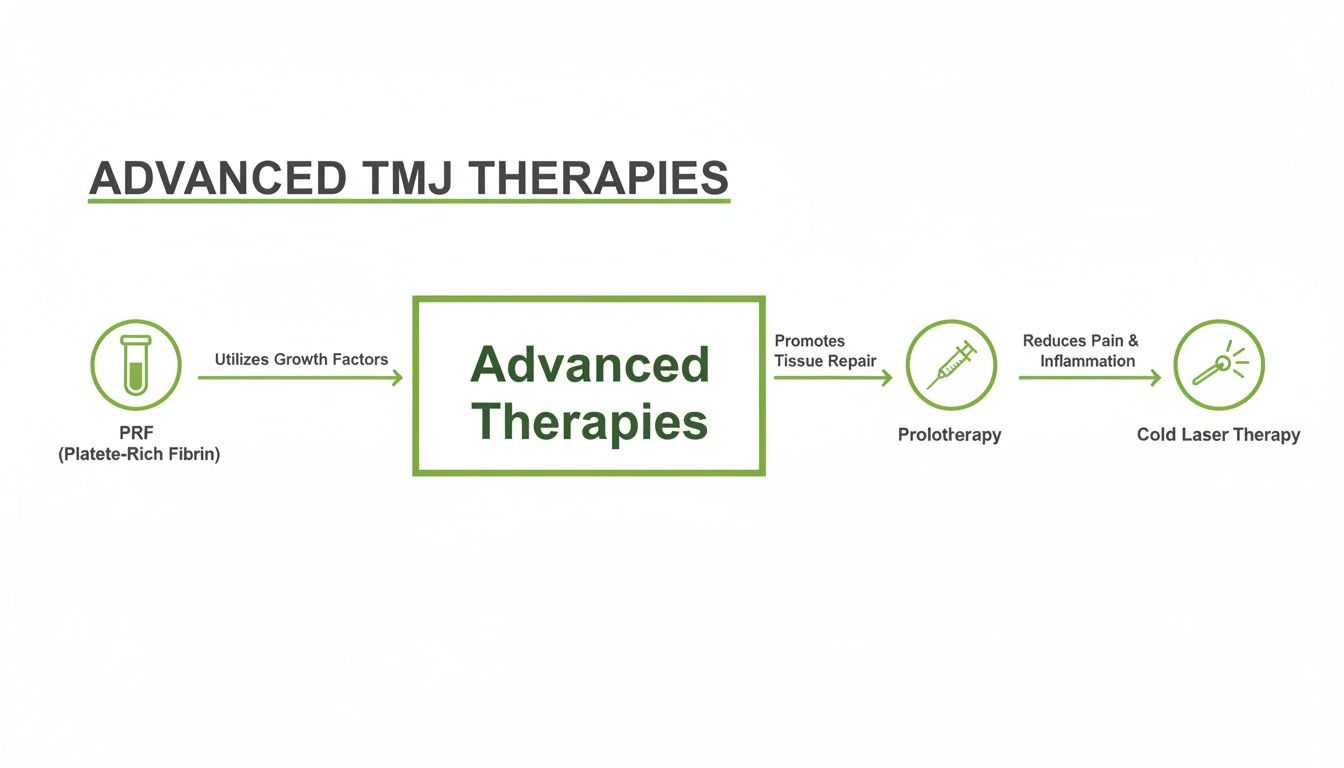
Advanced Therapies That Promote Natural Healing
When conservative treatments and home care aren't enough to get rid of that nagging jaw pain, it’s easy to feel like you've hit a dead end. But this is often where modern, minimally invasive therapies can make a world of difference. These advanced options work with your body, sparking its own powerful healing abilities to repair damaged tissue for TMJ pain relief that lasts.
Instead of just masking symptoms with medication, these treatments get to the root of the problem by promoting real regeneration. They're designed to kickstart the body’s natural repair process, making them especially helpful for TMJ pain caused by damaged ligaments, chronic inflammation, or an unstable joint.
Platelet-Rich Fibrin: Your Personal Healing Concentrate
Imagine if we could bottle the most powerful healing ingredients in your own blood and deliver them right where you need them most. That’s the simple idea behind Platelet-Rich Fibrin (PRF) therapy. It's a completely natural approach that uses your body's own resources to speed up tissue repair.
The process is incredibly straightforward:
- We start by drawing a small amount of your blood, just like a routine lab test.
- That sample is spun in a centrifuge to separate and concentrate the platelets and white blood cells into a golden, fibrin-rich matrix.
- This potent concentrate, which is full of growth factors, is then carefully injected into your jaw joint.
Think of PRF as a bioactive construction crew for your joint. Once injected, it slowly releases a flood of growth factors over several days. This tells your body to get to work building new blood vessels, calming inflammation, and regenerating damaged cartilage and connective tissues. It’s a highly targeted way to fire up your body's own healing engine.
Prolotherapy: Strengthening the Foundation of Your Jaw
A lot of chronic TMJ pain comes down to ligaments that have been stretched, weakened, or injured over time. When these ligaments act like overstretched rubber bands, they can no longer hold the jaw joint securely, leading to that all-too-familiar instability, clicking, and pain. Prolotherapy tackles this problem head-on.
This therapy involves injecting a natural solution—usually a simple dextrose (sugar water) mixture—into the weak ligaments around the TMJ. This creates a mild, controlled inflammatory response.
Now, I know what you’re thinking: "More inflammation? Isn't that what we're trying to get rid of?" But this localized inflammation is precisely what your body needs. It’s a powerful signal that tricks the body into thinking there’s a new injury, triggering a rush of natural healing processes. This leads to the creation of new, strong collagen fibers that thicken and strengthen the ligaments.
Over a few treatments, the ligaments get tighter and stronger, restoring stability to the jaw joint. The end result is not just less pain, but a jaw that actually works the way it’s supposed to.
Cold Laser Therapy: Healing with Light
Another fantastic tool we have for natural healing is Cold Laser Therapy, also known as Photobiomodulation. This gentle, non-invasive treatment uses specific wavelengths of low-level light to penetrate the skin and stimulate healing deep within the joint and surrounding muscles.
When the laser is applied to the painful area, the light is absorbed by the mitochondria—the "powerhouses" inside your cells. This gives them an energy boost, which helps them repair damage, reduce inflammation, and even block pain signals from reaching the brain. Patients often say it feels soothing and notice a real decrease in pain and muscle tightness right away. It's an excellent choice for anyone looking for a drug-free path to recovery.
Connecting TMJ Pain, Sleep, and Your Airway
What if your daily jaw pain isn't just a jaw problem? What if it’s a distress signal from a much deeper issue that happens every night while you sleep? The link between your jaw, your sleep, and how you breathe is one of the most critical—and overlooked—pieces of the puzzle for lasting TMJ pain relief.
For many people, the nightly battlefield is inside their own airway. When your airway is narrow or becomes obstructed during sleep, your body instinctively fights for oxygen. This is the core issue behind conditions like sleep apnea.
To open that airway, your brain sends a powerful signal: push the lower jaw forward. This action tightens the muscles around the airway, allowing you to breathe again. It's a brilliant survival mechanism, but it comes at a huge cost to your jaw.
How a Compromised Airway Drives Jaw Pain
Imagine trying to hold a heavy weight with your arms slightly extended all night long. Your muscles would be screaming by morning. That’s precisely what happens to your jaw when it's forced into a tense, forward position for hours just to protect your breathing.
This constant strain creates a cascade of problems:
- Intense Muscle Fatigue: The muscles of your jaw, face, and neck are forced to work overtime. This leads to deep, aching pain and stubborn trigger points.
- Protective Teeth Grinding (Bruxism): Clenching and grinding are often the body's frantic attempt to keep the airway open. This puts immense pressure on the TMJ itself, wearing down the joint and your teeth.
- Joint Inflammation: The non-stop tension and grinding can lead to severe inflammation within the joint capsule, causing that sharp pain, clicking, and popping.
This relationship isn't just a theory; the data backs it up. Research analyzing over 20,000 people found that bruxism is a common partner to TMD. In fact, here in North America, a staggering 70% of TMD cases co-occur with teeth grinding—often driven by these underlying sleep and breathing issues.
Retraining Your Body for Lasting Relief
If a compromised airway is the root cause, then simply treating the jaw with a standard night guard might not be enough. True relief comes from addressing the source of the problem. This is where specialized therapies can make a profound difference by retraining your body's most fundamental functions.
Orofacial Myofunctional Therapy (OMT)
One of the most effective ways to address these root causes is with Orofacial Myofunctional Therapy (OMT). Think of it as physical therapy for your tongue, lips, and facial muscles. A trained therapist guides you through a series of simple, targeted exercises designed to correct dysfunctional patterns you’ve likely had your whole life.
OMT is all about re-establishing proper oral function. The goal is to train your tongue to rest naturally against the roof of your mouth, encourage nasal breathing, and ensure you swallow correctly—all of which are essential for maintaining an open airway.
A key focus of OMT is achieving correct tongue posture. When your tongue rests low and forward, it can easily fall back and block your airway during sleep. By training it to rest up against the palate, you naturally create more space in the back of your throat. This can dramatically reduce the need for your jaw to thrust forward all night long.
By correcting these foundational habits, OMT helps stabilize your jaw and reduce the chronic muscle strain that leads to pain. Our guide on how myofunctional therapy for sleep apnea explains how this can be a game-changer for both breathing and jaw comfort.
The Power of Proper Breathing Techniques
Along with OMT, learning to breathe correctly is fundamental. Many people with TMJ pain are chronic mouth breathers, a habit that destabilizes the jaw and contributes to a dry, collapsed airway.
Specialized methods teach you to restore gentle, quiet nasal breathing. Breathing through your nose is your body’s natural design—it filters, warms, and humidifies the air, and it promotes the ideal oral posture for a relaxed jaw. By consciously practicing nasal breathing during the day, you help reprogram your brain to maintain it during sleep, giving your TMJ the restful environment it needs to finally heal.
Navigating Your Path to Lasting Relief
Taking that first step toward getting professional help for TMJ pain can feel a bit overwhelming. You know you want to feel better, but the path forward often seems complicated. At the Pain and Sleep Therapy Center, we believe in a patient-first approach that turns that confusion into a clear, supportive process built entirely around you.
It all starts with a simple but powerful foundation: we listen first. Before any tests are run or treatments are suggested, our most important job is to hear your story. When did the pain start? What does it feel like day-to-day? How is it getting in the way of your life? This conversation is everything, because your personal experience gives us the clues we need to guide the entire diagnostic process.
Seeing the Full Picture with Advanced Diagnostics
Once we understand your story, the next step is to get a crystal-clear look at what’s actually happening inside your jaw. Effective treatment can't be based on guesswork. This is where advanced diagnostic tools, especially 3D imaging (CBCT), make all the difference.
Unlike a flat, 2D X-ray, a Cone Beam Computed Tomography (CBCT) scan creates a detailed, three-dimensional model of your entire jaw structure. Think of it as the difference between looking at a photograph of a house and having the complete architectural blueprints. This technology lets us see:
- The precise condition and position of your jaw joints
- The exact anatomy of your airway
- Signs of joint degeneration or inflammation
- The relationship between your bite, joints, and skull
This detailed view is essential for pinpointing the root cause of your pain, not just chasing the symptoms.
Your Personalized Roadmap to Recovery
With a complete picture of both your symptoms and your unique anatomy, we can finally create an integrated, personalized treatment plan. This isn’t a one-size-fits-all solution; it’s a collaborative roadmap designed specifically for you.
A truly effective treatment plan is like a coordinated team effort. It brings together the right combination of therapies—from physical therapy to custom appliances or regenerative treatments—at the right time, ensuring every part of your care works in harmony to achieve the best possible outcome.
This collaborative approach ensures that your plan addresses all the contributing factors, from muscle tension and joint instability to underlying sleep and breathing issues. You are an active partner in this process—feeling supported, informed, and confident every step of the way. Our goal isn’t just temporary TMJ pain relief; it’s about giving you the tools and treatments you need for a lasting recovery and a return to a life free from pain.
Common Questions About TMJ Pain Relief
When you’re starting the journey to find lasting TMJ pain relief, it’s natural to have questions. Knowing what to expect and understanding your options is the first step toward moving forward with confidence. Here are some straightforward answers to the questions we hear most often.
How Long Until I Feel Relief from TMJ Pain?
This is usually the first thing people ask, and the honest answer is: it depends on your unique situation. How quickly you feel better is tied to the root cause of your pain, how severe your symptoms are, and which treatment path you take.
Some people find immediate comfort from simple at-home care or their first conservative treatments. But for true, lasting results, the process is more of a marathon than a sprint. Think of it like physical therapy after a knee injury—it takes time for the body to heal, adapt, and build new strength. Deep-seated relief typically builds over several weeks to a few months as the inflammation goes down and your jaw system learns healthier habits.
Does Insurance Cover TMJ Treatments?
Navigating insurance can feel a bit like a maze. Coverage for TMD treatments varies quite a bit between medical and dental plans, which can be confusing. Some medical insurance companies see TMD as a musculoskeletal issue and will cover things like physical therapy or diagnostics, while others don't. Dental plans might cover an oral appliance but not other types of therapy.
Our team is great at helping patients make sense of their benefits. We’ll work with you to verify your coverage and are committed to making care accessible with flexible payment options.
Because it varies so much, it’s always best to get a clear picture of what your specific plan covers. We can help you with this part of the process so there are no surprises down the road.
Is Surgery My Only Option for Severe Pain?
Let’s clear this up right away: absolutely not. This is a common fear, but the reality is that surgery is very rarely the first or even second step for managing TMJ pain. In fact, more than 95% of TMJ cases are successfully resolved with non-surgical treatments.
The advanced conservative and regenerative therapies we’ve talked about—from custom oral appliances and physical therapy to PRF and Prolotherapy—are incredibly effective, even for the most stubborn pain. Surgery is only ever considered a last resort. It's reserved for the very small number of cases where there's severe structural damage to the joint that hasn’t responded to anything else. The odds are overwhelmingly in your favor that your path to relief will be a non-invasive one.
At Pain and Sleep Therapy Center, our goal is to give you answers and create a personalized plan that finally brings you relief. If you’re ready to take the next step, schedule a consultation with our expert team today.