Your 6-year-old sleeps with their mouth open, snores loudly, and seems unable to focus at school. You may also notice restless sleep, morning headaches, picky eating, crowded teeth, or a dry mouth. Each sign can look like a separate issue, but together they may describe how your child's airway is functioning during sleep, feeding, speech, and quiet daytime breathing.
Pediatric airway assessment brings those observations into one clinical picture. It doesn't replace a pediatrician, ear, nose, and throat specialist, dentist, orthodontist, or orofacial myofunctional therapist. Instead, it helps those professionals ask related questions and coordinate care rather than treating each symptom in isolation.
Why Pediatric Airway Assessment Matters More Than You Think
A child can appear healthy while still working hard to breathe during sleep. Snoring may be dismissed as a family trait, mouth breathing as a habit, and poor concentration as a school or behavioral concern. Yet breathing pattern, sleep quality, oral posture, facial growth, and daytime function can influence one another.
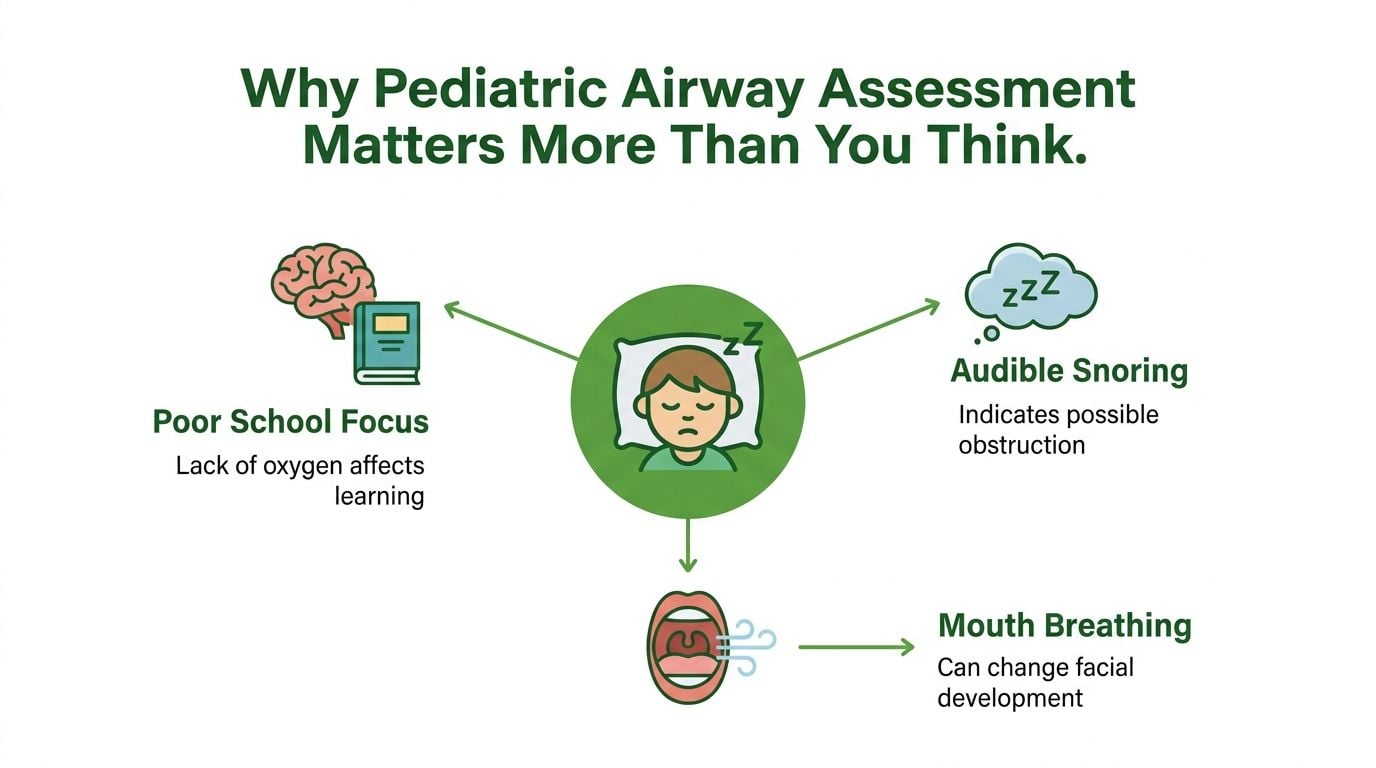
A parent might report that a child sleeps restlessly and wakes tired. A teacher might describe inattention. A dentist might see a narrow dental arch, an open-mouth resting posture, or signs of altered swallowing. An ENT may find enlarged tonsils or adenoids. None of these observations proves obstructive sleep apnea or another airway disorder, but together they justify a closer evaluation.
Practical rule: A symptom is a clue, not a diagnosis. The value comes from connecting the clues and checking how anatomy and function interact.
The history of pediatric airway assessment extends back more than a century. In 1897, Bayeux examined 28 cadaveric larynges from children aged 4 months to 14 years, using lost-wax casting and plaster techniques to study airway morphology. That work predates Eckenhoff's landmark 1951 work on the infant larynx and established an enduring principle: a child's airway changes with age, so evaluation must be age-appropriate (historical review of pediatric airway anatomy).
This connected perspective also explains why airway-focused education for clinicians matters. Resources such as airway certification insights from ProMed Certifications can help professionals understand airway planning, equipment choices, and escalation strategies. For families, the practical message is simpler: don't wait for one dramatic sign if several quieter signs are appearing together.
Age-Specific Anatomy That Changes the Picture
Children aren't smaller adults. Their airway shape, soft-tissue proportions, jaw development, and breathing reserve change as they grow. A finding that matters greatly in an infant may have a different meaning in an adolescent.
An infant's airway can be understood as a short, compact funnel. The tongue occupies a large proportion of the oral space, the neck is relatively short, and small changes in position or swelling can affect airflow. This is why clinicians pay close attention to feeding, breathing effort, oxygenation, facial structure, and previous airway history before anesthesia or instrumentation.
Toddlers still have a small passage, but lymphoid tissue can become an important source of obstruction. Enlarged tonsils or adenoids may act like a bulky object inside a narrow tube. A child doesn't need a dramatic structural abnormality for sleep breathing to become disrupted.
School-age children often develop more recognizable patterns of chronic nasal obstruction, mouth breathing, altered tongue posture, or dental crowding. The nasal cavity may remain limited while adenoid tissue occupies a substantial amount of the available space. Orthodontists therefore track palatal width and dental arch form, while ENTs evaluate the nose, tonsils, adenoids, and nasopharynx.
Why proportion matters more than size alone
The question isn't only, “Does my child have a small airway?” Clinicians also ask how much room remains after the tongue, tonsils, adenoids, palate, jaw, and other soft tissues are considered. A modest enlargement can matter more in a small child than the same finding would in an older patient.
Adolescents move toward adult airway proportions, but earlier mouth-breathing patterns may persist. A low tongue posture, limited nasal breathing, altered swallowing, or a constricted dental arch can continue to affect function even after the child has grown taller.
| Age Group | Key Anatomical Features | Common Obstruction Sites | Clinical Implication |
|---|---|---|---|
| Infant | Compact airway, relatively large tongue, short neck | Tongue position, supraglottic structures, swelling | Careful age-specific planning is essential before anesthesia or airway instrumentation |
| Toddler | Small airway with developing facial and lymphoid structures | Tonsils, adenoids, nasal congestion | Minor tissue enlargement may produce noticeable breathing symptoms |
| School age | Growing jaws and dental arches, persistent nasal-space limitations | Adenoids, tonsils, narrow nasal or palatal structures | Sleep, breathing pattern, oral posture, and facial growth should be considered together |
| Adolescent | More adult-like proportions, but possible persistent oral habits | Nasal obstruction, residual lymphoid tissue, jaw or tongue-related restriction | Earlier functional patterns may remain clinically relevant |
For a plain-language review of how obstruction can appear in children, see this guide to pediatric airway obstruction. The central lesson is that clinicians should measure growth trajectory, not just record whether a structure looks large or small at one visit.
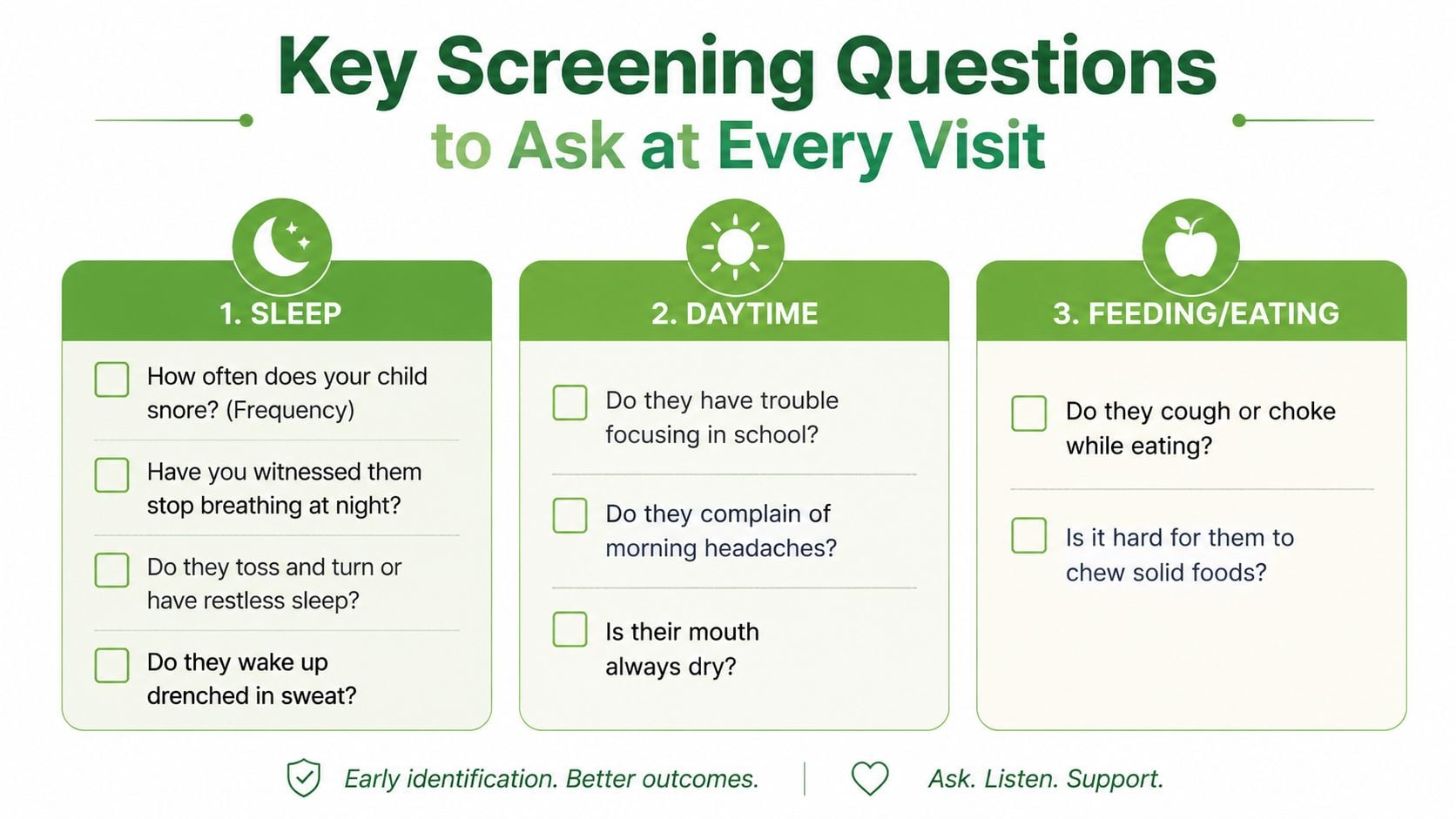
Key Screening Questions to Ask at Every Visit
A child may seem fine in the chair yet show a different pattern during sleep, meals, school, or play. A useful screening conversation connects those settings. Sleep, daytime behavior, feeding, and growth are separate windows into the same breathing and orofacial system, helping dental and medical teams decide whether observation, examination, or referral is appropriate.
Sleep questions
Ask whether the child snores and how often. Snoring on 3 or more nights per week is clinically meaningful and should prompt attention, particularly when paired with other signs (AAPD pediatric airway assessment tool).
Ask whether anyone has seen breathing pauses, gasping, choking, or noisy breathing after a pause. Sleep quality also matters: does the child toss and turn, sweat, sleep with the neck extended, or wake repeatedly? Ask about bedwetting that continues beyond the age when it would normally be expected.
Morning clues can be just as useful. Headaches, dry mouth, irritability, or waking without feeling restored may suggest that sleep deserves closer review. These answers do not diagnose obstructive sleep apnea. They show when a formal medical assessment may be appropriate.
Daytime questions
Ask about mouth breathing, ongoing nasal congestion, daytime sleepiness, restlessness, inattention, and morning headaches. A child with disrupted sleep may look hyperactive rather than tired, so ask parents, teachers, and other caregivers whether the pattern changes across settings.
The AAPD pediatric airway assessment tool includes mouth breathing, morning headaches, restlessness, inattention, and daytime sleepiness. That broader checklist helps clinicians avoid treating snoring as the only relevant symptom.
Feeding and growth questions
Meals can reveal functional limits that a brief oral inspection misses. Ask whether the child takes an unusually long time to eat, avoids textures, struggles to chew, coughs or chokes, or has had prolonged bottle, pacifier, or thumb-sucking habits.
Growth questions should cover weight gain, posture, facial development, dental crowding, and changes over time. A parent questionnaire can organize observations about sleep, daytime behavior, and eating, while a focused conversation during a medical, dental, or hygiene visit often brings out details families did not realize mattered.
The Physical Exam and Orofacial Evaluation
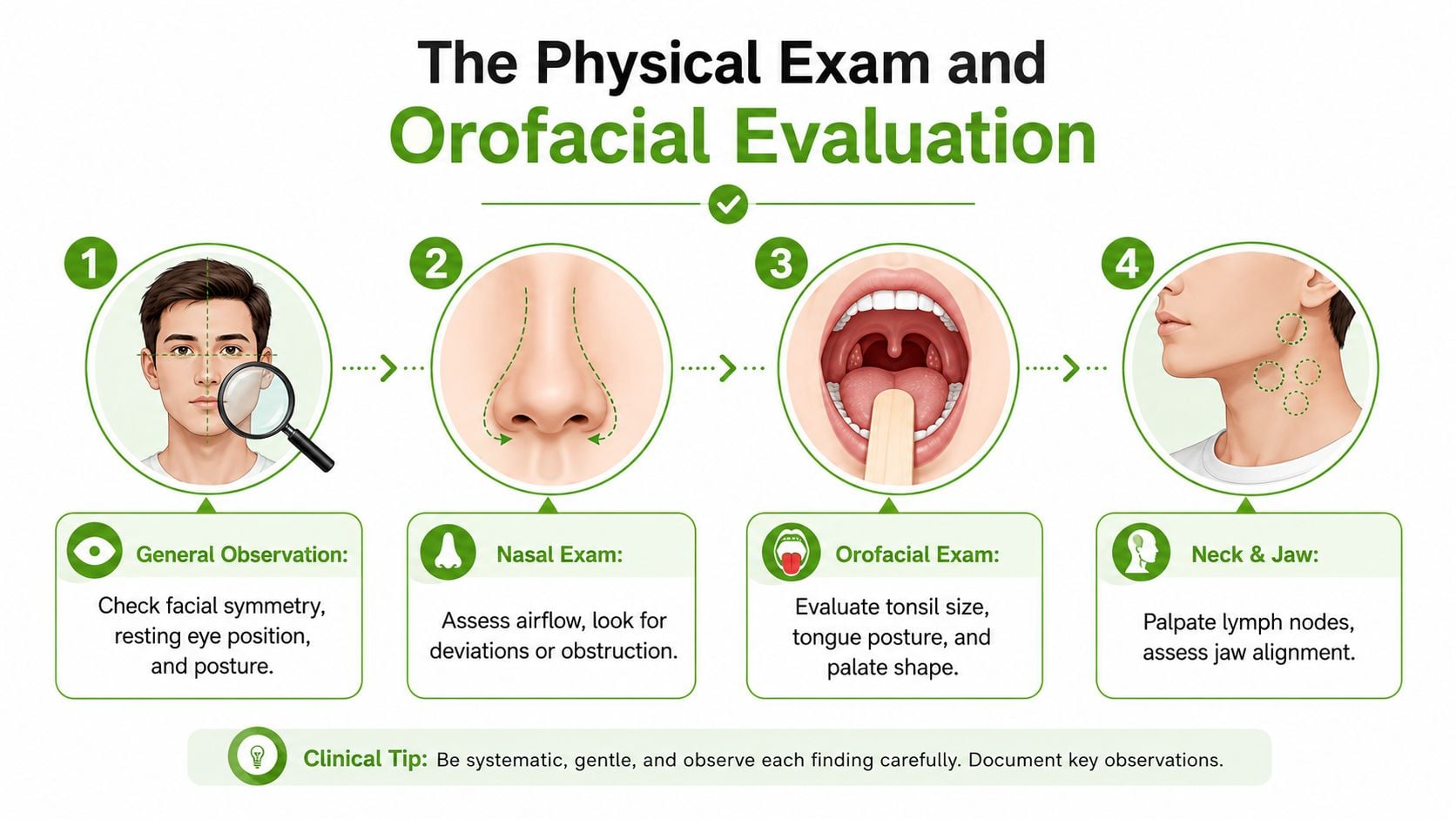
The hands-on exam should begin before the clinician asks the child to open their mouth. Quiet breathing, lip posture, head position, facial symmetry, and body posture can show how the child manages airflow without being prompted.
Start with observation
The clinician watches whether the lips rest together, whether the child breathes comfortably through the nose, and whether the head or neck is held in an unusual position. Facial profile, chin position, midface development, and visible asymmetry add context. A child who appears comfortable while sitting may still show mouth breathing or effort during conversation, walking, or lying down.
The nasal examination assesses patency, congestion, septal deviation, and other visible barriers. The mouth exam then considers tonsil size, uvula position, palatal height, dental arch form, tooth alignment, and the condition of the oral tissues.
A high-arched or narrow palate may be associated with chronic mouth breathing, but it doesn't prove that mouth breathing caused the shape. The clinician must compare the finding with nasal symptoms, sleep observations, tongue posture, facial growth, and other functional information.
Assess oral posture and movement
An orofacial myofunctional evaluation looks at what the lips, tongue, jaw, and muscles do at rest and during movement.
- Lip seal: Can the child maintain a relaxed seal without visible strain?
- Tongue posture: Does the tongue rest against the palate, or does it sit low and forward?
- Tongue mobility: Can the tongue reach the alveolar ridge and move through functional tasks?
- Swallowing: Does the tongue thrust forward, does the jaw move excessively, or do the lips recruit strongly?
- Speech: Do articulation patterns suggest reduced tongue control or oral-motor compensation?
A tongue that can't reach the alveolar ridge may indicate restricted mobility, but mobility must be interpreted alongside function. Palpation of the submental and suprahyoid muscles can reveal excess tension or compensation. Gentle mandibular advancement may show whether a different jaw position makes nasal breathing easier, but it isn't a substitute for diagnostic testing.
Clinical handoff: Document observations in functional language, such as “mouth open during quiet breathing” or “tongue unable to maintain palatal contact,” rather than writing only “airway concern.”
A useful referral note includes the child's symptoms, sleep observations, nasal findings, tonsil and palate description, tongue mobility, swallowing pattern, relevant history, and the specific question for the next clinician.
The following video can help families understand the visual components of an airway-focused exam:
When to Refer for Sleep Studies and Imaging
A child may show a narrow palate, altered tongue posture, or mouth breathing during a dental and orofacial evaluation. Those findings raise a clinical question, not a diagnosis: does sleep-related airway obstruction occur, and what is contributing to it? Select the next test according to the uncertainty that remains after the history and examination.
Polysomnography, or PSG, records breathing, oxygen levels, sleep stages, and related changes throughout the night. It helps confirm or rule out obstructive sleep apnea and indicates its severity. Pediatric guidance identifies PSG as the diagnostic gold standard for children with suspected OSA. A home sleep apnea test may provide limited screening information in selected situations, but families should not assume it replaces laboratory PSG for most children. The ordering clinician should explain what the chosen test can and cannot detect. For a plain-language overview of pediatric sleep apnea, families can review how symptoms and evaluation fit together.
| Test or Referral | What It Answers | Typical Next Step |
|---|---|---|
| Polysomnography | Is sleep-disordered breathing present, and how significant is it? | A sleep physician or ENT reviews the results and matches treatment to the findings |
| Lateral cephalometric radiograph | How do the jaws relate, and does the image suggest reduced nasopharyngeal space? | Orthodontic, dental, or ENT interpretation |
| CBCT | What does the three-dimensional craniofacial anatomy look like? | Use selectively when added structural detail could change planning |
| Drug-induced sleep endoscopy | Where does airway collapse occur during induced sleep? | Often informs surgical or targeted airway planning |
| ENT consultation | Are tonsils, adenoids, allergies, or nasal structures contributing? | Medical treatment, observation, surgery discussion, or further testing |
| Orthodontic or craniofacial consultation | How are jaw width, palate, and facial growth affecting function? | Growth monitoring, orthodontic planning, or coordinated referral |
Dental findings belong in the broader airway conversation. A practical overview of does sleep apnea harm oral health can help families understand why oral dryness, mouth breathing, and bite development may deserve attention alongside sleep symptoms. The dental orofacial assessment and medical airway workup should inform each other, like two views of the same pathway. One describes structure and function while awake, and the other measures breathing during sleep. Neither should be treated as a substitute for the other.
Red Flags That Should Move You to Act Sooner
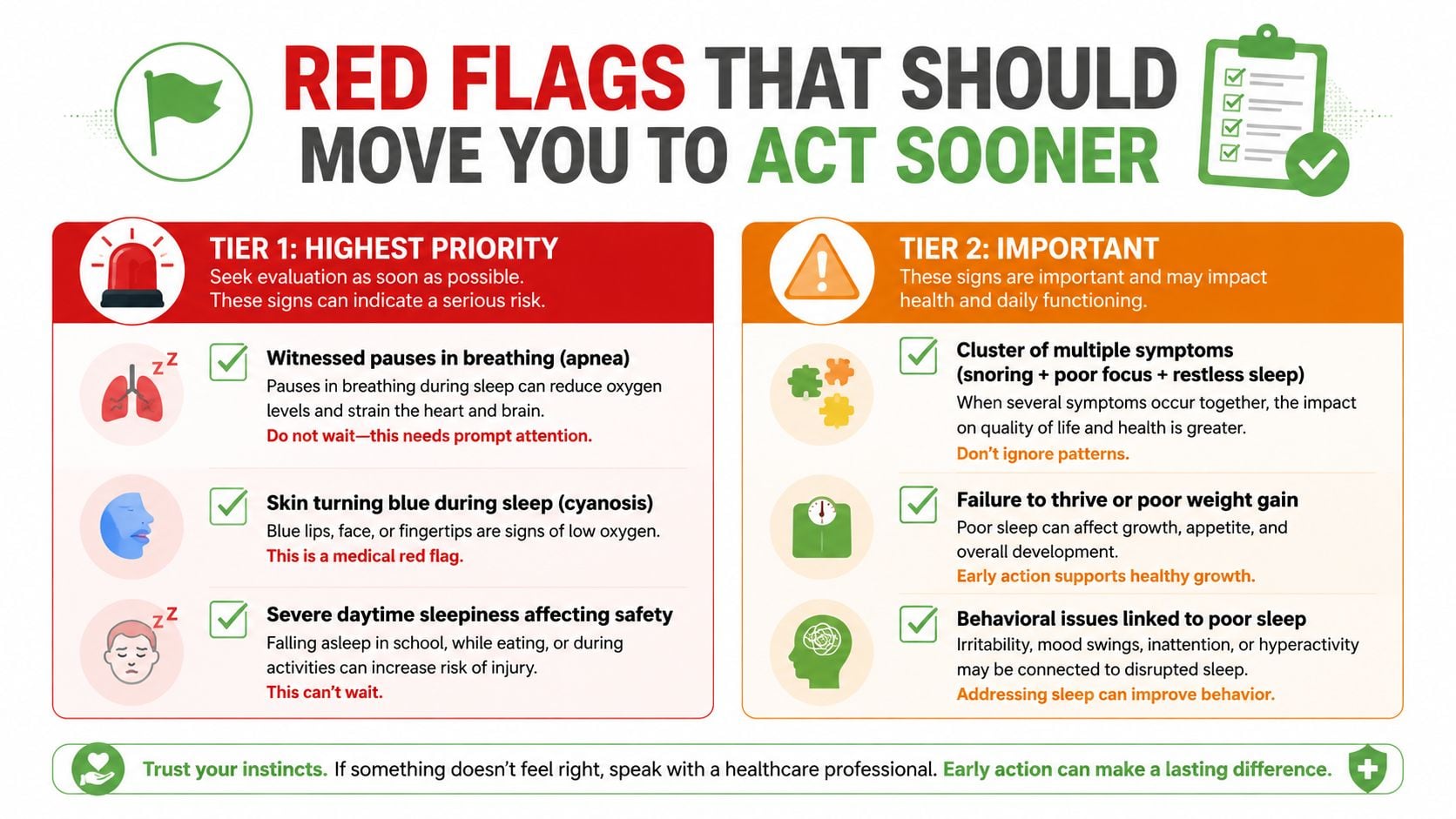
Airway concerns become more urgent when several clues appear together. Occasional snoring during a cold differs from regular snoring paired with restless sleep, mouth breathing, morning headaches, or difficulty functioning during the day. Dental and orofacial findings can strengthen that concern, because they provide the awake, structural view of the same breathing pathway assessed medically during sleep.
Seek urgent medical guidance
Witnessed breathing pauses, blue skin during sleep, severe breathing effort, or dangerous daytime sleepiness require prompt medical attention. Poor growth, significant feeding difficulty, or a clear decline in behavior and daily function should also accelerate evaluation.
Call emergency services for acute breathing difficulty, blue discoloration, inability to stay awake safely, or any situation in which your child appears seriously unwell. Breathing compromise should not wait for a routine dental or primary-care visit.
Arrange timely evaluation
As noted in the screening section above, persistent mouth breathing and other ongoing sleep or daytime concerns warrant assessment rather than indefinite observation. A pediatrician, ENT clinician, sleep specialist, dentist, or airway-focused team can help determine which findings need medical testing and which require orofacial evaluation. Current pediatric OSA guidance supports taking these patterns seriously.
Clues may accumulate over time. A narrow facial pattern, long soft palate, dark under-eye circles, open-mouth posture, dental crowding, or learning struggles does not establish a diagnosis alone. When several occur together, document them and request coordinated airway assessment using the AAPD pediatric airway assessment tool.
Management Pathways From Tongue-Tie to Myofunctional Therapy
Treatment works best as a connected sequence, not as a collection of unrelated procedures. The first question is often whether the child can breathe comfortably through the nose. Allergic inflammation, nasal obstruction, tonsillar or adenoidal enlargement, and other medical causes may need attention before oral exercises can succeed.
Once nasal breathing is supported, an orofacial myofunctional therapist may work on tongue posture, lip seal, swallowing, chewing, nasal breathing habits, and relaxed oral rest position. The exercises require repeated practice, and progress depends on the child's age, cooperation, baseline function, and the reason the pattern developed.
Where tongue-tie release fits
A restricted lingual frenulum may limit tongue elevation or other movements, but the decision to release it should follow a functional evaluation. Frenotomy or functional frenuloplasty may be performed by an appropriately trained pediatric dentist, ENT, or other qualified clinician, depending on the child's needs and local practice standards.
Release alone doesn't automatically create a stable new tongue posture. Therapy before or after the procedure may help the child learn to use the available movement. The plan should also account for healing, pain, feeding, speech, sleep symptoms, and the possibility that the restriction isn't the primary cause of the airway concern.
Orthodontists may address palatal or jaw development when expansion or other growth-guided treatment is appropriate. The physician coordinates sleep, growth, and medical outcomes, while the therapist monitors functional retraining.
A balanced plan weighs: timing, financial cost, home-practice demands, procedure risks, and the risk of treating too much or too little.
Families can use a simple home log for breathing, sleep, speech, chewing, and exercises. Guidance on tracking speech progress at home offers a practical model for recording functional changes without relying only on memory. For families exploring evaluation of a restricted frenulum, this information on tongue-tie release can provide useful preparation for a clinician discussion.
Reassessment matters. A child's airway and facial structures change with growth, so clinicians should review symptoms and function at planned intervals rather than assuming that one intervention ends the process.
What Parents and Referring Clinicians Should Do Next
Parents can begin with observation. Keep a short symptom record that notes snoring, mouth breathing, restless sleep, witnessed pauses, morning headaches, daytime energy, attention, feeding, and any changes in growth or dental development. A brief sleep video may help a clinician understand a pattern, but it shouldn't delay urgent care when breathing appears dangerous.
Bring specific questions:
- What did the exam show? Ask about nasal patency, tonsils, adenoids, palate, tongue mobility, lip seal, and swallowing.
- What remains uncertain? Clarify whether the concern is obstruction, sleep-disordered breathing, oral-motor dysfunction, craniofacial development, or several factors.
- Which professional should evaluate next? Ask whether the referral should go to a pediatrician, ENT, sleep physician, dentist, orthodontist, or myofunctional therapist.
- What should we monitor? Request a written plan with warning signs and a follow-up interval.
Pediatricians, dentists, hygienists, orthodontists, and therapists can improve referrals by sending observations instead of vague labels. A useful message might read:
Referral question: “This child has regular snoring, habitual mouth breathing, restless sleep, morning headaches, and difficulty maintaining lip seal. Examination shows enlarged tonsils, a high palate, and limited tongue elevation. Please assess for sleep-related breathing disorder and advise whether PSG, ENT evaluation, or coordinated orofacial therapy is indicated.”
The process is usually developmental rather than one-time. Nasal care, sleep evaluation, oral function, orthodontic growth guidance, and therapy may need to be coordinated over time. If your child has acute breathing difficulty, blue discoloration, severe sleepiness, significant feeding problems, or concerning growth changes, seek medical guidance promptly instead of waiting for routine monitoring.
Pain and Sleep Therapy Center provides pediatric airway-focused evaluations that can connect nasal breathing, oral posture, tongue mobility, swallowing, sleep symptoms, and facial development. Visit Pain and Sleep Therapy Center to learn about coordinated pediatric airway, tongue-tie, and orofacial myofunctional care, and to request guidance on the appropriate next step.