
You wake with a stiff jaw, get through the morning, and then feel a steady band of pressure building around your temples by afternoon. Maybe you've blamed your screen, your glasses, stress, or poor sleep. Maybe you've tried headache medication, yet the pain keeps returning. When jaw tenderness, clenching, or pain with chewing appears alongside that pressure, TMJ and tension headache symptoms may be connected, but they aren't automatically the same condition.
The important distinction is often missed online. A clicking jaw without pain isn't equivalent to a painful temporomandibular disorder, and a tension-type headache isn't automatically caused by the jaw. The useful question is whether a clinician can reproduce your familiar head pain by examining and loading the painful jaw muscles or joint.
When Your Headaches and Jaw Are Telling the Same Story
A desk worker we'll call Maya had spent months treating her afternoon headaches as a computer problem. The pain wrapped around both sides of her head in a dull, pressing band. She adjusted her glasses, took screen breaks, changed her pillow, and tried medication intended for migraine. Nothing lasted.
What she hadn't connected was the stiffness in her jaw each morning. Her temples felt bruised when she touched them, and long meetings left her jaw tired. A clinician finally asked about daytime clenching, nighttime grinding, and whether chewing made the headache worse. During the examination, pressure over the temporalis muscles reproduced the exact pain Maya had described.
That finding changed the clinical question. Instead of asking only, “Which headache medicine should she try next?” the provider could ask, “Is painful jaw-muscle activity helping maintain this headache?”
Why the label can mislead
A bilateral, pressure-like headache often gets labeled tension-type headache because its pattern resembles a primary headache disorder. That label describes the headache phenotype, but it doesn't always identify the source of the pain. A person may have primary tension-type headache, headache attributed to TMD, or both at the same time.
The overlap is common. A 2022 systematic review and meta-analysis found that headaches occurred in 61.58% of people with TMD, while TMD occurred in 59.42% of people with headache, with the pooled estimates and confidence intervals reported in the systematic review and meta-analysis. Those figures show coexistence, not proof that every headache comes from the jaw.
Clinical clue: A headache that changes with chewing, clenching, talking, or jaw movement deserves a jaw-focused examination, even when it feels exactly like ordinary tension pressure.
People seeking headache care may also explore approaches such as natural migraine therapy for adults, particularly when medication hasn't addressed the pattern. The next step isn't to assume that every headache is TMJ-related. It's to determine whether the jaw is a reproducible contributor.
The Shared Anatomy Behind Jaw Pain and Head Pain
The connection becomes clearer when you follow the anatomy.
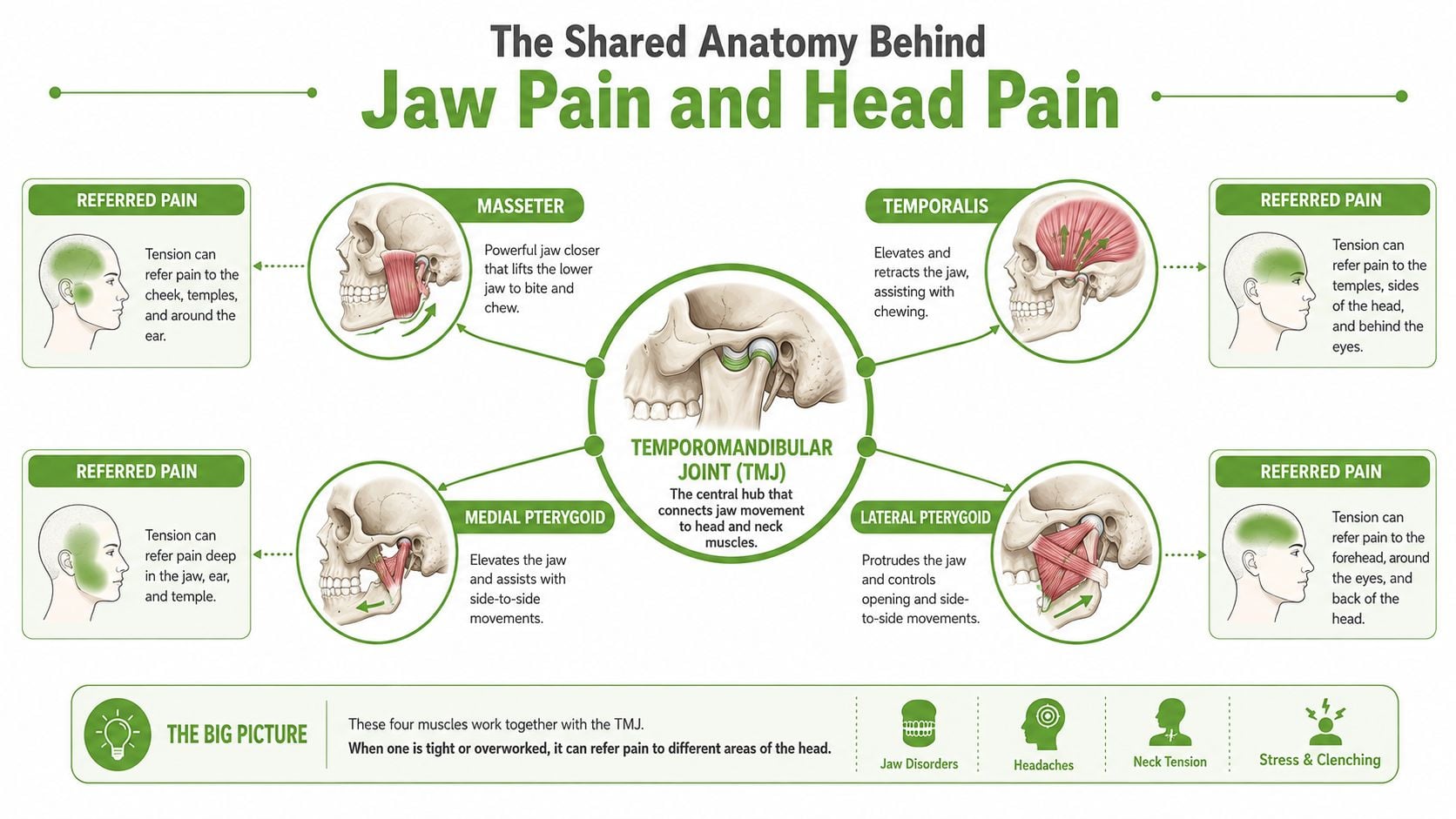
The temporomandibular joint, or TMJ, sits on each side of the face where the lower jaw meets the skull. The joint itself doesn't work alone. Four major muscles coordinate chewing, speaking, swallowing, and jaw positioning:
- Masseter: Helps raise the jaw and often becomes tender with sustained clenching.
- Temporalis: Spreads across the side of the skull and helps close and position the jaw. Irritation here can refer pain into the temple and forehead.
- Medial pterygoid: Supports jaw elevation and side-to-side movement deep inside the cheek.
- Lateral pterygoid: Helps guide jaw opening and forward movement and contributes to joint-disc coordination.
The trigeminal bridge
These structures connect to the head through the trigeminal nerve, the main sensory nerve of the face. Its mandibular division, V3, supplies the muscles that move the jaw. The trigeminal system also carries sensation from areas supplied by its ophthalmic and maxillary divisions, V1 and V2, including parts of the forehead, temple region, face, and area behind the eyes.
The brain doesn't always identify the exact tissue producing a pain signal. Signals from an overloaded temporalis or masseter can be interpreted as pain in the temple, forehead, cheek, or around the eye. This is called referred pain, and it explains why a patient may feel head pain more strongly than jaw pain.
Why chronic symptoms spread
Repeated clenching, grinding, or protective muscle guarding can keep the masticatory muscles active for too long. In persistent cases, central sensitization may also develop. The nervous system becomes more responsive to incoming signals, so ordinary input from jaw muscles can feel painful or can amplify an existing headache.
That shared wiring makes jaw-driven headache feel remarkably similar to primary tension-type headache. The sensation may be pressing, aching, bilateral, and non-pulsing. The difference often appears only when the examiner connects the pain to jaw function or reproduces the familiar headache through targeted testing.
Why Some TMJ Problems Trigger Headaches and Others Don't
A jaw can click during breakfast while the temples feel completely normal. Another person may have little joint noise but develop temple pain after clenching through a stressful task. These are different clinical stories. The overlap with tension-type headache is linked mainly to painful TMD, not to every TMJ sound or movement pattern.
A 2022 systematic review found an association between painful TMD and tension-type headache across the studies it examined. The evidence certainty ranged from very low to low, so the finding supports a connection without proving that every painful jaw condition causes every headache. Online advice often turns this into a simple cause-and-effect statement, but diagnosis still depends on identifying the painful tissue and reproducing the familiar symptoms.
Two patterns clinicians separate
Myogenous TMD affects the chewing muscles, particularly the temporalis and masseter. The pattern may include morning soreness, chewing fatigue, tenderness when those muscles are pressed, or pain that increases after clenching. The muscle acts like an overworked cable: repeated contraction can produce pain locally and refer discomfort toward the temple or forehead.
Arthralgia means pain arising from the jaw joint itself. Tenderness directly over the TMJ, pain during loading or movement, and restricted motion may support this pattern. Joint pain can contribute to head pain, but the examination must still determine whether jaw function reproduces the headache and whether the muscles are involved.
Clicking, popping, or a slight deviation while opening may indicate an articular finding. By itself, however, a sound does not explain a headache. A painless disc displacement can exist without the muscle tenderness or jaw-provoked temple pain that supports a TMD-attributed headache.
| TMD Subtype | Key Features | Headache Association | Evidence |
|---|---|---|---|
| Painful muscle-related TMD | Temporalis or masseter tenderness, clenching sensitivity, pain with jaw use | More likely to overlap with tension-type headache | Painful TMD was associated with TTH across studies |
| Painful joint-related TMD | Local joint tenderness, pain with loading or movement | May contribute when symptoms are reproducible with jaw function | Examination must identify the painful structure |
| Nonpainful articular TMD | Clicking, popping, or disc-related findings without pain | No positive association with TTH was found in the cited review | A sound alone is not evidence of a headache disorder |
For a practical explanation of the connection between clenching and head pain, see this guide to headaches caused by jaw clenching. The working rule is simple: a sound is a finding, not a diagnosis.
What a TMJ-Focused Headache Evaluation Actually Looks Like
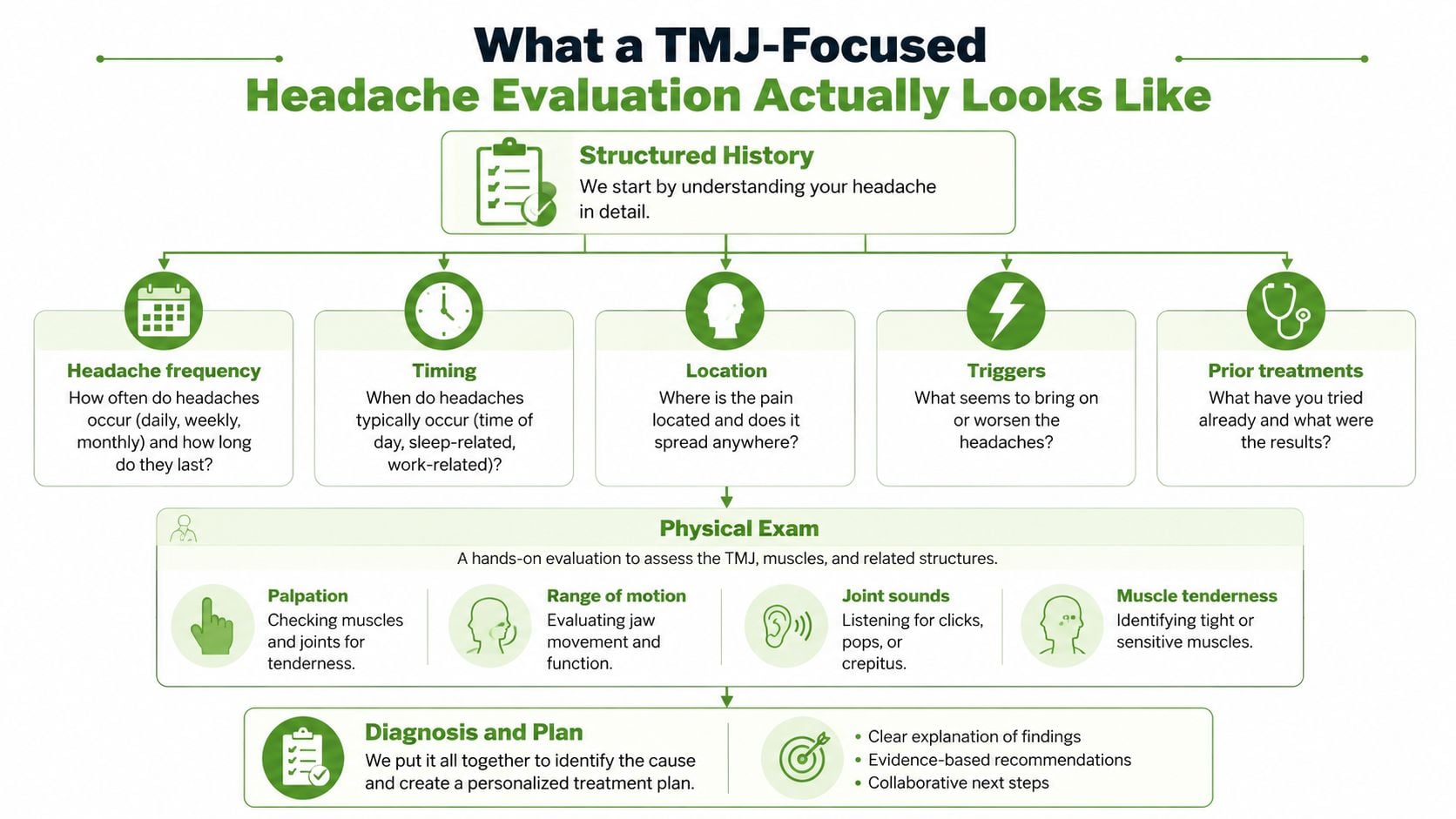
A useful assessment begins before the physical examination. The clinician needs to know whether the headache follows jaw activity, appears on waking, changes during stressful tasks, or persists independently of jaw use.
History first
Expect questions about:
- Headache pattern: location, timing, frequency, severity, and duration
- Jaw behavior: daytime clenching, suspected grinding, gum chewing, prolonged talking, or nail biting
- Morning symptoms: jaw stiffness, temple soreness, tooth sensitivity, or fatigue on waking
- Joint symptoms: clicking, locking, catching, or a sudden bite change
- Previous care: headache medication, dental treatment, splints, injections, or physical therapy
A headache diary can reveal a pattern that memory hides. Note whether pain begins after a long meeting, follows chewing, appears after poor sleep, or is present before the jaw becomes active.
The examination should reproduce the complaint
The clinician palpates the temporalis and masseter on both sides, checks jaw opening and side-to-side movement, listens for joint sounds, and tests whether resisted opening or other functional movements reproduce the familiar headache. The examiner may also assess the neck because cervical muscle dysfunction can add another source of head pain.
Published diagnostic research in headache subjects with TMD found that criteria combining temple headache, painful TMD, and provocation by TMD testing achieved 89% sensitivity and 87% specificity in the cited study of 373 headache subjects. These figures come from the diagnostic criteria study, and they provide a useful benchmark for a focused clinical workflow.
Imaging has a narrower role. A panoramic radiograph, CBCT, or MRI may help when the clinician suspects joint degeneration, disc displacement, trauma-related injury, or another structural concern. Imaging shouldn't replace palpation and functional testing, because a scan may show an anatomic finding that isn't producing the patient's pain.
The following video provides another visual overview of the evaluation process:
Treatment Options Ranked by What They Target
Treatment makes more sense when each option is matched to a specific problem. A night appliance, for example, may reduce loading but won't automatically retrain a guarded neck or improve tongue posture.
| Therapy | Primary Target | Best For | Evidence Level |
|---|---|---|---|
| Stabilization oral appliance | Reducing nocturnal loading and protecting the dentition | Patients with suspected nighttime clenching or grinding and muscle overuse | Useful for selected patients, but it doesn't correct every contributing behavior |
| Physical therapy | Jaw mechanics, opening range, cervical contribution, and muscle coordination | Patients with restricted movement, muscle tenderness, or neck involvement | Possible benefit, but protocols and study quality vary |
| PRF or prolotherapy | Ligament support and joint remodeling | Selected cases involving laxity, hypermobility, or arthropathy | More targeted to joint or ligament problems than isolated muscle tension |
| Low-level laser therapy | Local inflammatory and cellular processes in the joint and masticatory muscles | Patients with localized pain who need a noninvasive adjunct | Mixed but promising evidence, with treatment response dependent on the underlying diagnosis |
| Myofunctional therapy | Tongue posture, swallowing pattern, nasal breathing habits, and resting jaw position | Patients with dysfunctional oral posture or persistent muscle recruitment | Generally adjunctive rather than a standalone solution |
Match the tool to the dominant driver
A stabilization appliance should be fitted and monitored rather than purchased as a universal answer. It can reduce mechanical loading during sleep, but it doesn't necessarily change why a person clenches or how the jaw rests during the day.
Physical therapy may include manual techniques, controlled jaw opening, cervical exercises, and coordination work. A plain-language overview of headache-focused rehabilitation is available in this physical therapy guide for headaches. Patients considering exercises can use this resource on TMJ headache relief exercises as a starting point, but painful or restricted movement should be evaluated before aggressive stretching.
PRF and prolotherapy belong in a different category. They may be considered when examination and imaging suggest ligament laxity, hypermobility, or degenerative joint involvement. They aren't logical first-line answers for a headache driven mainly by temporalis tenderness.
Low-level laser therapy may serve as an adjunct for local pain, while myofunctional therapy addresses the resting system around the jaw. Neither should be presented as a guaranteed cure. The most defensible plan targets the findings the examination identified.
Why a Single Jaw Therapy Rarely Fixes Everything
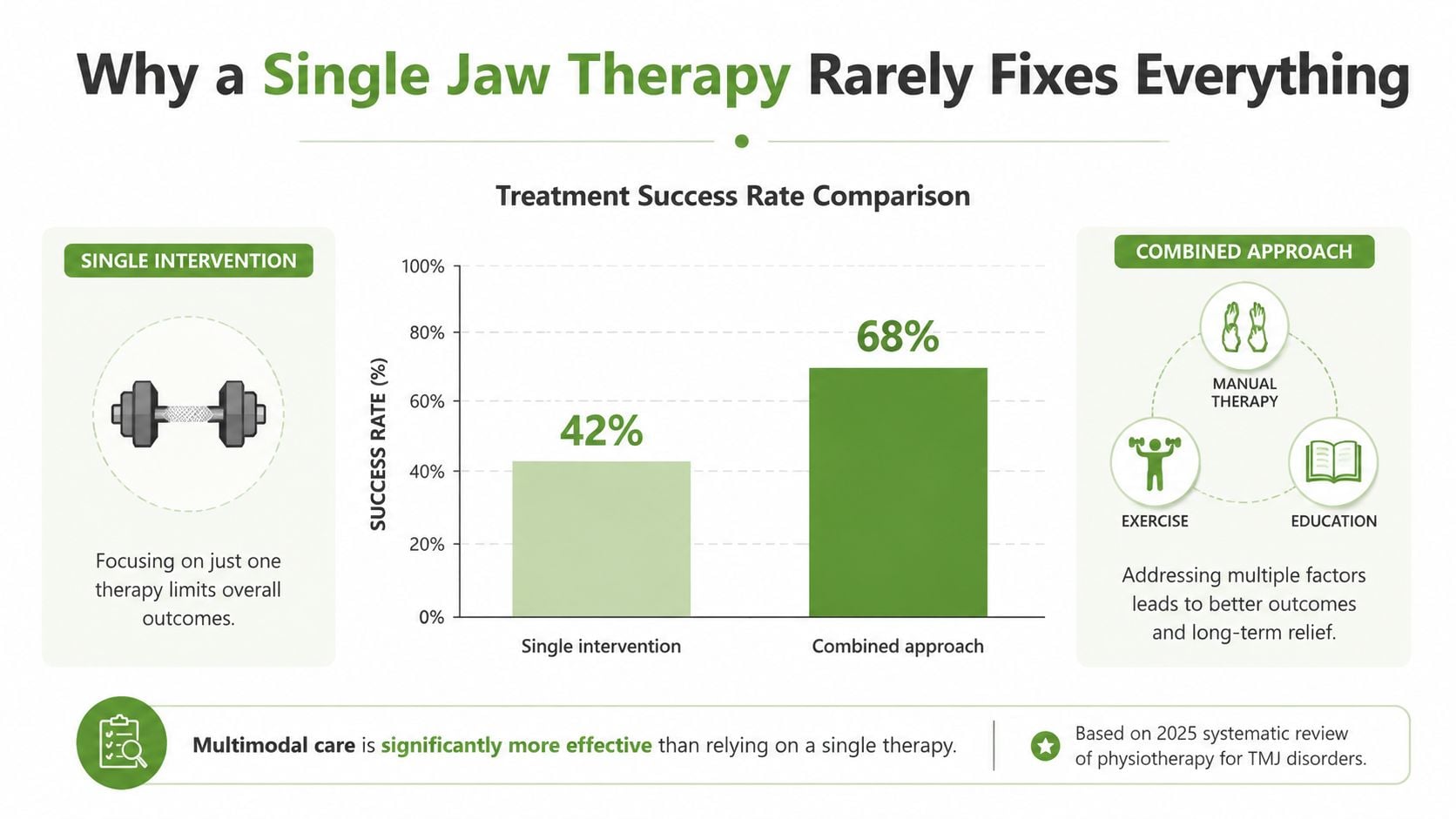
A patient may wake with jaw soreness, develop temple pressure by afternoon, and reasonably ask for one treatment to fix both. The biology is usually less tidy. Painful TMD can supply one stream of input, while sleep disruption, stress-related muscle recruitment, neck dysfunction, visual strain, medication patterns, or heightened nervous-system sensitivity keeps the headache active.
A 2025 systematic review examined physiotherapy for chronic headaches in patients with TMD. It included five studies. Three reported improvement, one favored the control group, and one found no difference. The interventions and study quality varied, so the authors could not perform a meta-analysis, as reported in the systematic review of physiotherapy.
Why one target may leave symptoms behind
Jaw-focused care can reduce painful muscle or joint input without correcting daytime clenching, cervical mechanics, poor sleep, or a separate primary headache disorder. The jaw may be part of the pattern, not the whole pattern.
That distinction guides reassessment. If an appliance reduces morning jaw soreness but afternoon headaches remain, the clinician should reconsider which driver is still active rather than intensify the same treatment.
A targeted therapy can be necessary without being sufficient.
A plan may bring together orofacial pain assessment, physical therapy, headache care, sleep evaluation, and behavior or breathing work. A multidisciplinary approach to pain management gives each contributor a defined place instead of treating every head pain as a TMJ problem.
Red Flags and When to Seek Specialty Care
Most recurring pressure-like headaches with clear jaw provocation can be evaluated in a planned appointment. Some symptoms require faster action.
Seek emergency care for sudden or neurological changes
Go to emergency care for a sudden, severe headache unlike any previous headache, especially when it comes with confusion, weakness, numbness, slurred speech, seizure, or a new visual disturbance. Fever with severe headache and a stiff neck also requires urgent medical assessment.
These symptoms don't fit a routine jaw-muscle explanation. Don't wait for a dental appointment to see whether they settle.
Arrange specialty evaluation for persistent or structural symptoms
A TMJ-focused dentist or orofacial pain clinician should assess persistent jaw pain, daily headaches, painful chewing, or symptoms that keep returning despite reasonable self-care. Oral and maxillofacial surgery may be appropriate for suspected dislocation, significant structural injury, persistent locking, or a sudden bite change.
Contact a clinician promptly after jaw trauma, whiplash, or a dental procedure if symptoms persist. Fever, swelling, unexplained weight loss, or night pain unrelated to clenching also deserves medical evaluation rather than home treatment.
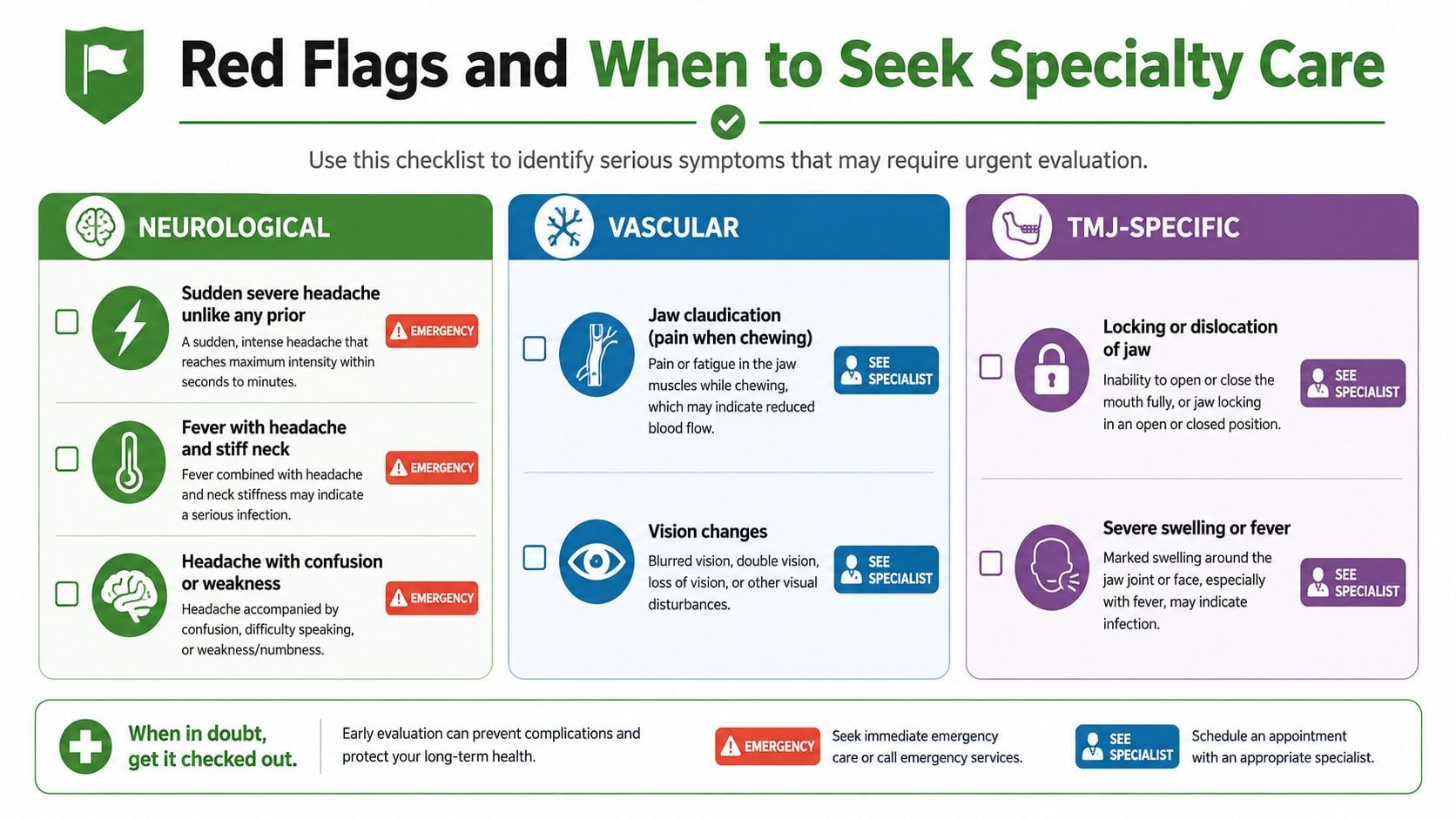
Decision rule: If the headache pattern is worsening and any red flag appears, stop self-treating and seek an evaluation today.
Building a Plan That Addresses Both the Jaw and the Headache
Return to Maya's situation. Medication hadn't resolved the headaches because it addressed the sensation without identifying the jaw-muscle input that repeatedly recreated it. A practical plan would begin with clarification, not a rushed appliance or injection.
Phase one clarifies the driver
Start with a TMJ-focused history and examination. Keep a headache diary that records location, timing, jaw activity, waking symptoms, and whether palpation or chewing reproduces the familiar pain. The clinician should distinguish muscle-related pain from joint-centered symptoms and consider whether a primary headache disorder is also present.
Phase two layers conservative care
Treatment should follow the findings:
- Physical therapy: Address masticatory and cervical muscle coordination, jaw movement, and restricted opening.
- A stabilization appliance: Consider a professionally designed night appliance when nocturnal loading or grinding appears relevant.
- Myofunctional therapy: Add exercises for tongue posture, swallowing, resting jaw position, and breathing mechanics when those patterns contribute.
- Regenerative options: Consider PRF or prolotherapy only when examination and imaging support ligament laxity, hypermobility, or joint degeneration.
A provider should explain what each treatment is expected to change. If the explanation is that one device will fix every headache, ask for a more specific diagnosis and follow-up plan.
Phase three measures the response
Reassess using consistent markers, such as headache days, jaw opening, and tenderness during examination. If symptoms remain after two appropriately targeted conservative treatment cycles, referral may be needed for further headache assessment, suspected disc displacement without reduction, or sleep-disordered breathing that could be contributing to clenching.
Look for a TMJ-focused provider who performs a hands-on orofacial pain examination, can access appropriate imaging when indicated, and coordinates with physical therapists, neurologists, sleep clinicians, or dental specialists. Pain and Sleep Therapy Center provides assessment and treatment for TMJ disorders, facial pain, headaches, and sleep-related breathing concerns, with options that include physical therapy coordination, oral appliances, myofunctional therapy, PRF, prolotherapy, and cold laser therapy.
If your headaches occur with morning jaw stiffness, temple tenderness, clenching, or pain during chewing, schedule a focused evaluation rather than continuing to rotate through medications. Visit Pain and Sleep Therapy Center to discuss whether your jaw, headache pattern, and sleep-related factors need to be assessed together.