You wake up tired despite spending the night in bed. Your partner says you snored, gasped, or seemed to stop breathing, while you remember only fragmented sleep and a dry mouth. You tried CPAP, but the mask felt claustrophobic, the airflow bothered you, or the machine became one more obstacle between you and sleep. That frustration is common, but it doesn't mean effective care ends with the mask.
Non surgical sleep apnea treatment works best when it matches the location and behavior of the airway obstruction. A custom oral appliance may reposition the jaw, myofunctional therapy may improve tongue and orofacial function, positional therapy may reduce back-sleeping events, and nasal airway care may make nasal breathing more sustainable. The right plan begins with diagnosis, not device selection.
| Treatment approach | Main mechanism | Most useful when | Important limitation |
|---|---|---|---|
| CPAP or PAP | Splints the airway open with positive pressure | A strong reduction in respiratory events is the priority | Long-term nightly use can be difficult |
| Custom oral appliance | Holds the lower jaw forward during sleep | CPAP isn't tolerated, particularly in selected mild to moderate cases | It may not normalize every patient's breathing |
| Myofunctional therapy | Trains tongue, lips, palate, and breathing function | A patient needs rehabilitation or combination care | Results vary with protocol and adherence |
| Positional therapy | Encourages side sleeping | Events are mainly associated with back sleeping | It won't address every anatomical obstruction |
| Nasal airway restoration | Improves the ability to breathe through the nose | Congestion or nasal resistance undermines sleep therapy | Nasal treatment alone isn't a universal apnea solution |
Rethinking Sleep Apnea Care Beyond the Mask
A patient may arrive carrying a CPAP machine in one hand and skepticism in the other. They may have tried different masks, adjusted humidity, and changed sleeping positions, yet still remove the equipment during the night. The problem isn't a lack of motivation. A treatment that feels uncomfortable, disrupts intimacy, or aggravates nasal breathing can become difficult to sustain.
Adherence changes the real-world result
CPAP remains the most established non-surgical therapy for obstructive sleep apnea, and it produces the strongest physiological control in many comparisons. Yet use outside the laboratory has remained a persistent challenge. A review covering studies over two decades found an overall CPAP non-adherence rate of 34.1% when optimal nightly sleep time was defined as seven hours, while mean nightly use was 4.6 hours. Older evidence reviews reported nonadherence ranging from 46% to 83% when adherence meant using CPAP for more than four hours per night. These findings come from the long-term CPAP adherence review.
The practical question is therefore not, “Which treatment is strongest?” It is, “Which treatment can control my breathing and remain part of my nightly routine?” A custom oral appliance, breathing retraining, nasal care, and positional support may offer a more workable plan for a patient who cannot maintain PAP use.
Root-cause care is still medical care
A multidisciplinary approach doesn't mean replacing evidence-based treatment with exercises or lifestyle slogans. It means identifying the contributing factors that influence airway collapse, including jaw position, tongue posture, nasal resistance, sleep position, muscle function, and temporomandibular joint health.
Clinical perspective: A device can support the airway tonight, but long-term success also depends on whether the patient can use it comfortably, breathe nasally, and return for objective follow-up.
This approach also protects against a common mistake, choosing an appliance before examining the jaw and airway. A patient with significant TMJ sensitivity may need slower advancement and closer monitoring. Someone with persistent nasal obstruction may need nasal evaluation before any oral treatment can work comfortably. Non-surgical care is most effective when the plan is built around the person rather than around a single product.
The Role of Custom Oral Appliance Therapy
Custom oral appliance therapy uses a dentist-fabricated mandibular advancement device, or MAD, to hold the lower jaw in a carefully selected forward position during sleep. Advancing the mandible can move the tongue and related soft tissues away from the back of the throat, creating more functional space for airflow. The appliance doesn't force air into the airway. It changes the mechanical relationship between the jaw, tongue, and upper airway.
Why custom design matters
Guidelines from the American Academy of Sleep Medicine and the American Academy of Dental Sleep Medicine support custom, titratable oral appliances for adults with obstructive sleep apnea when appropriate, especially when CPAP isn't tolerated or when a patient prefers an alternative. The guideline evidence also supports oral appliances as an option that can reduce daytime sleepiness. The broader guideline document notes that obstructive sleep apnea affects an estimated 2% to 26% of the general population, depending on age, sex, and diagnostic criteria. Those figures are reported in the AASM and AADSM oral appliance guideline.
An over-the-counter boil-and-bite mouthguard may be cheaper or easier to obtain, but it isn't designed to provide controlled mandibular advancement or protect the bite and TMJ during long-term use. A custom device can be adjusted in small increments, evaluated for retention, and modified if the patient develops jaw soreness, tooth discomfort, or changes in the bite.
Efficacy versus CPAP
The trade-off is clear. Comparative evidence shows that oral appliances reliably lower the oxygen desaturation index and improve the apnea-hypopnea index, but CPAP generally produces larger reductions in AHI, minimum oxygen saturation, and arousal-related measures. In pooled randomized data, oral appliances reduced AHI by about 7.05 events per hour versus control, while CPAP was superior by about 6.11 events per hour on AHI and improved lowest oxygen saturation more than oral appliances. These findings are detailed in the clinical practice guideline for oral appliance therapy.
That doesn't make MAD therapy a weak option. It means the expected target is often meaningful improvement or partial normalization, rather than complete elimination of respiratory events. The patient should have a follow-up sleep assessment to confirm that the chosen advancement is controlling breathing adequately.
Practical rule: Comfortable use is necessary, but comfort alone doesn't prove that an oral appliance is treating the apnea.
The appliance also needs to respect the masticatory system. A patient with TMJ pain, limited opening, bruxism, missing teeth, or unstable dental support may need a modified design and a slower titration pathway. The clinician should monitor symptoms and occlusion while balancing airway response against joint and muscle tolerance.
Patients comparing these options can also review this practical discussion of sleep apnea oral appliance versus CPAP, but personal candidacy still depends on the sleep study, examination, and follow-up testing.
Airway Rehabilitation Through Myofunctional Therapy
A mandibular advancement device changes the airway's nighttime geometry. Orofacial myofunctional therapy works on the muscles and behaviors that support breathing, swallowing, lip seal, and tongue posture. It resembles physical therapy for the airway, but the exercises must be selected and performed consistently to have a meaningful clinical role.
What the exercises target
A therapist may assess whether the tongue rests against the palate or drops toward the floor of the mouth, whether the lips remain sealed without strain, and whether the patient breathes through the nose or defaults to mouth breathing. Treatment can include controlled tongue elevation, palate contact, lip-strengthening work, swallowing retraining, soft-palate exercises, and nasal-breathing practice.
The mechanism matters. A tongue that rests low and a mouth that remains open can reinforce an unfavorable breathing pattern. Training doesn't physically remove an obstruction, and it shouldn't be marketed as a guaranteed replacement for PAP or an oral appliance. It may, however, improve the functional support around a mechanically vulnerable airway.
A realistic role for therapy
A recent systematic review found improvements in daytime sleepiness and sleep quality compared with controls. The Epworth Sleepiness Scale improved by 3.54 points, and the Pittsburgh Sleep Quality Index improved by 2.24 points, while the pooled AHI effect wasn't statistically significant in that analysis. Those findings are reported in the systematic review of myofunctional therapy.
Earlier meta-analyses and clinical series reported larger AHI changes, including an approximate 50% adult reduction and one controlled report in which mean AHI fell from 24.5 to 12.3 events per hour. The same evidence base shows why outcomes vary. Protocol intensity, adherence, baseline anatomy, and patient phenotype all influence the result.
A sensible program starts with an evaluation rather than a generic exercise sheet:
- Establish nasal breathing first. If congestion prevents comfortable nasal airflow, tongue and lip exercises won't address the primary barrier.
- Train resting posture. The patient learns where the tongue, lips, and jaw should rest when awake.
- Practice function. Swallowing and breathing patterns need to transfer into daily life, not remain isolated drills.
- Combine when appropriate. Myofunctional therapy often fits best alongside a MAD or CPAP when the objective is stronger airway support.
Therapy is most useful when the patient can explain what each exercise changes and how that change relates to sleep breathing.
A clinician also needs to distinguish airway rehabilitation from unsafe jaw pushing. A MAD advances the mandible through a measured, titratable mechanism. Myofunctional therapy should support that treatment, not encourage forceful jaw positions that aggravate the TMJ. Patients interested in the clinical process can learn more about orofacial myofunctional therapy.
Positional Therapy and Nasal Airway Restoration
Some patients experience substantially more obstruction while lying on their backs. In those cases, positional therapy may reduce the mechanical disadvantage created by gravity and posterior movement of the tongue. Wearable prompts, specialized pillows, and other positioning systems aim to encourage side sleeping without relying on uncomfortable improvised methods.
The first step is confirming that position influences the patient's events. A sleep study can show whether breathing disturbances cluster in a particular posture. If events occur across positions, side sleeping may still improve comfort, but it shouldn't be treated as the complete solution.
Nasal breathing supports every other therapy
Nasal obstruction changes the patient's breathing strategy. Congestion, allergies, structural narrowing, or poor nasal habits can encourage mouth opening, dry mouth, and a less stable oral posture. A patient who can't breathe through the nose may struggle with CPAP, lose lip seal around an oral appliance, or find breathing exercises uncomfortable.
Nasal restoration can involve medical management of congestion, evaluation of structural limitations, internal nasal dilators, and breathing retraining. Buteyko breathing emphasizes quieter nasal breathing and reduced overbreathing during appropriate exercises. It should be taught carefully, particularly when a patient has significant respiratory disease or severe obstruction.
Combining position with function
Positional therapy changes where the patient sleeps. Myofunctional therapy changes how the mouth and tongue behave while awake and during the transition into sleep. Buteyko-based nasal breathing practice reinforces the habit that makes both approaches more sustainable.
That combination can be useful because airway collapse rarely depends on one factor alone. A side-sleeping patient who keeps the mouth open may still have poor tongue support. A patient with strong oral posture may continue to experience events while supine. An internal nasal dilator may improve airflow but won't correct jaw retrusion or pharyngeal collapse.
A practical nightly plan might include using the prescribed positional device, placing the tongue in its trained resting position before sleep, and maintaining the nasal routine recommended by the treating clinician. Avoid claiming that any single method cures apnea. The purpose is to reduce contributing load and make the primary therapy easier to tolerate.
Comparing Non-Surgical Treatment Efficacy
Treatment selection should follow the patient's physiology, not the popularity of a device. CPAP generally offers the greatest reduction in respiratory events, while oral appliances may be easier for some patients to use consistently. Myofunctional therapy can improve symptoms and sleep quality, but current evidence supports it more reliably as an adjunct than as a standalone substitute when a large AHI reduction is required.
A recent review identified mandibular advancement devices as the most established non-CPAP therapy, while a network meta-analysis found PAP delivered the largest overall improvements in AHI, sleepiness, and quality of life. The same review described MADs as especially useful when PAP isn't tolerated. These conclusions appear in the recent review of non-CPAP sleep apnea therapies.
Non-Surgical Treatment Comparison
| Treatment modality | Primary benefit | Best candidate profile | Adherence level |
|---|---|---|---|
| CPAP or PAP | Strongest control of airway events in comparative testing | Patients who can tolerate positive pressure and need substantial physiological control | Variable, with long-term use remaining a challenge |
| Custom MAD | Portable mechanical airway support without a mask | Adults with appropriate anatomy, especially those who can't tolerate CPAP | Often practical, but objective use can decline over time |
| Myofunctional therapy | Improves selected functional measures, including sleepiness and sleep quality | Patients willing to practice consistently, often alongside another therapy | Depends heavily on sustained participation |
| Positional therapy | Reduces back-sleeping exposure | Patients with position-dependent obstruction | Depends on comfort and nightly consistency |
| Nasal airway care | Supports nasal breathing and tolerance of other therapies | Patients with congestion, nasal resistance, or mouth-breathing habits | Requires ongoing routine and appropriate clinical guidance |
Severity and candidacy matter
Oral appliance therapy is a major non-surgical alternative for adults with mild to moderate obstructive sleep apnea and for people who can't tolerate CPAP. It can also be considered in other situations after specialist assessment, but the more severe or complex the obstruction, the more important objective verification becomes.
Myofunctional therapy shouldn't be presented as a universal replacement for PAP. The recent review found a non-significant pooled AHI result, even though daytime sleepiness and sleep quality improved. That distinction protects patients from a common marketing promise: feeling better doesn't necessarily mean the airway events have been adequately controlled.
Adherence also needs measurement rather than assumption. One study in the recent review found objective oral appliance adherence fell from 80.0% at one month to 67.3% at six months, with psychological comorbidities associated with lower adherence. Early follow-up matters because discomfort, jaw symptoms, and declining nightly use can be addressed before the treatment becomes abandoned.
Sleep environment can support the plan without pretending to replace it. Patients who are evaluating sleep surfaces may find this sleep apnea bed firmness guide useful when considering how mattress support affects side sleeping and comfort.
Combination care often makes more sense
A MAD can provide immediate structural support while myofunctional therapy addresses tongue posture, lip seal, and swallowing patterns. Positional therapy can reduce supine exposure, and nasal care can make the entire routine easier to tolerate. The clinician should still use follow-up sleep testing to determine whether the combination is controlling events rather than relying on symptom impressions alone.
The Importance of Personalized Diagnostics
The same diagnosis can arise from very different airway mechanics. One patient may have a retruded lower jaw and a tongue that moves backward during sleep. Another may have nasal resistance, a narrow palate, enlarged soft tissue, or a combination of functional and structural factors. Prescribing the same device to both patients ignores the reason their airways collapse.
Begin with objective sleep data
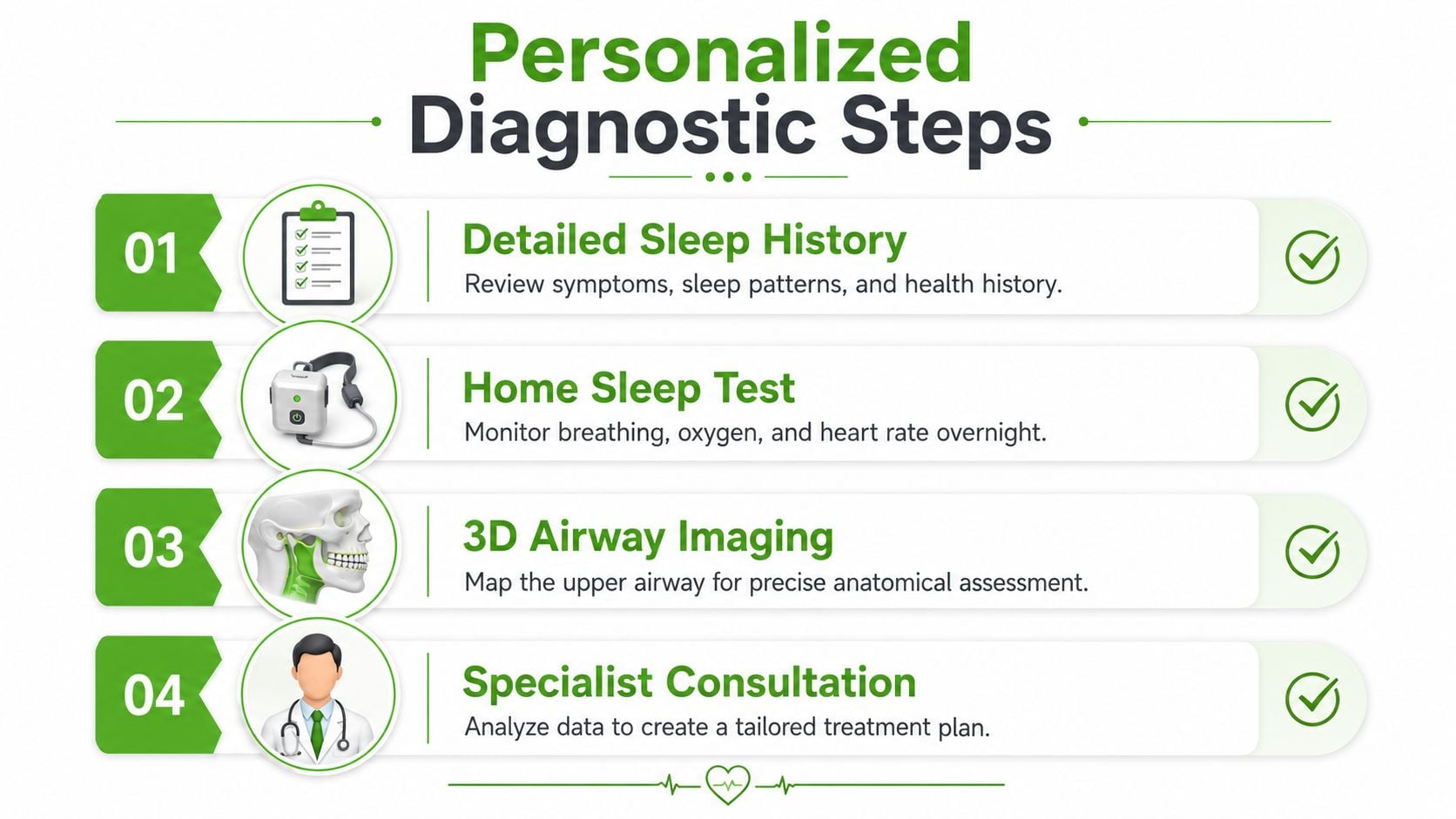
A sleep evaluation should connect symptoms with recorded breathing patterns. A home sleep study may be appropriate for selected adults, while some patients need in-lab testing because of medical complexity, uncertain findings, or suspected disorders beyond uncomplicated obstructive sleep apnea. Patients can review how clinicians assess home sleep study accuracy before testing.
The result isn't a treatment prescription by itself. It helps establish the pattern and severity of the breathing disorder, while the clinical examination explains how anatomy and function may be contributing.
Examine more than the teeth
A dental sleep medicine evaluation should include the teeth, periodontal support, bite, range of motion, jaw joints, and muscles. A TMJ assessment is especially important before advancing the mandible, because a patient may tolerate a device poorly if the joint or chewing muscles are already overloaded.
A broader airway evaluation may include nasal breathing, oral posture, facial growth pattern, palate shape, tongue mobility, and craniofacial relationships. Three-dimensional imaging can help the clinician understand airway anatomy, although an image still represents anatomy at a particular moment and doesn't replace sleep testing.
Diagnostic principle: The best appliance is the one selected after the clinician understands the obstruction, the joint, the teeth, and the patient's ability to use it.
This process also helps identify when a non-surgical dental approach isn't enough. Significant nasal disease, complex medical conditions, or an airway pattern that doesn't respond to mandibular advancement may require collaboration with sleep medicine, ENT, orthodontic, or other specialists. Root-cause care isn't about avoiding referral. It's about making the referral at the right time.
Starting Your Journey to Better Sleep
Start by documenting what happens at night and how you feel during the day. Note snoring, witnessed breathing pauses, gasping, morning headaches, dry mouth, restless sleep, daytime sleepiness, jaw pain, and any difficulty using CPAP. Bring your medication list, prior sleep studies, CPAP compliance information if available, and details about previous oral appliances.
A practical pathway
- Complete an initial sleep screening. A sleep quiz can identify symptoms that deserve formal evaluation, but it can't diagnose obstructive sleep apnea.
- Meet with the appropriate clinician. The consultation should review your sleep history, health conditions, nasal breathing, jaw function, dental status, and treatment preferences.
- Complete sleep testing. Follow the instructions closely. A home test may involve sensors that monitor breathing and related signals overnight, while an in-lab study provides supervised assessment when indicated.
- Select the treatment. Options may include PAP, a custom titratable MAD, positional therapy, myofunctional therapy, nasal care, or a combination.
- Verify the response. Don't judge success solely by reduced snoring or improved energy. Follow-up testing helps determine whether respiratory events and oxygen disturbances have improved.
A custom oral appliance typically requires careful records, fabrication, fitting, gradual advancement, and reassessment. The clinician may adjust the device to improve airway response while watching for tooth movement, bite changes, muscle fatigue, or TMJ symptoms. Maintenance includes cleaning, inspection, replacement of worn components, and periodic review of fit.
Make adherence part of the plan
Tell the clinician early if you experience jaw soreness, tooth pressure, dry mouth, nasal blockage, or anxiety about treatment. Small problems can become reasons to stop using therapy if they aren't addressed. Psychological comorbidities have also been associated with lower oral appliance adherence in objective follow-up data, so the plan should account for sleep-related anxiety, mood symptoms, and routine barriers rather than treating missed nights as a character flaw.
Don't start exercises, buy an unregulated mouthguard, or advance a jaw device aggressively without professional guidance. A treatment that feels simple may still affect the bite, TMJ, airway, and sleep physiology.
For patients seeking coordinated support, Pain and Sleep Therapy Center evaluates sleep-related breathing, TMJ function, oral appliance needs, orofacial myofunctional therapy, and nasal-breathing strategies as part of individualized care.
Visit Pain and Sleep Therapy Center to discuss a diagnostic pathway for non-surgical sleep apnea care, including custom oral appliance therapy and airway-focused rehabilitation. Bring your sleep history and any previous testing so the team can help match treatment to your breathing pattern, jaw health, and ability to use it consistently.