A deep or excessive overbite is generally not a strong standalone cause of TMJ disorder. In the 2002 study, adjusted odds ratios were 0.36 for an overbite of −8 to −1 mm and 1.08 for an overbite of 6 to 15 mm, with confidence intervals crossing 1.0, so neither category reliably predicted TMD symptoms.
Why, then, do so many people hear that their overbite is causing their jaw pain? The question exposes a common gap in conventional thinking. A bite is easy to see and measure, while bruxism, airway resistance, muscle guarding, joint loading, and oral posture are less obvious. A deep bite may contribute to stress in a susceptible jaw, but it rarely tells the whole story.
The Short Answer on Overbite and TMJ
The assumption is simple: the upper front teeth overlap too much, the lower jaw gets pushed backward, and the temporomandibular joint becomes painful. The clinical reality is more complicated. An overbite can be one part of a multifactorial risk pattern, but it usually isn't sufficient by itself to explain TMJ pain, clicking, locking, or limited movement.
A population-based German study published in 2005 examined 3,033 people ages 10 to 75, with 53% female, and compared normal overbite and overjet values with high and low values. After controlling for age and sex, the researchers found no statistically significant association between overbite or overjet and TMJ clicking or crepitus. The odds ratios ranged from 0.7 to 1.3, and none reached statistical significance, as reported in the 2005 German population study.
That doesn't mean your bite is irrelevant. It means a bite measurement can't identify the source of symptoms on its own. Your joint responds to how often it loads, how forcefully the muscles contract, whether the disc and condyle move smoothly, and whether sleep or breathing problems keep the jaw active for hours.
Practical rule: Treat the painful system, not the most visible measurement.
A useful evaluation asks several questions:
- Joint load: Does the jaw hurt during chewing, yawning, or prolonged talking?
- Muscle activity: Do you clench during the day or grind while sleeping?
- Airway and sleep: Do snoring, mouth breathing, fatigue, or suspected sleep-disordered breathing increase nighttime strain?
- Movement: Is opening limited, deviated, or accompanied by catching?
- Oral posture: Does the tongue rest low, does the jaw hang open, or do you hold the teeth together?
The rest of the assessment should connect these findings to the mechanics of your bite, your age, and your symptoms. That approach is more useful than assuming that braces or bite adjustment will automatically resolve TMJ dysfunction.
How Overbite Changes the Mechanics of Your Jaw
An overbite describes vertical overlap, meaning how much the upper front teeth cover the lower front teeth. Overjet is different. It describes the horizontal distance between the upper and lower front teeth. They can occur together, but they don't describe the same jaw relationship or necessarily create the same loading pattern.
Think of the lower jaw as a hinged lever. The condyles sit near the back of the mandible, while the front teeth and chewing muscles influence how that lever closes. When the front teeth overlap, the lower incisors may contact the palate or the backs of the upper teeth during closure. That contact can guide the mandible along a different path than a more balanced bite would.
The mechanics matter most when the teeth, muscles, and joints aren't sharing force comfortably. A deep bite may be associated with:
- Altered closing paths: The lower jaw can follow a more restricted path as the incisors meet.
- Different muscle length: The masseter and temporalis muscles may work from a shortened or guarded position.
- Changed tooth contact: The front teeth can absorb more guidance forces, while posterior contacts may become uneven.
- Increased sensitivity to clenching: Repeated force can amplify muscle fatigue in someone who already clenches or grinds.
A commonly described concern is posterior condylar positioning, where the mandible appears to seat farther back under certain closure patterns. That doesn't prove that the joint is being damaged or that the disc is displaced. It describes a possible mechanical relationship that may become relevant when other stressors are present.
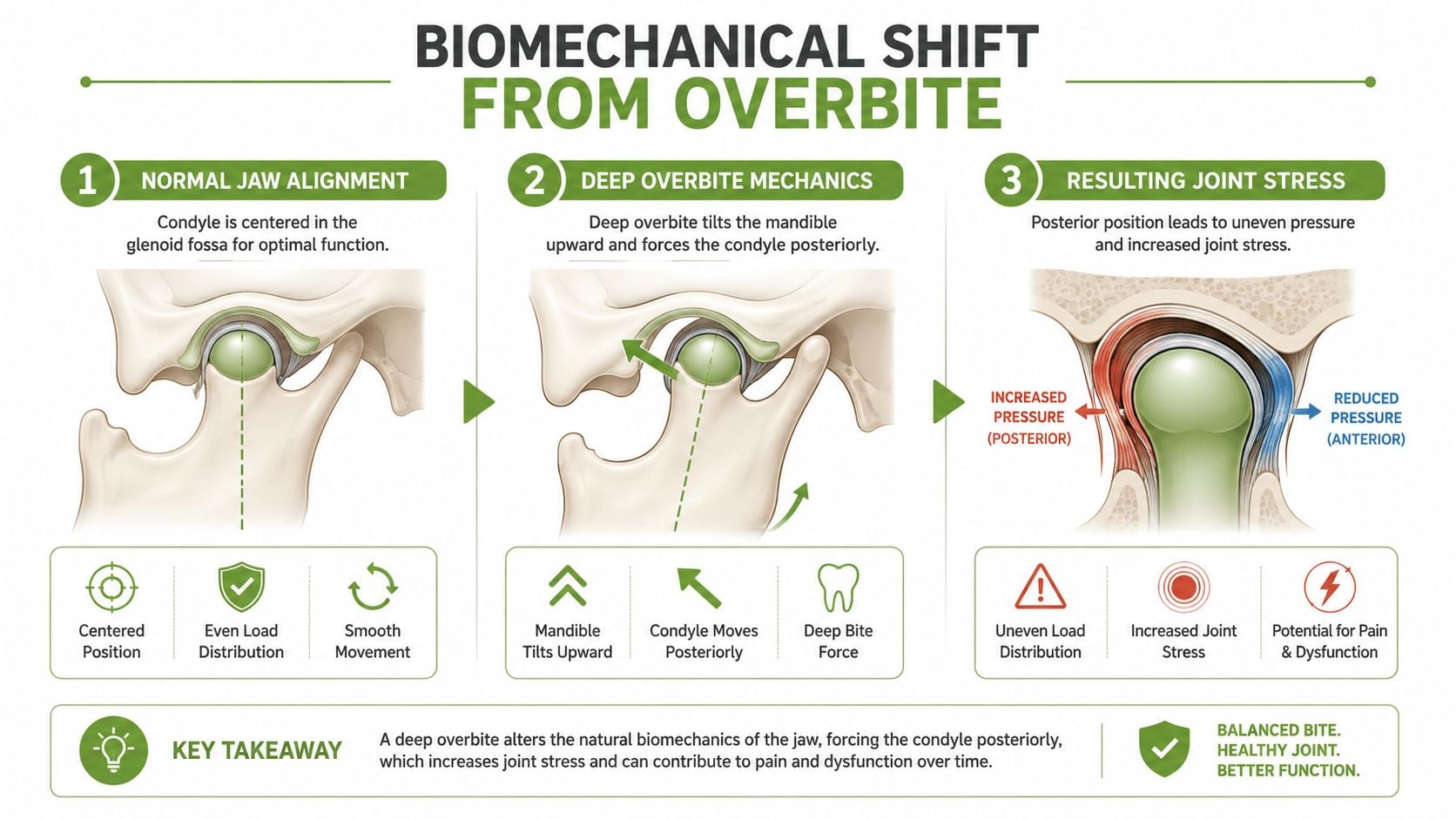
Why the bite number isn't enough
An anterior open bite creates a different pattern. The front teeth don't overlap normally, so the back teeth and chewing muscles may carry more of the functional demand. Crossbites and Class II relationships can also alter how the mandible moves, but the presence of a pattern doesn't prove that it causes pain.
The joint isn't exposed to a fixed load because your teeth overlap. You load it when you chew, clench, grind, brace the jaw, or hold the mandible in a strained position. A moderate bite difference may remain symptom-free for years, while a smaller discrepancy can become painful during a period of intense clenching, poor sleep, trauma, or persistent muscle tension.
That distinction prevents overtreatment. Orthodontic correction may be appropriate for tooth wear, function, hygiene, aesthetics, growth, or skeletal imbalance. It shouldn't be prescribed as a guaranteed TMJ cure based only on the depth of an overbite.
What the Research Actually Shows About the Link
The strongest evidence doesn't support a simple equation between overbite and TMD. In the 2002 study, the adjusted odds ratio for an overbite category of −8 to −1 mm was 0.36, while the ratio for 6 to 15 mm was 1.08. Both confidence intervals crossed 1.0, and the study found similarly non-significant results for joint noises and limited mouth opening. Its conclusion was that overbite and overjet weren't associated with self-reported TMD in that dataset, as detailed in the 2002 population study.
In plain language, an odds ratio near 1.0 means the measured category didn't clearly distinguish people with symptoms from those without them. A value below 1.0 in this context also shouldn't be interpreted as proof that a low overbite protects against TMD, especially when the confidence interval includes the possibility of no association. The key point is that the bite categories didn't function as reliable predictors.
The 2005 German investigation reached a similar conclusion for joint sounds. It tested the long-held idea that a deep overbite might drive clicking or crepitus and found no statistically significant relationship after accounting for age and sex. That historical result matters because it examined a large community sample rather than relying only on patients already seeking care.
Association is not a treatment prescription
A later meta-analytic review of malocclusion and TMD reported associations more often with Class II malocclusion, anterior open bite, crossbite, and increased overbite or overjet. Those findings were observational. They identify patterns that may occur together, but they don't establish that changing the bite will eliminate pain.
A separate controlled clinical study also found no differences between deep-overbite and normal-overbite subjects across TMJ dysfunction indicators and questioned overbite as an isolated cause of TMD symptoms, as summarized in the clinical study record.
The evidence supports a risk model, not a single-cause diagnosis.
For patients, the practical consequence is important. A clinician should document pain location, function, joint sounds, muscle tenderness, sleep-related loading, and movement before recommending irreversible bite changes. If those findings point to muscle overuse or airway-related clenching, correcting the overbite alone may leave the primary driver untouched.
Airway, Tongue Posture, and the Hidden Load on Your Joint
The jaw doesn't work independently from the tongue, throat, neck, and breathing pattern. A patient with a deep bite may also have a low tongue posture, chronic mouth breathing, nasal obstruction, or sleep-related airway resistance. Those factors can encourage the head and mandible to shift into a position that keeps the jaw muscles active.
During the day, the pattern may look subtle. The lips part, the tongue rests low, and the teeth touch repeatedly while the person concentrates. At night, airway resistance or sleep-disordered breathing may trigger repeated protective muscle activity. The jaw then experiences frequent loading even though the patient isn't consciously choosing to clench.
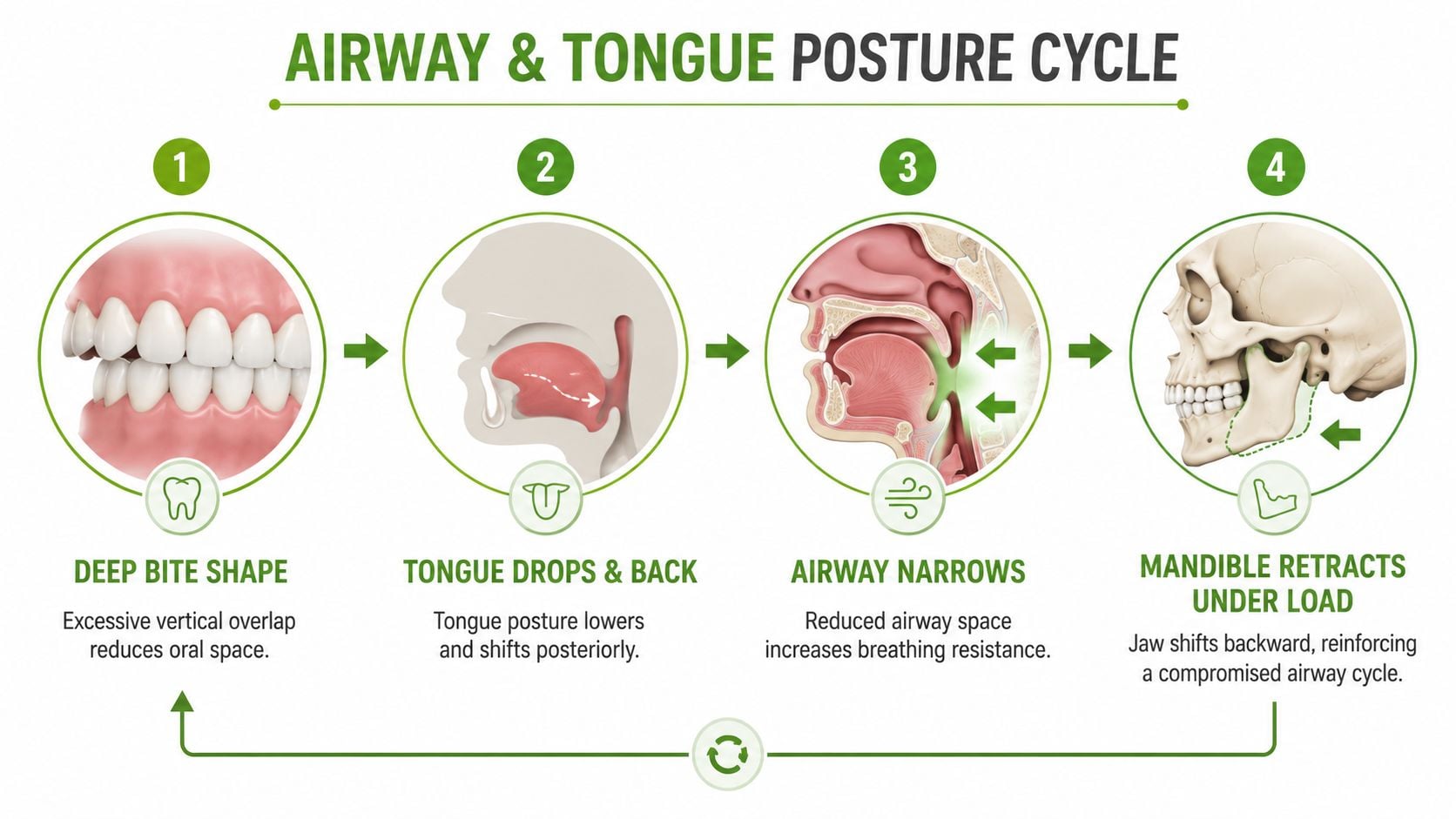
The interaction clinicians look for
A deep bite doesn't automatically narrow the airway, and not every person with mouth breathing has a TMJ disorder. The useful question is whether several findings reinforce one another:
- Nasal breathing: Can you breathe comfortably through your nose during rest and sleep?
- Tongue position: Does the tongue rest broadly against the palate, or does it sit low and back?
- Jaw posture: Do you habitually retract or brace the mandible?
- Nighttime activity: Do you wake with tight muscles, headaches, tooth sensitivity, or jaw fatigue?
- Neck tension: Does forward-head posture accompany shallow breathing or prolonged screen use?
Orofacial myofunctional therapy may help retrain tongue resting position, swallowing coordination, lip seal, and nasal breathing habits when those problems are present. Buteyko-style breathing retraining can also be considered as part of a broader nasal-breathing program. These approaches shouldn't be sold as a way to reshape an adult jaw overnight. Their role is to reduce unhelpful patterns and improve functional control.
For patients whose symptoms overlap with snoring or suspected sleep-disordered breathing, airway-focused orthodontic care may be one part of a coordinated evaluation. An orthodontist, dentist, ENT clinician, sleep specialist, or myofunctional therapist may each contribute different information.
The joint responds to accumulated force, not to a number viewed in isolation. If breathing problems, clenching, and poor oral posture keep the muscles working, a modest bite difference may become more noticeable. Treating those contributors can be more logical than immediately moving teeth without understanding why the jaw is overloaded.
Why Age Matters in the Overbite and TMJ Picture
Children and adults shouldn't receive the same explanation for jaw symptoms. Growth, developing bite relationships, habits, airway anatomy, and pain reporting all change the clinical picture. A deep bite that deserves orthodontic monitoring in a child isn't automatically the cause of facial pain in an adult.
A 2025 systematic review of TMD in people under 18 found that pain-related TMD was more often associated with posterior crossbite, Class II or III malocclusion, excessive overjet, and anterior open bite. Isolated deep bite alone didn't stand out as a strong driver. For a child or adolescent with pain, the evaluation should consider growth, crossbite, jaw asymmetry, airway symptoms, oral habits, and muscle function rather than focusing only on vertical overlap.
Adult patterns can differ. A 2024 review noted a correlation between decreased overbite and muscle or TMJ pain, while classic studies found that overbite and overjet weren't reliable predictors of clicking or crepitus. The direction of an association may therefore vary by age and phenotype, which is one reason a universal bite-based explanation fails.
| Age Group | Bite Patterns Linked to TMD | Strength of Evidence | Where Overbite Fits |
|---|---|---|---|
| Children and adolescents | Posterior crossbite, Class II or III relationships, excessive overjet, and anterior open bite were more often associated with pain-related TMD in the 2025 review. | Associations from a systematic review, not proof of causation. | Isolated deep bite didn't emerge as a strong standalone driver. |
| Adults | Decreased overbite was correlated with muscle and TMJ pain in a 2024 review, while classic studies didn't find overbite or overjet to be reliable predictors of joint sounds. | Mixed and phenotype-dependent evidence. | Evaluate it alongside pain, muscle activity, sleep, posture, and joint function. |
What this means for families and adults
Parents should seek an orthodontic and airway-aware assessment when a child has pain alongside a crossbite, open bite, significant overjet, mouth breathing, or difficulty chewing. Adults with a deep bite and persistent symptoms should first clarify whether the dominant problem is muscular, articular, sleep-related, or postural.
Ear symptoms can complicate the picture. Jaw-related discomfort and tinnitus may coexist, but tinnitus has multiple possible causes, so persistent ringing deserves appropriate hearing and medical evaluation. A resource such as tinnitus management at Z Audiology can help patients understand when an audiology assessment belongs alongside a TMJ evaluation.
What a Clinician Actually Evaluates Beyond Your Bite
A TMJ-focused examination begins with your symptoms, not with a ruler placed between the incisors. I want to know where the pain occurs, what triggers it, whether it spreads into the temple or ear, and whether the jaw locks, catches, or deviates during opening. The timing matters too. Morning soreness suggests a different loading pattern than pain that appears only after chewing.
Movement and joint findings
The clinician may map clicking, popping, or crepitus on both sides while you open, close, protrude, and move laterally. Range of motion is recorded, and the examiner watches for deviations, deflections, hesitation, or pain at a particular point in the movement.
Muscle examination usually includes the masseters and temporales, with attention to the lateral pterygoid region when clinically appropriate. Tenderness, protective guarding, trigger points, and referred pain can reveal that the muscles are driving symptoms even when the joints themselves aren't the primary source.
The oral examination can identify wear facets, fractured restorations, cheek ridging, tongue posture, swallowing patterns, and buccal exostoses. A clinician may also screen for a restrictive lingual frenulum when tongue mobility or oral posture appears relevant. None of these findings proves a diagnosis by itself, but together they show how the system functions.
Breathing and imaging
Airway screening may include nasal patency, lip posture, tongue position, neck posture, and a visual assessment such as Mallampati classification. If snoring, witnessed breathing pauses, unrefreshing sleep, or daytime fatigue are present, the next step may involve a sleep-focused referral rather than immediate orthodontic treatment.
Imaging has a specific job. A panoramic radiograph provides a broad view of the teeth, jaws, and condylar regions. Cone-beam CT can clarify bony anatomy, asymmetry, and degenerative changes. MRI is the more appropriate study when the clinician needs to evaluate soft tissues such as disc position, although imaging findings must match the symptoms and examination.
A TMJ specialist evaluation should therefore combine history, movement, palpation, dental wear, breathing, and selective imaging. The overbite is one observation within that process, not the diagnosis.
Non-Surgical and Interdisciplinary Care Options
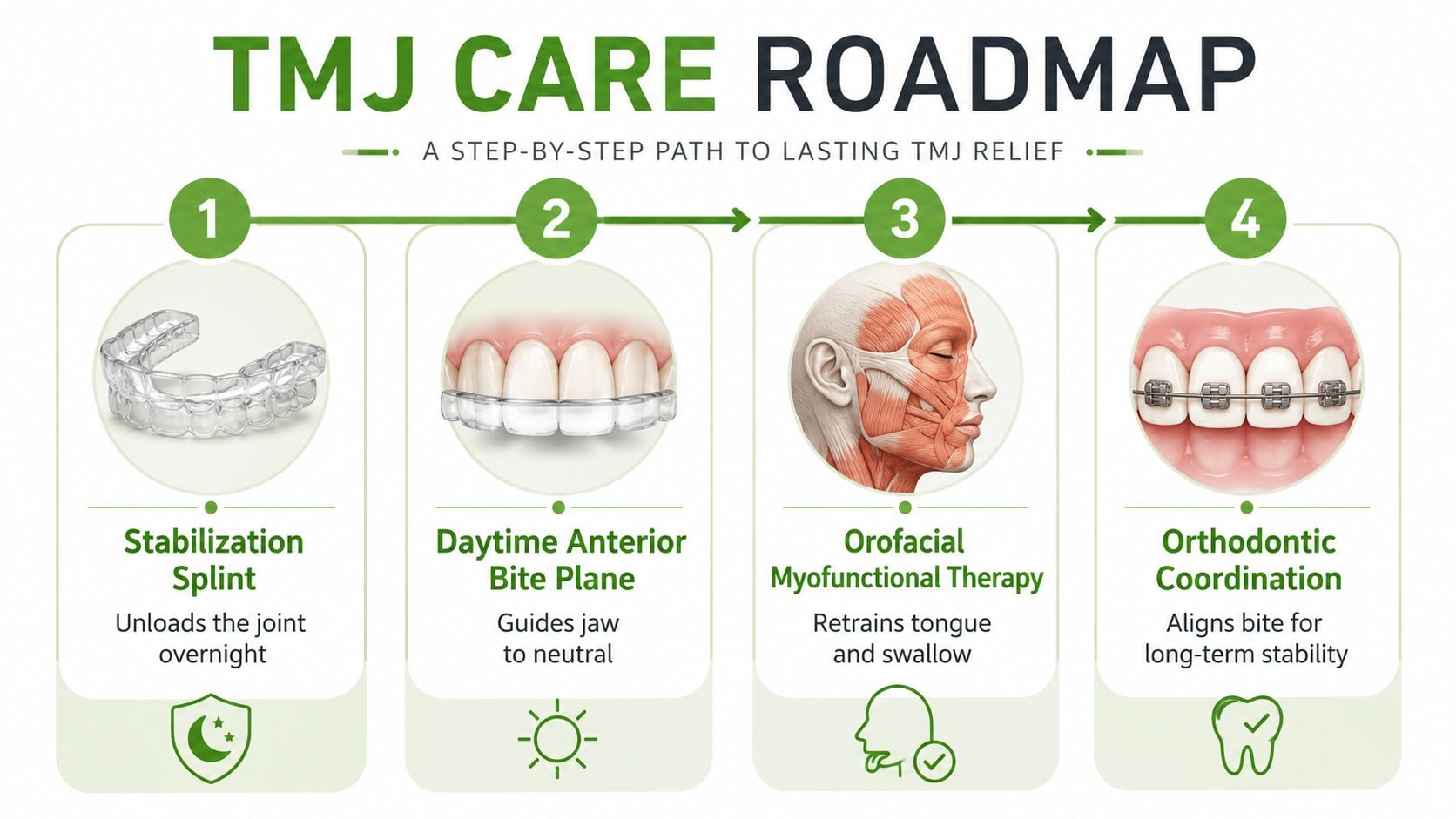
Treatment should follow the loading pattern. If clenching and nighttime overload dominate, a custom stabilization splint may reduce harmful contact and give the muscles a more controlled environment. That isn't the same as a generic boil-and-bite guard. Appliance design, fit, adjustment, and follow-up matter, particularly when symptoms change.
A daytime anterior bite plane may be useful in selected cases to interrupt habitual clenching and guide the mandible toward a less strained position. It shouldn't be worn indefinitely without supervision, because any appliance can influence tooth contact and jaw position. The clinician needs to define the purpose, schedule, and reassessment point.
Match the intervention to the driver
Orofacial myofunctional therapy can address tongue posture, swallowing, lip seal, and breathing coordination when those functions contribute to jaw strain. Physical therapy may help patients with muscle guarding, restricted movement, cervical tension, and poor movement control. Sleep evaluation belongs in the plan when snoring, suspected apnea, or persistent fatigue suggests nighttime airway stress.
Some clinics also offer regenerative or supportive modalities, including Prolotherapy, Platelet-Rich Fibrin injections, and cold laser therapy. These should be discussed as adjuncts, not guaranteed cures. The clinician should explain the target tissue, expected benefit, alternatives, risks, and how the intervention fits into the broader plan.
Orthodontic treatment may be appropriate when the bite creates functional limitations, tooth trauma, progressive wear, growth concerns, or a skeletal discrepancy. The sequence matters. Stabilizing pain and controlling clenching before moving teeth can make the treatment plan easier to evaluate. In other cases, orthodontic or airway correction needs to occur early because the structural problem is central to function.
A practice that coordinates dental sleep medicine, myofunctional therapy, orthodontics, ENT care, and TMJ treatment can reduce fragmented decision-making. Even administrative support, such as a dental practice AI answering service, can help a clinic route questions and referrals, but it can't replace clinical judgment.
For patients who want to understand non-surgical approaches to bite correction, overbite treatment without surgery can provide useful context. The right plan depends on the cause of the overbite, symptom behavior, airway status, muscle loading, and joint findings.
Pain and Sleep Therapy Center evaluates TMJ pain, facial tension, bite-related loading, oral posture, and sleep-related breathing concerns using an individualized, interdisciplinary approach. Visit Pain and Sleep Therapy Center to request an assessment and discuss whether splint therapy, myofunctional care, breathing support, regenerative options, or coordinated orthodontic referral fits your symptoms.