
You've tried the night guard, the stretching, maybe even physical therapy, yet your jaw still aches by afternoon and your sleep still feels broken by morning. That pattern is common when the underlying problem sits higher up, at the tongue, where a small band of tissue can change how you breathe, swallow, rest your jaw, and hold your head.
Adult tongue tie, or ankyloglossia, is less often diagnosed in adults than in infants. Review data place prevalence in children, teenagers, and adults at 0.1% to 2.08%, compared with 1.72% to 10.7% in newborn-focused studies, and a 2022 meta-analysis summarized by the American Dental Association reviewed 71 studies and found an overall prevalence of 5%, with 7% in infants, 1% in children, and 2% in adolescents NCBI review data. In practice, that means many adults are never examined for it unless someone looks closely at oral function, not just anatomy. For a related overview of how tongue restriction can show up, see tongue-tie complications in adults and children.
More Than a Childhood Concern What Is Adult Tongue Tie
A lot of adults don't walk in saying they have a tongue tie. They describe a jaw that clicks, neck muscles that stay tight by late afternoon, sleep that never feels restorative, or headaches that flare after talking, chewing, or clenching under stress. The tongue is often overlooked because the symptoms seem disconnected.
Adult tongue tie means the lingual frenulum, the tissue under the tongue, limits movement enough to affect function. Some people have lived with that restriction since childhood and built workarounds without realizing it. The body can compensate for years, but that compensation has a cost.

Why adults get missed
Adults are missed more often because the condition is diagnosed less consistently in grown patients than in infants, and the wide prevalence range reflects differences in how the condition is defined and recorded NCBI review data. Mild restriction can also look normal on a quick glance when the person has adapted around it for years.
A functional exam matters more than a casual look in the mirror.
If the tongue can move but the person still has recurring pain, fatigue, or poor sleep, the question is not only how the tongue appears. It is how it works during rest, speech, swallowing, and breathing. That functional view is where root causes start to come into focus, especially when jaw strain, airway concerns, and chronic muscle tension keep showing up together.
For a clearer look at the ripple effects of restriction, read adult tongue-tie complications. If you are looking for a practical sign to start with, Florida Special Care Dentistry about your tongue offers a useful place to compare symptoms with tongue function.
Many adults also need care that reaches beyond the tongue itself. In a clinic that coordinates dental, myofunctional, airway, and body-based treatment, the goal is to connect the dots between a restricted tongue, TMJ strain, sleep-disordered breathing, and pain patterns that have been treated one symptom at a time.
The Anatomy of a Restricted Tongue
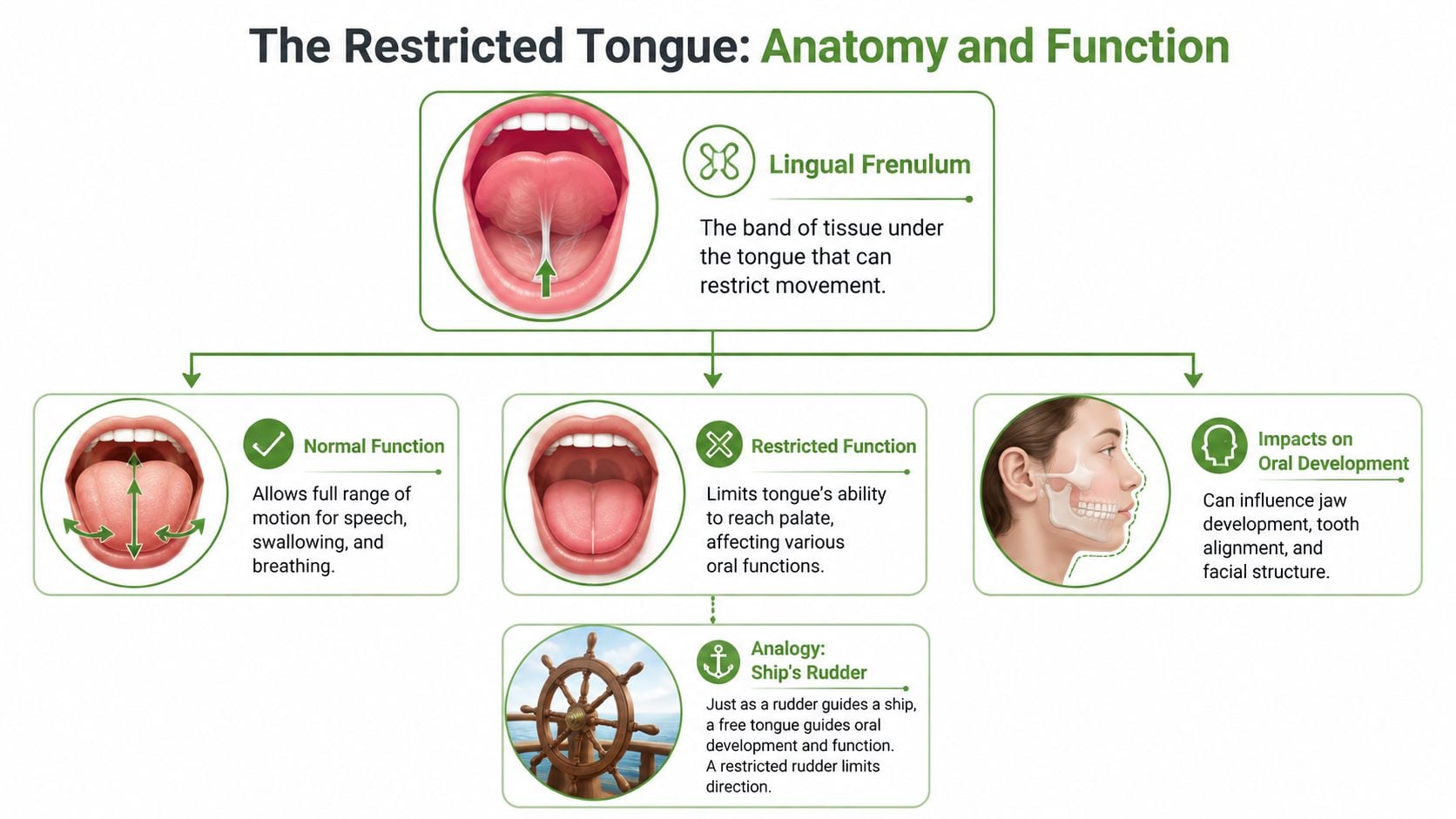
Think of the tongue as a strong sail. The muscle has power, but the lingual frenulum acts like the tether that decides how freely it can lift, spread, and settle against the palate. When that tether is short or tight, the tongue doesn't guide the oral system the way it should.
Anterior and posterior restrictions
An anterior tie sits closer to the tongue tip and is easier to spot. A posterior tie sits farther back and can be subtler, which is one reason adults may have symptoms for years before anyone connects the dots. The hidden restriction can still interfere with elevation, suction, and coordinated tongue posture.
That matters because the tongue does more than move food around. At rest, it helps shape oral balance, supports nasal breathing, and influences how the jaw settles. When it can't rest up and forward where it belongs, the rest of the system often starts compensating.
A useful way to think about function
A ship's rudder doesn't need to be large to affect direction. It only needs to be free. The tongue works the same way in the mouth. A restricted tongue can't steer swallowing, speech, and resting posture cleanly, so other muscles pick up the slack.
For readers who want a broader view of visible signs and oral-health clues, Florida Special Care Dentistry about your tongue is a helpful external reference. It reinforces a point many people miss, the tongue is an oral-function organ, not just a speech tool.
Unseen Connections How a Tongue Tie Impacts Your Body
The strongest connection between adult tongue tie and TMJ pain is mechanical. When the tongue can't rest high on the palate, the jaw often stays more active than it should. That extra activity shows up as clenching, muscle fatigue, and pain around the temporomandibular joint.
Why the jaw and neck pick up the load
A low tongue posture changes the way the mouth closes. Instead of the tongue helping stabilize the system, the jaw muscles and the muscles under the chin do more of the work. Over time, that can contribute to tension patterns that radiate into the face, head, and neck. For a plain-language overview of jaw-joint symptoms, Understanding TMJ jaw pain offers a useful background explanation.
Sleep can be affected for the same reason. A tongue that doesn't rest well on the palate can leave less space behind it, so the airway is less supported during sleep. That doesn't mean every adult tongue tie causes sleep apnea, but it does mean tongue posture belongs in the conversation when snoring or sleep-disordered breathing are part of the story. See also sleep apnea causes and symptoms.
A restricted tongue can't be treated as an isolated mouth problem when the patient's complaint is jaw pain, fragmented sleep, or neck tension. The body pays the price for compensation.
The ripple effect beyond the jaw
Speech can become effortful because the tongue has less freedom for precise placement. Swallowing can become less efficient, which may encourage a tongue-thrust pattern or other compensation. People also describe neck and shoulder tension, which makes sense when the head and upper body keep adjusting to make up for restricted oral mechanics.
Here's the part that matters clinically. These symptoms often coexist, and that clustering is a clue. When a person has TMJ pain, sleep disruption, and chronic oral tension together, the tongue deserves a careful functional look, not a quick glance. The goal is to find the root cause of the compensation, not just calm the area where the pain shows up.
Getting a Clear Diagnosis The Functional Evaluation Process
A clear adult tongue-tie evaluation starts with the symptoms the person experiences. Jaw pain, sleep disruption, speech fatigue, swallowing difficulty, and trouble keeping the tongue in a relaxed resting position all matter. A frenulum can look tight and still be less relevant than the way the restriction changes breathing, posture, and daily function.
What a functional exam looks for
Clinicians look at whether the tongue can rise, protrude, and move side to side without the jaw or neck taking over. They also watch for compensation, such as jaw deviation during opening, difficulty maintaining tongue-to-palate suction, or an overactive floor-of-mouth pattern. The goal is to see how the body is working around the restriction, because those workarounds often explain why pain shows up in the jaw, neck, or sleep.
A functional exam also needs to match what specialty guidance already emphasizes. The Mayo Clinic notes that surgery is considered when tongue tie causes functional problems, meaning measurable dysfunction such as impaired oral hygiene, TMJ symptoms, speech compensation, or swallowing difficulty, not appearance alone Mayo Clinic diagnosis and treatment guidance.
Why function comes before treatment
That order protects patients from procedures that do not address the underlying problem. It also helps separate people who need release plus rehabilitation from those whose symptoms likely come from another source. If the tongue restriction is not creating dysfunction, the jaw pain or sleep complaint deserves a wider search for the root cause.
A thorough evaluation usually includes oral posture, breathing pattern, and myofunctional habits, because the tongue does not work alone. In a specialty setting, that broader picture can show whether the problem is mostly structural, mostly habitual, or a mix of both. A clinic such as Pain and Sleep Therapy Center builds that kind of workup into its care for TMJ, facial pain, and sleep-related breathing issues, with input from different disciplines rather than a single isolated exam.
If treatment is being considered, a detailed adult tongue-tie procedure review helps connect the findings of the exam to the next step in care.
Your Path to Relief Treatment Options and Rehabilitation
Treatment works best when it follows the problem, not a preset script. For adult tongue tie, that often means myofunctional therapy before and after release, with surgery added when the restriction is clearly limiting function. A frenectomy without retraining can leave the same dysfunctional patterns in place, which is why the sequence matters.
Therapy before and after release
Orofacial myofunctional therapy can prepare the tongue, lips, and jaw for better movement patterns before a procedure. After a release, it matters even more because the brain and muscles have to learn a new normal. Higher-quality outcome reviews note that postoperative protocols and rehabilitation are part of good care, and that long-term adult outcomes depend heavily on retraining oral function, not just on the surgical release itself postoperative rehabilitation review.
What the release does
A frenectomy or frenotomy removes or releases the tight tissue so the tongue can move more freely. If you want a closer look at the adult release procedure, the clinic's overview of adult tongue-tie procedure options explains how the release fits into care. In many practices, a soft-tissue laser is used for precision and control. The procedure addresses the restriction, but it does not automatically erase the compensation that built up over years.
Supportive tools and coordinated care
Some clinics add regenerative or healing-supportive therapies, such as PRF or cold laser therapy, as part of a broader plan. Those tools do not replace rehabilitation, but they can fit into a coordinated strategy when tissue healing and comfort are priorities. The work happens when the release, exercise program, and follow-up are tied together.
- Pre-procedure preparation: Build better tongue awareness and reduce tension patterns.
- Release procedure: Free the restricted tissue.
- Post-procedure retraining: Restore nasal posture, swallowing mechanics, and tongue mobility.
- Follow-up: Watch for compensation, soreness, or incomplete functional change.
The result patients want is not just more movement. It is a jaw that feels quieter, sleep that feels deeper, and a tongue that can do its job without recruiting the rest of the body to help.
Recovery and Realistic Outcomes What to Expect After Treatment
The first few days after an adult tongue release can feel odd, because the tongue suddenly has a different range of motion and the tissues are healing at the same time. Some soreness is expected, and the mouth may feel tight before it feels easier. That's normal healing, not a sign that the treatment failed.
What helps recovery
Consistent stretching and follow-through matter because the goal is to keep the tissue from reattaching in a restricted pattern. Patients who stay with their post-op plan usually do better than those who only focus on the procedure itself. The exercises are about preserving motion and teaching the tongue how to live in the new space.
Healing is not just tissue closure. It's functional retraining.
What success looks like
A successful outcome is measured by function, not just by a wider-looking frenulum gap. People often look for easier swallowing, less jaw strain, improved oral posture, better sleep quality, or less need to clench. Speech may also feel less effortful, especially when compensation had been part of the picture for years.
Recovery timelines vary, and adults should expect progress to build over time rather than appear all at once. The most reliable improvements usually come from treating the tongue as part of a system, then reinforcing that change with daily habits and follow-up care. That's the difference between a temporary release and a durable functional change.
Common Questions About Adult Tongue Tie Treatment
An adult who has lived for years with jaw tension, restless sleep, or a sense that speaking and swallowing take extra effort often wants straight answers before starting treatment. The questions below come up often because the procedure is only one part of care. The rest depends on how the tongue, jaw, airway, and daily movement patterns respond together.
Is a laser frenectomy painful? Most adults describe it as manageable discomfort rather than severe pain, but the exact experience depends on the restriction, tissue tension, and healing response. A tight frenulum, guarded jaw muscles, and sensitivity in the surrounding tissues can all shape the first few days after treatment.
How long does the procedure take? It's usually a short outpatient treatment, but the appointment is more than the procedure itself because evaluation, planning, and aftercare matter just as much. In a functional setting, the visit often includes discussion of symptoms, oral habits, and how the tongue may be affecting the jaw or airway.
Am I too old to have this treated? No. Adults can still benefit when the restriction is driving symptoms, and age alone doesn't rule out meaningful functional improvement. The deciding factor is whether the tongue tie is limiting movement and contributing to problems that have not resolved on their own.
Will my speech change immediately? Sometimes speech feels different right away because the tongue can move more freely, but lasting change usually depends on practice and myofunctional retraining. The brain has to learn the new movement pattern, and that learning can also affect swallowing, resting posture, and the habits that developed around the restriction.
If your jaw pain, sleep problems, or chronic facial tension have never fully made sense, stop treating each symptom as if it lives on its own. A careful functional evaluation can show whether tongue restriction is part of the root cause, and a well-coordinated plan can connect diagnosis, treatment, and rehab in a way that addresses the whole pattern.
Pain and Sleep Therapy Center evaluates adult tongue tie in the context of TMJ pain, facial tension, and sleep-related breathing concerns, then builds care around function rather than appearance alone. If you're ready for a clearer answer, visit Pain and Sleep Therapy Center and ask for a thorough evaluation that looks at the tongue, jaw, airway, and the habits tying them together.