

You're dealing with the kind of problem that shows up in ordinary moments, biting into a sandwich on one side, waking with a tight jaw, hearing a click when you yawn, or noticing that your mouth feels more crowded than it used to. People often assume the jaw itself is “out of place,” but in clinic the issue is usually a mix of bite fit, joint loading, muscle strain, and sometimes airway position. That's why jaw alignment without surgery can be very effective in some cases and frustratingly incomplete in others, depending on what's driving the problem.
A jaw can look crooked because the teeth don't meet evenly, the muscles are guarding, the joint disc is irritated, or the upper and lower arches don't match well enough to let the mandible settle comfortably. In mild to moderate cases, orthodontic treatment can address many of those patterns without an operation, and that's not a niche idea, it's a mainstream pathway for selected patients. The key is figuring out whether the problem is primarily dental, skeletal, muscular, or airway-related before anyone reaches for an appliance.
People also tend to arrive after trying quick fixes, night guards bought online, one-off bite adjustments, or exercises they found on social media. Some of those help symptoms, but they rarely answer the root question: what's causing the jaw to load unevenly in the first place? A practical local resource for practices that need to educate patients about these distinctions is affordable social media plans for clinics, especially when the message has to be clear, visual, and medically accurate.
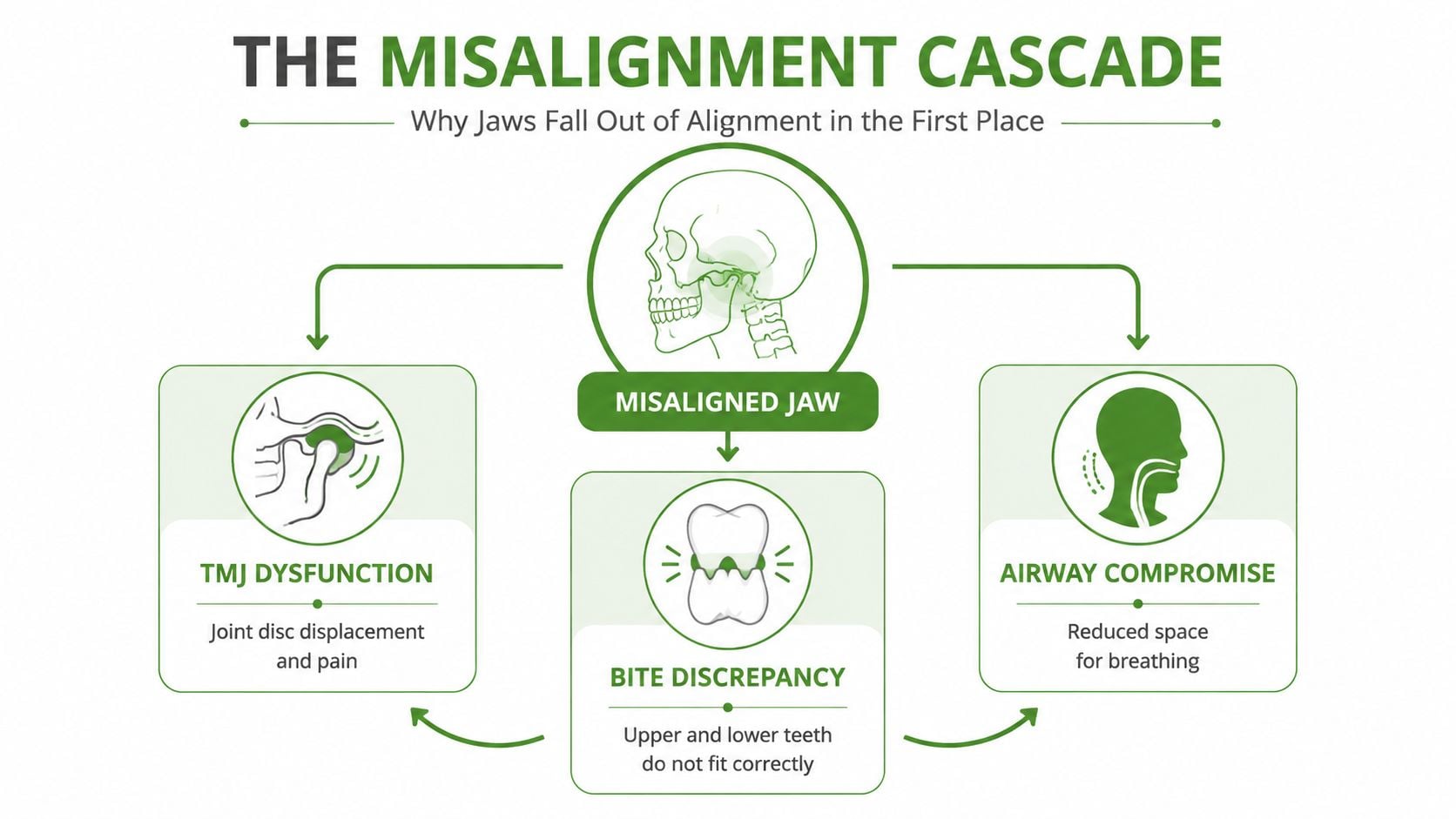
Why Jaws Fall Out of Alignment in the First Place
A patient will usually describe a story that starts small. A jaw clicks on the right side after a stressful year, chewing starts to feel uneven, then headaches show up, and before long the face feels tight by the afternoon. That sequence is common because the temporomandibular joint, the teeth, the chewing muscles, and even breathing patterns all influence each other.
A system, not a single tooth problem
When the bite is off, the muscles often compensate first. The mandible may shift subtly to find a more comfortable closure, and that altered path can irritate the joint and overload one side of the chewing muscles. Over time, that can create pain, limited opening, facial tension, or a sense that the jaw “doesn't sit right.”
Bone and soft tissue matter too. In adults, non-surgical jaw alignment is often a bone-remodeling process, not a simple straightening job, because orthodontic forces move teeth through alveolar bone and the surrounding structures adapt gradually. That's why stability depends on controlled force, follow-up adjustments, and retention after active treatment. The science is gradual, which is exactly why it can work well when the discrepancy is mild to moderate.
Practical rule: if the jaw problem changes with clenching, posture, or daily fatigue, the muscles and joint probably matter as much as the teeth.
Why some cases drift and others don't
Some people have a bite discrepancy that's been present since childhood and becomes more noticeable with wear, bruxism, or growth changes. Others have asymmetry that's largely functional, where the jaw shifts to avoid a painful or unstable contact. Those two patients can sound similar on the phone and need very different plans in person.
The most useful mindset is to treat the jaw like a load-bearing system. If the contacts are uneven, the muscles adapt. If the muscles adapt, the joint load changes. If the joint is irritated, the airway and posture can be affected too. That's why the first question isn't “How do we move the jaw?”, it's “What is forcing the jaw to compensate?”
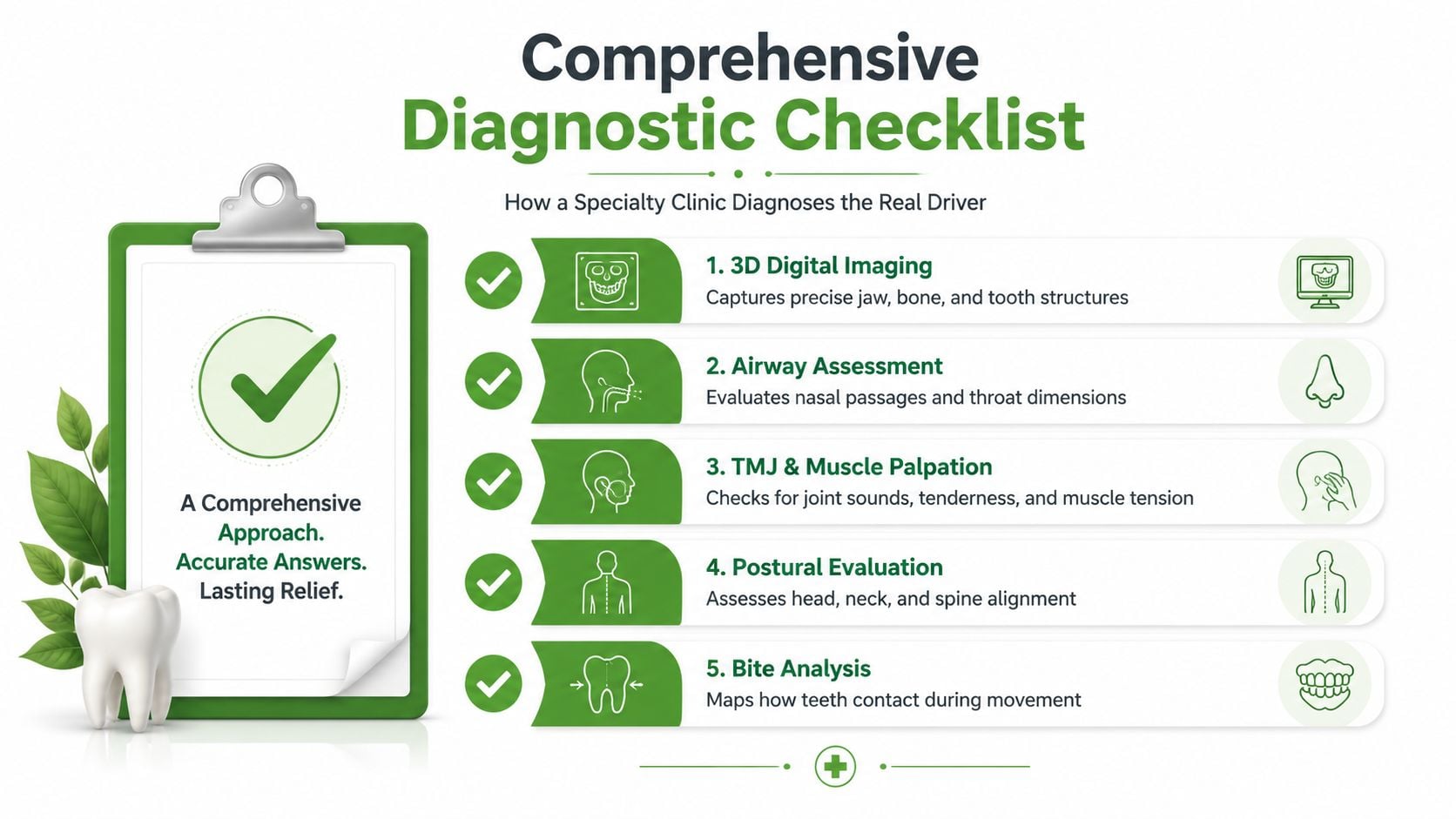
How a Specialty Clinic Diagnoses the Real Driver
A serious evaluation starts with structure, not guesses. Digital scans and 3D imaging help map the teeth, arches, and asymmetry, while the exam looks at joint sounds, opening pattern, tenderness, and how the muscles behave when the bite closes. In a specialty setting, the goal is to separate dental, muscular, joint, skeletal, and airway-driven causes before selecting any appliance.
What gets checked and why it matters
A dental-origin problem usually shows up as a contact issue, one side hits first, the bite slides, or a crossbite keeps the jaw from settling. A muscular pattern often presents as tenderness, fatigue, or pain that changes with stress and clenching. A joint-driven case may include popping, locking, or limited opening, which can shift the treatment priority away from orthodontics alone.
Airway clues matter just as much. If a patient snores, wakes unrefreshed, or breathes through the mouth at night, the plan has to consider tongue posture, palate width, and jaw position together. That's one reason a clinic like Pain and Sleep Therapy Center's orofacial pain specialist can be relevant for patients whose symptoms don't fit a simple braces-only story.
If a provider jumps straight to aligners before looking at the joint and airway, the diagnosis is probably too shallow.
Questions worth bringing to the first visit
- What is the primary driver? Ask whether the issue looks dental, skeletal, muscular, joint-related, or airway-related.
- What imaging will you use? Ask how scans or 3D records will change the plan.
- What's being treated first? Pain, function, breathing, and tooth position don't always move in the same order.
- What happens if the bite improves but symptoms don't? That question reveals whether the clinic has a real fallback plan.
Red flags are easy to spot. Be cautious if the answer is always the same device for every patient, if airway symptoms are ignored, or if nobody explains why a treatment should work in your case. Good diagnosis should make the treatment choice feel narrower, not broader.
Orthodontic and Appliance-Based Options Compared
A patient with jaw alignment problems usually does better when the appliance matches the driver, not when the same tool gets used for every case. In practice, braces, clear aligners, functional appliances, expansion devices, and retention each solve a different part of the problem, and the key question is which layer needs help first. A widely cited orthodontic overview from Brockway Orthodontics overview describes non-surgical jaw-alignment care as a structured path with predictable endpoints, which fits how these cases are handled in specialty practice.
Choosing the tool that fits the problem
Traditional braces are still the most controllable option when bite correction needs fine adjustments. They are more visible, but they give the clinician stronger control over tooth movement, midline correction, and coordination with elastics or other appliances. Clear aligners fit better when the case is mild to moderate and the patient can wear them exactly as directed, because the treatment depends heavily on compliance and on whether the skeletal problem is small enough for aligner mechanics to hold.
Functional appliances belong in a different discussion. They are used to influence jaw posture or growth patterns, usually alongside other orthodontic mechanics, so they are chosen for the kind of case they can change. For adult transverse maxillary deficiency, MARPE or MSE style expansion uses mini-screw anchorage to create more arch width and improve jaw balance without relying only on tooth tipping, which is why it is often considered when a crossbite or narrow palate is part of the picture. Adult asymmetry correction can also use intermaxillary elastics anchored to microimplants, but relapse risk rises if retention and muscle function are not addressed afterward. Orthodontic expansion and correction overview
The overlooked piece is often retention. If the teeth are moved but the bite is not stabilized, the result can drift back toward the old pattern because bone and soft tissue adapt only within certain limits. That is why a non-surgical plan should be judged as a whole sequence, not as a single appliance choice.
| Option | Best For | Typical Timeline | Key Trade-Off |
|---|---|---|---|
| Traditional braces | More complex bite control and predictable force delivery | Often within the broader non-surgical treatment window | More visible, but often more controllable |
| Clear aligners | Mild to moderate cases where discretion matters | Often within the broader non-surgical treatment window | Less visible, but depends heavily on wear time |
| Functional appliances | Jaw guidance and selected bite correction cases | Variable, based on response and staging | Useful for mechanics, not a universal fix |
| MARPE or MSE | Adult narrow palate or transverse deficiency | Case dependent | More technical, but can address skeletal width better than tooth-only expansion |
| Retainers | Stability after correction | Ongoing after active treatment | Does not correct the problem by itself |
A good clinic also tells you when appearance is not the deciding factor. A splint, for example, may be chosen to calm the joint and reduce strain, while a standard guard mainly protects teeth from grinding, so the two serve different goals. Patients comparing appliance types often benefit from a direct look at TMJ splint vs night guard, because the wrong choice can protect teeth without changing the underlying loading pattern. In cases where breathing mechanics also matter, a plan may include work that helps boost breathing and performance, since airway support can affect how stable the bite feels during sleep and wakefulness.
TMJ Therapy, Myofunctional Work, and Airway Support
Orthodontics can move teeth and influence bite position, but muscle behavior still decides whether the result feels stable. That's why many specialty plans layer TMJ-focused care on top of appliance therapy, including custom oral appliances, cold laser therapy, regenerative injections, orofacial myofunctional therapy, and breathing retraining. When these are used well, they target different parts of the same load-bearing system.
Matching therapy to the layer that's driving symptoms
A custom orthotic or splint can help stabilize the joint and reduce strain while the bite is being evaluated. That's different from a night guard, which mainly protects teeth from grinding. For a deeper comparison, patients often benefit from reading about what is orofacial myofunctional therapy, because tongue posture and swallow pattern can determine whether the correction holds.
Myofunctional work matters because the tongue, lips, and cheeks influence resting posture all day and night. If those muscles keep pulling the system back toward the old pattern, the bite change can feel temporary even when the teeth are moving correctly. Breathing retraining can support nasal breathing and reduce the habit of mouth posture, which is one reason some clinics pair dental care with structured exercises.
A bite that looks better on paper can still feel unstable if the muscles keep searching for the old position.
What patients usually experience week to week
Early on, the plan often feels behavioral rather than dramatic. Patients wear an appliance, practice exercises, and return for adjustments or progress checks. The changes are usually subtle at first, then become clearer as tension drops and chewing feels more even.
For patients who want to support breathing mechanics more directly, resources such as boost breathing and performance can help explain how breathing muscles are trained in a structured way. That's not a substitute for dental diagnosis, but it's useful context when airway support is part of the treatment goal.
A practical point: single-visit bite adjustments rarely last if the joint and muscle pattern aren't addressed. Appliance therapy works best when it's paired with habit correction, follow-up, and a plan for stability.
How Jaw Alignment Connects to Sleep and Breathing
A lot of people still think jaw alignment is mainly about appearance. In real practice, it often sits inside a broader airway and sleep conversation, because jaw position, tongue posture, and palate width can change how easily someone breathes at night. That's why a treatment plan that ignores snoring, sleep quality, or daytime fatigue can miss part of the problem.
If you want a closer look at the mechanics of sleep-breathing treatment pathways, the digital workflow for sleep apnea care shows how clinics can organize evaluation and appliance planning around airway needs. That matters because orthodontic movement alone doesn't automatically mean better breathing. The question is whether the plan changes the airway enough to matter.
What non-surgical care can influence
Jaw position can affect tongue space, and tongue posture can affect whether the airway stays open during sleep. A narrower palate can also reduce room for nasal breathing, which is one reason adult expansion approaches draw attention in airway-focused care. These are not cosmetic details, they're functional variables.
The important distinction is between moving teeth and improving airway mechanics. A clear aligner may improve alignment without changing breathing much. A palate expansion approach may influence airway space more directly in selected cases. Those are different promises, and patients deserve to hear the difference clearly.
If sleep, snoring, or fatigue are part of the story, ask whether the plan addresses breathing or only tooth position.
What to ask before starting treatment
Ask whether the clinic measures airway risk, tongue posture, or nasal breathing patterns. Ask whether the appliance is meant to stabilize the bite, improve the airway, or both. If the answer is vague, the plan may be too narrow for your symptoms.
The best airway-aware plans are specific. They don't promise that every patient will sleep better just because their teeth move. They explain which changes are likely, which are not, and how follow-up will confirm whether the breathing story is improving.
When Non-Surgical Care Is Not Enough
There is a clear limit to what appliances and orthodontics can correct, and patients do better when that is explained early. If the jaws have a moderate to severe skeletal discrepancy, if the joints keep breaking down despite conservative care, or if airway restriction is large enough that tooth movement will not solve the functional problem, orthodontics alone can fall short. In those cases, orthognathic surgery remains the standard because the bone relationship itself has to change, not just the tooth positions.
A non-surgical plan can improve bite contact, reduce strain, and sometimes make breathing easier in selected cases. It cannot reliably fix a jaw relationship that is built on a major skeletal mismatch. That is the trade-off patients need to hear before they invest time in treatment that was never likely to solve the full problem.
Signs the case may need surgery
A major skeletal mismatch usually shows up as a persistent facial imbalance, a bite that cannot be coordinated without forcing the jaw into an unnatural posture, or a pattern that keeps relapsing after conservative treatment. If chewing, speaking, or sleeping remain impaired because the jaws do not relate well enough, it is time to talk about surgical options seriously.
The clinical question is simple. Is the problem mainly tooth position, or is the jaw base itself the barrier? When the bone relationship is the limiting factor, appliances can mask the issue for a while, but they do not change the foundation. That is why some patients can get meaningful relief from non-surgical care, while others reach a point where continued conservative treatment only delays the ultimate solution.
The source article from Cleveland Clinic orthognathic surgery information supports the same practical rule, most alignment problems are managed first with orthodontic or appliance-based care, while surgery is used for major skeletal discrepancies that affect function. That distinction matters because the right plan depends on the structure behind the symptoms, not on the desire to avoid surgery at any cost.
The language patients should use
If a clinician recommends surgery, ask what problem surgery solves that orthodontics cannot. Ask whether the issue is dental, skeletal, or airway-related, and whether the recommendation is about function, stability, or both. A good provider will not rush you, but they also will not pretend every jaw can be fully corrected without an operation.
Non-surgical care still has value when the goal is symptom relief or partial correction in selected cases. The mistake is treating it like a universal answer. It is not.
What to Expect From a Specialty Clinic Visit
A real first visit feels more like a case conference than a quick check. The clinician reviews symptoms, examines the bite and joints, and decides whether the main issue is pain, alignment, breathing, or a combination. At Pain and Sleep Therapy Center, the model is built around root-cause evaluation, which can include personalized TMJ care, sleep-related breathing support, and exercise-based guidance rather than temporary symptom masking.
The appointment usually starts with records. That can include scans, photos, and a history that covers jaw pain, headaches, snoring, clenching, sleep quality, and prior dental work. From there, the team decides whether you need appliance therapy, myofunctional work, breathing retraining, regenerative care, or a referral to another provider before anything starts.
How the plan is sequenced
The sequence matters because you don't want to remodel a bite before the joint and airway questions are clear. A thoughtful clinic will explain which part of the problem is stable enough to treat now and which part needs monitoring first. That kind of sequencing is what separates root-cause care from symptom-only management.
Patients should also ask about follow-up cadence, payment plans, and referral coordination. Pain and Sleep Therapy Center notes support for convenient payment planning and a referring-doctor network, which can matter when orthodontic, sleep, and TMJ issues overlap. That support is useful because these cases are rarely solved in one chair, by one tool, or in one day.
What to bring and how to judge the visit
Bring a list of symptoms, previous imaging if you have it, and any sleep-related concerns, especially snoring, unrefreshing sleep, or mouth breathing. If you've already worn a guard or aligner, note whether it helped, did nothing, or made symptoms worse. Those details help the clinician avoid repeating failed strategies.
A strong practice should leave you with a clear next step, not just a diagnosis label. If you're trying to understand whether your problem is being handled as a bite issue, a TMJ issue, or an airway issue, use that first appointment to ask direct questions and compare the answers against your symptoms. For a practical starting point, visit Pain and Sleep Therapy Center and request an evaluation that looks at bite, joint, muscle, and breathing together.