You wake up with a tight jaw. By lunch, your temples ache. During dinner, your jaw clicks on one side and you start chewing more carefully without even realizing it. If that sounds familiar, you're not overreacting. Jaw pain can be surprisingly disruptive, and many people spend months trying soft foods, ibuprofen, or a nightguard without ever getting a clear answer about why it's happening.
That confusion makes sense because the temporomandibular joint is small, but the system around it is not. Your jaw is influenced by muscles, teeth, posture, breathing, sleep, stress, prior injury, and the way the joint itself moves. TMJ disorder causes are rarely simple. In most patients, there isn't one culprit. There's a pattern.
A lot of advice online reduces TMJ problems to “stress” or a “bad bite.” Those explanations are often incomplete. Some people do clench more when they're stressed. Some do have bite relationships that aggravate symptoms. But if you stop there, you can miss the deeper drivers that keep the cycle going, especially airway strain, mouth breathing, poor oral posture, and sleep-related clenching.
Why Does My Jaw Hurt So Much
You wake up with jaw tightness, then notice a temple headache by midmorning and a click when you yawn that night. Those symptoms can seem unrelated at first, which is one reason TMJ disorders are so often misunderstood. In practice, I see patients connect the pattern only after the pain starts affecting meals, sleep, or concentration.
Jaw pain rarely comes from one structure in isolation. The joint, chewing muscles, teeth, neck, tongue, and airway all influence one another. That is why pain near the jaw can feel like an ear problem, a dental problem, a sinus problem, or a tension headache. The location is clear. The driver often is not.
What patients usually notice first
- Clicking or popping: A sound with chewing, yawning, or opening wide.
- Morning symptoms: Jaw tightness, tooth tenderness, or temple pressure after sleep.
- Muscle fatigue: A tired, heavy feeling in the cheeks or around the jaw hinges.
- Head and neck spillover: Pain that seems to radiate into the temples, ears, or upper neck.
Temporomandibular disorders are common enough that they should not be dismissed as a rare or unusual problem. The National Institute of Dental and Craniofacial Research notes that TMJ disorders affect millions of adults in the United States, with women affected more often than men, especially during the childbearing years, as described by the National Institute of Dental and Craniofacial Research overview of TMJ disorders.
Jaw pain may be the symptom you feel most clearly, but it often reflects a broader strain pattern.
That distinction matters. A sore joint may be reacting to repeated nighttime clenching. Overworked jaw muscles may be compensating for forward head posture or a tongue posture problem. In some patients, the clenching itself is tied to fragmented sleep, mouth breathing, or an airway that the body is trying to protect during the night. If treatment focuses only on where it hurts, the cycle often returns.
Good TMJ evaluation looks for the main load on the system. Sometimes that load is muscular. Sometimes it is joint inflammation, disc displacement, arthritis, or prior injury. Sometimes the biggest contributors are less obvious, such as poor sleep quality, chronic nasal obstruction, or postural habits that keep the jaw and neck braced all day. For a broader foundation on how bones, joints, muscles, and connective tissues work together, see this complete guide to human anatomy.
Understanding Your Jaw Anatomy
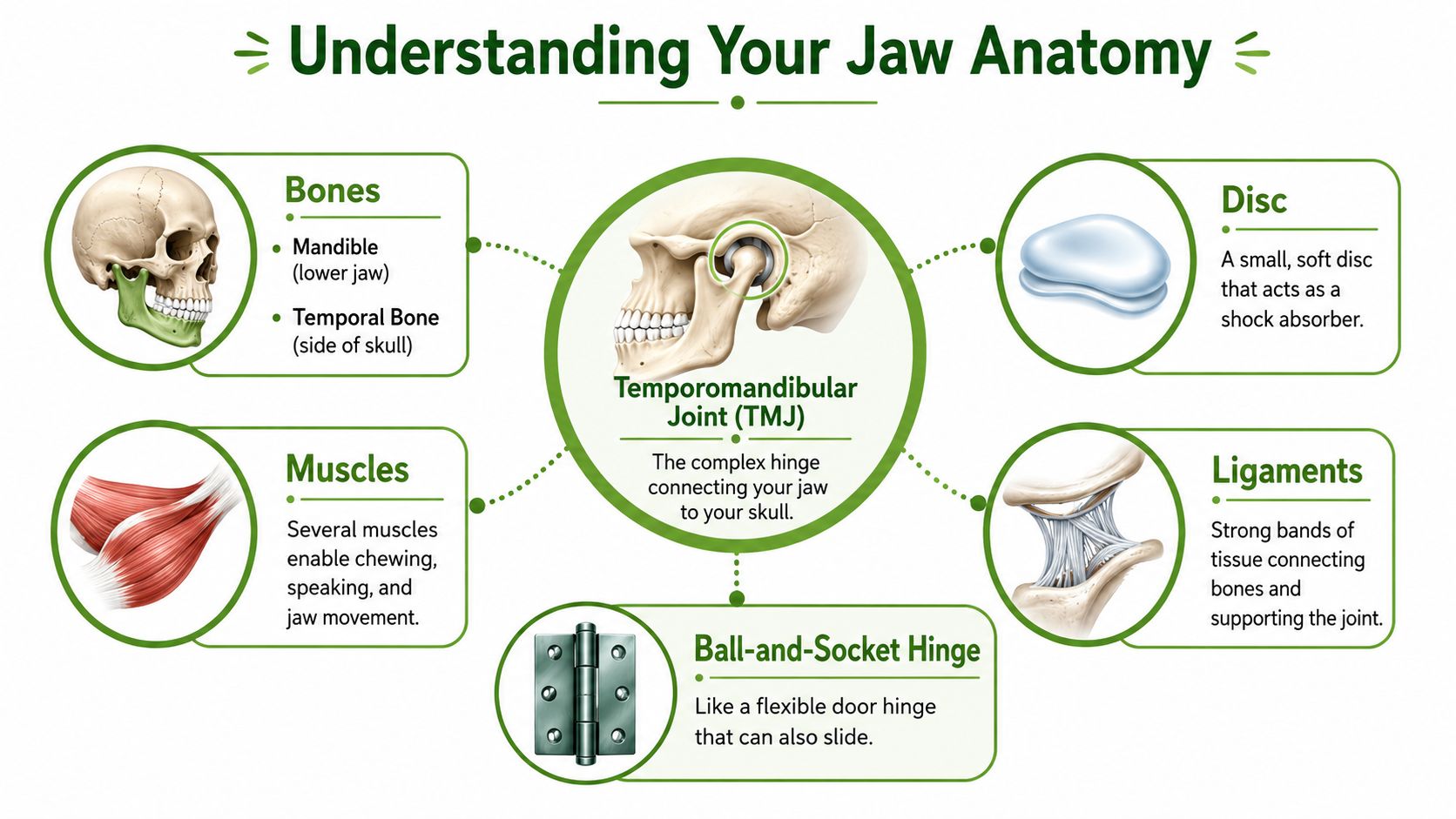
The temporomandibular joint is one of the hardest working joints in the body. You use it to chew, speak, swallow, yawn, and make the small jaw adjustments that happen all day long. It has to be stable, but it also has to glide smoothly.
A simple way to picture it is as a ball-and-socket hinge with a cushion in the middle. The lower jaw bone is the mandible. Its rounded top portion moves against part of the skull called the temporal bone. Between them sits a small articular disc, which acts like a shock absorber and helps the joint move with less friction.
The parts that matter most
| Structure | What it does | Why it matters |
|---|---|---|
| Mandible | Moves up, down, forward, and side to side | Carries chewing force |
| Temporal bone | Forms the upper part of the joint | Provides the socket side |
| Articular disc | Cushions and guides movement | Can slip or wear down |
| Muscles | Open, close, and stabilize the jaw | Often become overworked |
| Ligaments | Help support joint position | Can be strained by overuse or trauma |
If you want a broader foundation for how joints, muscles, and connective tissues work together, this complete guide to human anatomy is a useful plain-language refresher.
Why anatomy changes the diagnosis
People often assume any jaw pain means the joint itself is damaged. Sometimes that's true. Often it isn't. Many painful TMJ cases are driven more by muscles than by cartilage or bone. That matters because muscle pain and joint pain don't behave the same way.
Muscle-driven pain usually feels sore, tight, or fatigued. It may spread into the temples, cheeks, or neck. Joint-driven pain is more likely to feel sharp at the hinge point, produce catching or locking, or worsen at specific points of opening and closing.
Clinical shortcut: If a patient can point to one exact spot in front of the ear and says, “It hurts right there when I open,” I think carefully about the joint. If the whole side of the face feels tired and achy, muscle overload moves higher on the list.
That distinction isn't perfect, but it helps explain why one person improves with habit control and muscle work while another needs a deeper look at disc position, inflammation, or joint loading.
The Primary Drivers Muscular and Behavioral Causes
A common TMJ visit starts like this. The joint feels sore, but the patient wakes with tight cheeks, a tired jaw, temple pressure, and neck tension by the end of the day. In that pattern, the main problem is often not damaged joint surfaces. It is muscle overload.
The most frequent pain pattern I see is myogenous TMD, meaning the symptoms arise primarily from the chewing muscles and the way they are being used. Medscape's overview of temporomandibular disorders describes myogenous TMD as the most common subtype and links it to muscular hyperactivity and parafunctional habits such as clenching and bruxism.
Parafunctional means jaw activity that has no healthy job to do. Chewing food and speaking are normal functions. Clenching during computer work, pressing the tongue hard into the palate, biting nails, holding tension in the jaw during exercise, or grinding in sleep all add load without giving the muscles time to recover.

How small habits create big pain
Muscular TMJ pain usually builds through repetition. A single hard chew or one stressful day rarely explains months of symptoms. The jaw is more often reacting to frequent low-grade strain.
Common drivers include:
- Daytime clenching: Often shows up during focused work, driving, workouts, or emotional stress.
- Sleep grinding or bracing: Can leave the jaw sore and fatigued on waking.
- Chewing overload: Gum, ice, jerky, crusty bread, and other tough foods keep the muscles activated for long stretches.
- Oral habits: Nail biting, lip biting, chewing pens, and resting the chin on the hand can shift force into the jaw and neck.
Clinical reviews consistently report that oral behaviors are common in people with TMD, including clenching, grinding, gum chewing, and other repetitive habits, as summarized in this review of oral behaviors and temporomandibular disorders. The exact mix differs from person to person, which is why treatment works best when we identify the specific habits keeping your muscles switched on.
What muscular TMJ pain feels like
This type of pain has a pattern.
- A tired or heavy jaw later in the day
- Morning tightness or soreness
- Tender cheeks, temples, or the sides of the face
- Headaches that seem tied to jaw tension
- Neck and upper shoulder tension that flares with jaw symptoms
Patients often tell me, “My jaw never seems to relax.” That is a useful clue.
A nightguard may reduce tooth wear, but it does not always solve the reason the muscles are overworking. If clenching happens in sleep, the next question is why the nervous system is bracing in the first place. In some patients, the answer includes fragmented sleep, airway resistance, or sleep-disordered breathing. This practical guide to strategies for teeth grinding in sleep is a helpful overview for patients trying to understand that connection.
For symptom relief, I usually start with reducing muscle load, improving jaw rest posture, and spotting the daily situations that trigger bracing. Gentle self-care tends to help more than forceful stretching when the muscles are already irritated. Patients who want practical home support can review these ways to loosen tight jaw muscles.
A short visual explanation can make this easier to recognize in yourself:
The jaw should rest, not work, when you're not eating or speaking.
Treating every muscular case as a bite problem misses the larger pattern. If muscle overload is being fueled by stress physiology, forward-head posture, mouth breathing, poor tongue posture, or broken sleep, tooth-focused treatment alone rarely gives lasting relief. The root cause has to be addressed if the jaw is going to calm down.
When the Joint Itself Is the Problem
Some TMJ cases are less about overworked muscles and more about what's happening inside the joint. These are often called intra-articular disorders. The most common is articular disc displacement, which occurs when the disc erodes or moves out of its normal relationship between the jaw condyle and the temporal bone, as described in this review of temporomandibular joint disorders.
When that disc doesn't move properly, the joint can click, pop, catch, or lock. Patients often describe a moment during opening where the jaw shifts or jumps. Others say the mouth doesn't open evenly or that one side feels blocked.
Signs the joint may be the main source
Joint-centered problems often have a different flavor than muscle pain.
| More suggestive of muscle overload | More suggestive of joint involvement |
|---|---|
| Diffuse facial ache | Pinpoint pain near the joint |
| Fatigue with chewing | Catching, locking, or sudden deviation |
| Tightness on waking | Clicking tied to a specific opening point |
| Tender cheeks or temples | Pain deep in front of the ear |
This isn't a perfect rule, but it's clinically useful.
Common joint-based causes
- Disc displacement: The cushion is not tracking correctly.
- Inflammation: The lining or supporting tissues become irritated.
- Arthritic change: Wear, degeneration, or inflammation affects joint surfaces.
- Trauma: A direct blow, forceful opening, or repetitive overuse strains the joint.
The same review notes that trauma, including macrotrauma and microtrauma, can directly damage joint cartilage, ligaments, or the articular disc, leading to arthritis or capsular inflammation. That helps explain why some people develop symptoms after a fall, a sports injury, a difficult dental appointment, or a long period of overloaded chewing.
A click by itself isn't always dangerous. A click with pain, locking, or reduced opening deserves closer attention.
One practical mistake I see is assuming every click needs an aggressive fix. Many painless clicks can be observed while reducing strain on the system. But if clicking is paired with pain, limited opening, or episodes where the jaw gets stuck, the joint deserves a more careful assessment.
Patients trying to sort out whether their noises are harmless or more meaningful often find it useful to read about TMJ clicking and popping, especially when deciding when to seek a formal evaluation.
What usually works best for joint-centered problems is a conservative plan first. Reduce overload. Calm inflammation. Improve movement patterns. Identify whether a disc issue is stable or progressing. What doesn't tend to help is chasing random exercises online without knowing whether the disc, capsule, muscles, or bite forces are being irritated.
The Deeper Connection Airway Posture and Sleep
At this point, many patients finally make sense of the whole picture. They've already heard about stress and clenching. What they haven't heard is that clenching may be a response, not the original problem.
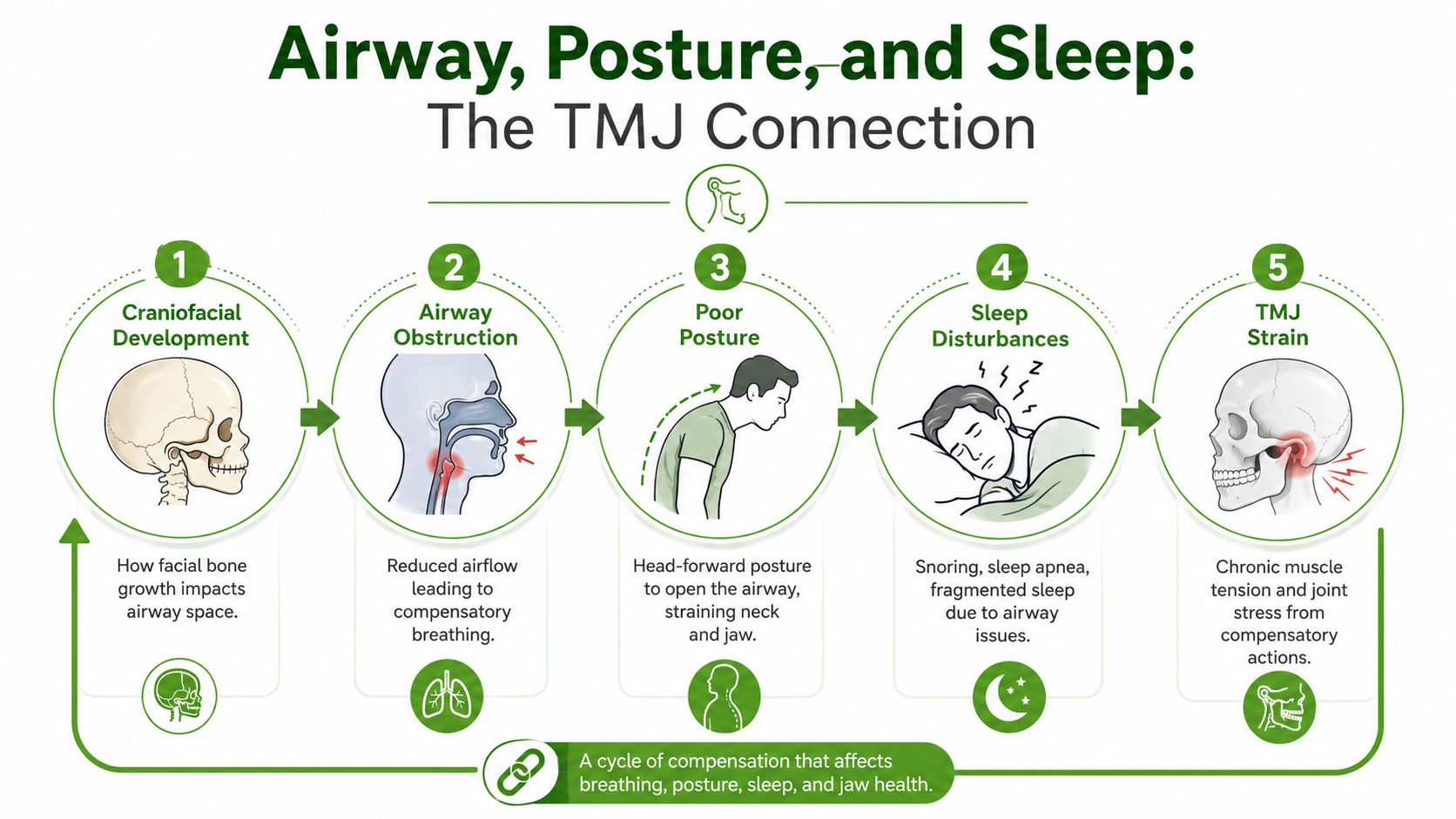
A frequently overlooked mechanism is the relationship between airway function, oral posture, craniofacial development, and sleep-disordered breathing. According to this discussion of TMJ dysfunction and airway mechanisms, underdeveloped maxilla bones, improper tongue posture, and mouth breathing habits can jam the mandible into the joint socket, creating a critical and often-missed link between TMJ dysfunction and airway collapse.
How the chain reaction happens
This pattern often unfolds in sequence:
Airway space is limited
The tongue doesn't rest well against the palate, or the jaws sit in a position that doesn't support easy nasal breathing.Mouth breathing becomes common
During the day, at night, or both, the body shifts into a less stable breathing pattern.Head posture changes
Many people move into a forward head posture to open the airway more easily. That loads the neck and changes jaw mechanics.Sleep becomes more fragmented
The body may respond to breathing instability with bracing, clenching, or grinding.The jaw pays the price
Muscles stay overactive. The condyle may be pushed posteriorly. The joint and surrounding tissues become irritated.
Why a nightguard isn't always enough
A guard can be useful in the right patient. It may reduce tooth wear or change joint loading. But if the body is clenching to help stabilize the airway during sleep, a guard addresses the effect more than the cause.
That's why some patients say, “I've worn the appliance faithfully, but I still wake up tight.” They're not failing treatment. The treatment may be too narrow.
The broader clues often sit outside the jaw:
- Snoring or restless sleep
- Morning dry mouth
- Chronic nasal congestion
- Forward head posture
- Fatigue despite enough hours in bed
For many people, sleep position also adds load. Side sleeping can be helpful for some and irritating for others, especially if the neck is twisted or the jaw is compressed into the pillow. If you're working on this piece of the puzzle, this guide to achieving optimal sleeping posture offers practical ideas that pair well with airway-conscious TMJ care.
What to look at beyond the jaw
The most useful root-cause evaluation often includes more than palpating the joint.
- Breathing pattern: Nasal versus mouth breathing
- Tongue posture: Whether the tongue rests low or forward
- Cervical posture: Head position relative to the neck and shoulders
- Sleep quality: Signs of snoring, fragmented sleep, or apnea risk
- Jaw rest position: Whether the teeth contact when they shouldn't
Patients trying to understand this distinction often benefit from learning the basics of nasal breathing vs mouth breathing, because that habit affects far more than the nose and throat.
If the jaw keeps tightening overnight, ask what your breathing is doing while you sleep.
This airway-posture-sleep model doesn't replace standard TMJ diagnosis. It completes it. In the right patient, it explains why stress management alone wasn't enough and why lasting improvement often requires restoring better breathing mechanics, oral posture, and sleep stability.
Debunking Common TMJ Disorder Myths
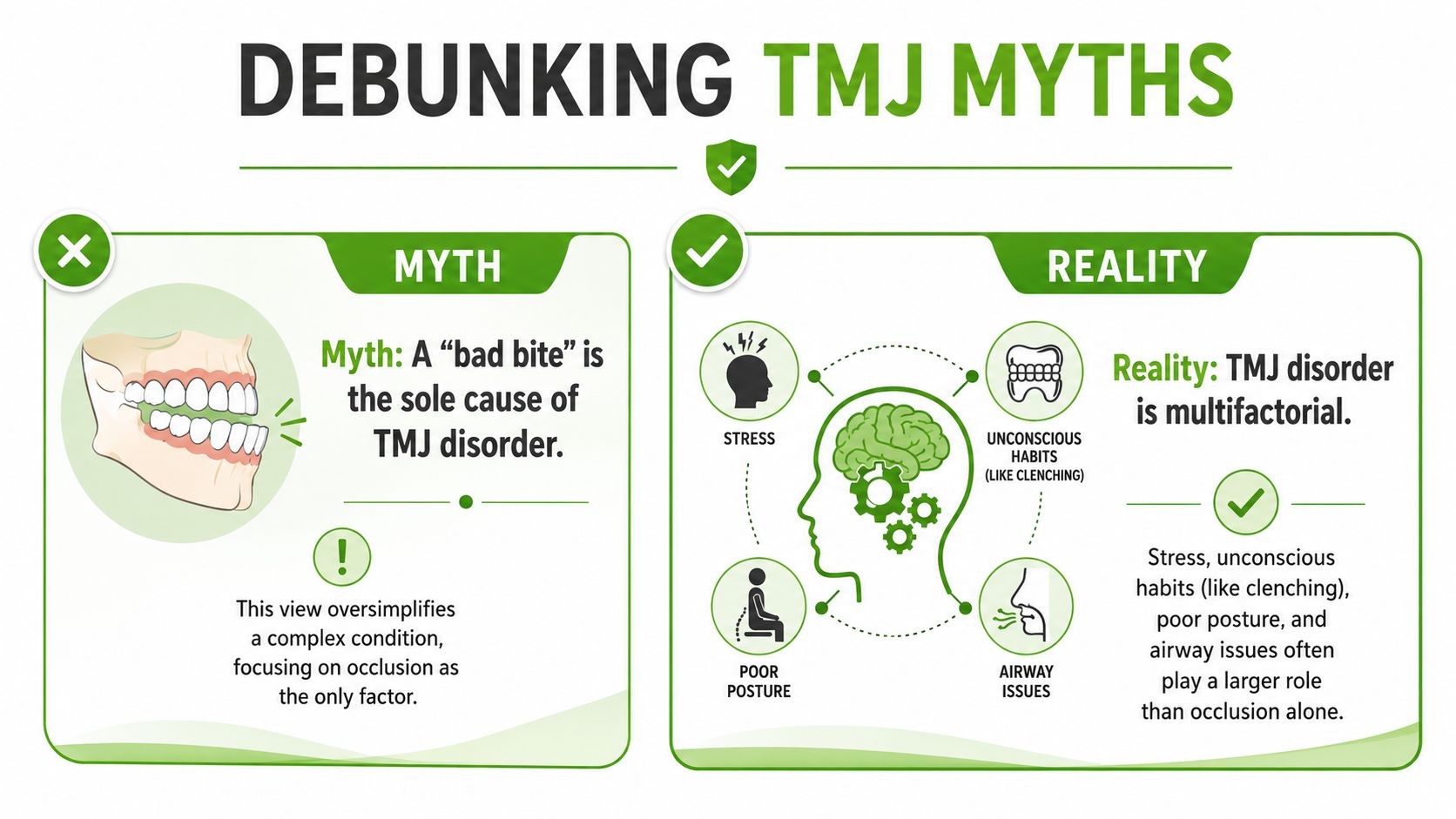
One of the most persistent myths in dentistry is that TMJ pain is mainly caused by a bad bite. That idea has been repeated for years, and it still drives many patients toward irreversible dental work they may not need.
The evidence doesn't support that simple story. The National Institute of Dental and Craniofacial Research states that evidence does not support the belief that a “bad bite” or orthodontic braces cause TMDs, as explained in its overview of temporomandibular disorders.
Myth versus reality
| Myth | Reality |
|---|---|
| A bad bite is the main cause of TMJ disorder | TMJ disorders are usually multifactorial |
| Orthodontics commonly causes TMD | Evidence does not support that belief |
| Bite adjustment is the direct fix | Permanent occlusal changes often don't address root drivers |
| Teeth are the whole story | Muscles, sleep, stress, trauma, posture, and airway matter |
This doesn't mean bite relationships are irrelevant. They can influence comfort, loading, and muscle behavior in some patients. But there's a difference between an aggravating factor and a root cause. That distinction protects patients from overtreatment.
What tends to help and what tends not to
Usually more helpful
- Conservative care first: Reduce load, calm irritation, improve movement
- Habit awareness: Catch daytime clenching and nonfunctional tooth contact
- Muscle and airway assessment: Especially when symptoms are worse on waking
- Sleep screening: Important when bruxism, fatigue, or snoring are present
Often less helpful as a first move
- Permanent bite adjustment without clear indication
- Assuming every click requires invasive treatment
- Treating the jaw without asking about sleep
- Focusing only on teeth when the neck, tongue, and breathing are involved
Another misconception is that if stress plays a role, the pain isn't physical. That's false. Stress can raise muscle tension, worsen sleep, and increase pain sensitivity. It doesn't make the condition imaginary. It changes how the nervous system and muscles behave, which is part of why TMJ disorders are better understood today as multifactorial rather than purely mechanical.
The best TMJ diagnosis usually comes from asking a wider question. What is overloading this system, and why is the body not recovering?
That's the mindset that leads to better decisions. Not every patient needs the same answer. Some need muscle-focused care. Some need a closer look at the joint. Some need sleep-disordered breathing addressed. Some need all three considered together. Good treatment starts when the explanation finally fits the pattern.
If your jaw pain, headaches, facial tension, or sleep-related clenching keep coming back, a root-cause evaluation can make the next step much clearer. Pain and Sleep Therapy Center focuses on TMJ disorders, facial pain, airway health, and sleep-related breathing issues with an approach that looks beyond the bite alone. If you're ready for a more complete explanation of what's driving your symptoms, their team can help you sort out the muscular, joint, breathing, and sleep factors that may be connected.