If your jaw clicks when you chew, your bite feels “off,” or you wake up with tension in your temples and neck, it's easy to assume the problem is just your teeth. Many people live with that discomfort for years. They adapt by chewing on one side, avoiding certain foods, or accepting headaches and poor sleep as separate issues.
Often, they aren't separate issues.
Jaw alignment affects how your teeth meet, how your muscles work, how your tongue rests, and how you breathe. That's why a narrow focus on the bite alone can miss the underlying cause. In practice, the most durable improvements usually come from treating the whole system, not just trying to force the teeth into a prettier line.
Surgery has an important place. But it isn't the first answer for every adult with jaw pain, asymmetry, clenching, or airway concerns. For many mild to moderate cases, aligning jaw without surgery is realistic with the right diagnosis and the right combination of therapies. That can include orthodontics, splint therapy, breathing retraining, myofunctional work, posture correction, and in some cases regenerative support for irritated joints and ligaments.
The key is knowing why your jaw is off before deciding how to treat it.
Your Path to Jaw Alignment Starts Here
You wake up feeling as if you clenched all night. Breakfast is harder to chew on one side. By afternoon, your temples feel tight, your neck is working too hard, and your bite still does not feel settled. That pattern is common, and it rarely starts with teeth alone.
Jaw alignment is a functional problem before it becomes a cosmetic one. The joints, chewing muscles, tongue, airway, cervical spine, and ribcage all affect how the jaw rests and moves. If nasal breathing is poor, the tongue often drops from the palate. If posture shifts forward, the jaw and throat muscles have to compensate. If the joint is irritated, the bite can feel different from morning to evening.
That is why early treatment decisions matter. A plan that only lines up teeth can miss the reason the jaw became unstable in the first place.
Why root cause matters
In practice, the best results come from identifying what is driving the misalignment. Sometimes the main issue is dental. Sometimes it is skeletal. Sometimes the bigger problem is airway strain, a tongue posture disorder, muscle overactivity, ligament laxity, or a joint that no longer tracks smoothly. The treatment should match that pattern.
A useful workup asks:
- What is changing the bite: Tooth position, jaw position, joint inflammation, or muscle guarding can each create a different kind of imbalance.
- How is the patient breathing: Mouth breathing, snoring, dry mouth, and nonrestorative sleep often point to airway stress that keeps the jaw and tongue in a poor resting position.
- What is the tongue doing at rest and during swallowing: Low tongue posture can narrow the upper arch over time and reduce stability after orthodontic treatment.
- How is the head and neck carried: Forward head posture and rib flare can alter jaw loading, swallowing mechanics, and muscle tension patterns.
Practical rule: Durable non-surgical care starts with a clear diagnosis, then builds treatment around function, not just appearance.
Progress is possible without surgery
Many mild to moderate cases improve without an operation, but the process is gradual and case selection matters. Children and teens may benefit from growth guidance. Adults often do well with a mix of orthodontics, splint therapy, myofunctional therapy, breathing retraining, posture-focused rehab, and, in selected cases, regenerative treatment for irritated joints or supporting tissues. If tooth position is part of the problem, Invisalign for overbite correction may help, but clear aligners alone do not correct every airway, muscle, or joint issue.
Treatment commonly takes 12 to 24 months for orthodontic and dentofacial change, as the American Association of Orthodontists explains in its overview of how long orthodontic treatment can take. That timeline reflects biology. Bone remodels slowly. Muscles need time to stop compensating. Breathing and tongue habits require repetition before they become automatic.
Patients usually find that reassuring once they understand the goal. The aim is not to force the jaw into position quickly. The aim is to build a bite and a breathing pattern your body can keep.
Understanding the Root Cause of Your Jaw Misalignment
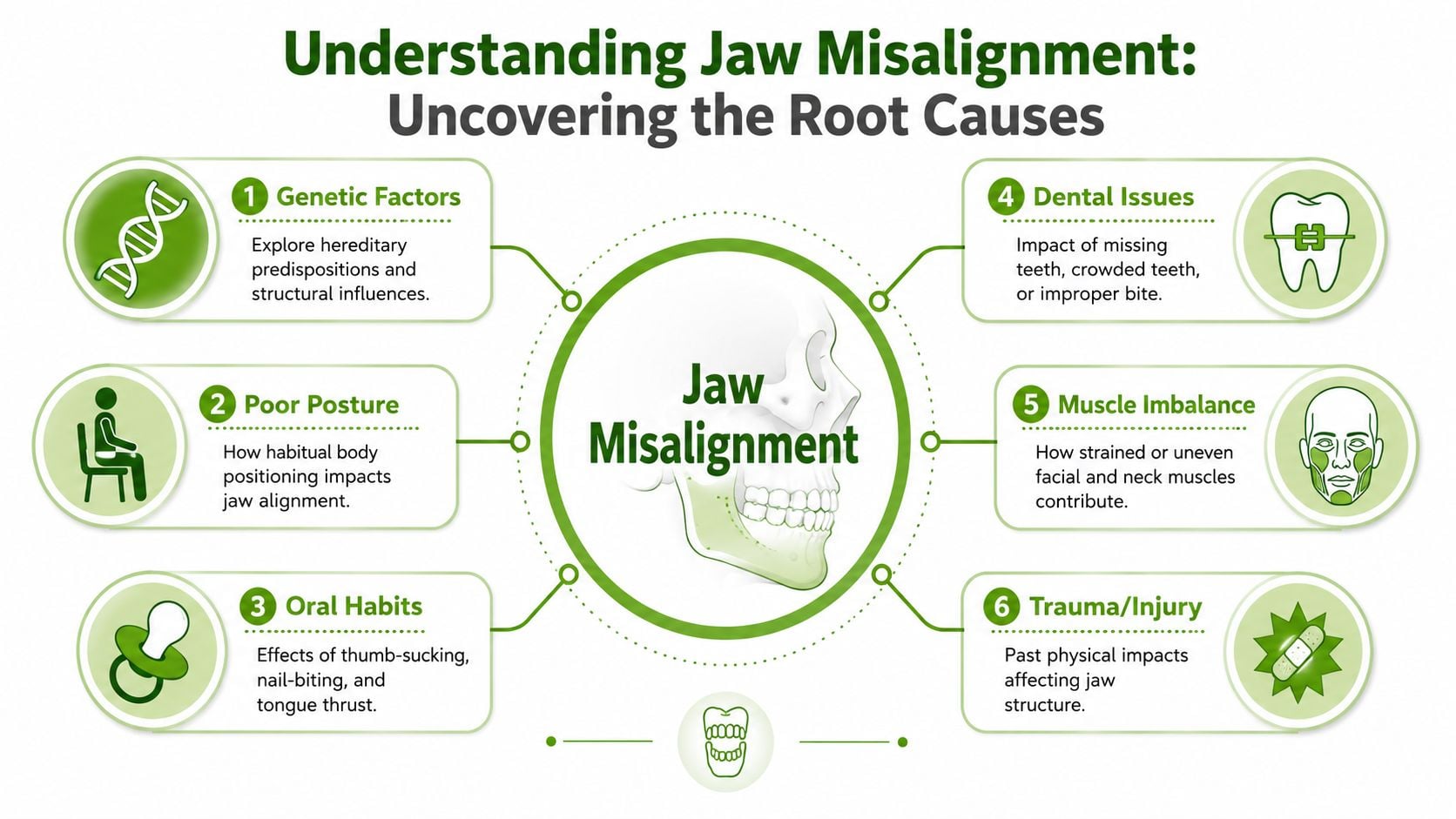
A patient may come in saying, “My bite feels off,” but the story often starts earlier. They have been mouth breathing for years, waking with a dry mouth, carrying neck tension, or chewing on one side because it feels easier. Jaw alignment problems rarely begin as a cosmetic issue alone. In practice, they are often the visible result of airway strain, muscle compensation, joint irritation, tongue posture, and bite imbalance working together.
That is why the root cause matters.
What you might notice at home
You do not need to diagnose yourself, but certain patterns are worth paying attention to:
- Uneven bite contact: One side hits first, or the back teeth meet before the front teeth settle.
- Jaw deviation: The jaw shifts to one side during opening or closing.
- Facial asymmetry: One side of the lower face looks fuller, tighter, or works harder.
- Tooth wear: Flattened edges, chips, or wear that is heavier on one side.
- Joint sounds: Clicking, popping, or a grating sensation.
- Breathing clues: Snoring, mouth breathing, daytime fatigue, dry mouth, or unrefreshing sleep.
A single sign does not tell the full story. Clicking can come from disc movement inside the joint. Tooth wear may reflect clenching rather than a true skeletal problem. A narrow upper arch often travels with low tongue posture and poor nasal breathing. The pattern matters more than any one symptom.
What a specialist evaluates
A proper workup needs more than a visual bite check. Digital scans and 3D imaging help separate tooth-position problems from jaw-position problems and show whether both are contributing. The American Association of Orthodontists explains how 3D imaging supports diagnosis and treatment planning in orthodontic care in its overview of CBCT in orthodontics. That distinction changes treatment choices. Teeth can often be moved predictably. Adult skeletal relationships are less flexible, so treatment has to respect the joints, muscles, airway, and long-term stability.
A root-cause assessment may include:
| Area checked | Why it matters |
|---|---|
| Bite analysis | Shows where teeth meet early, unevenly, or not at all |
| Muscle exam | Identifies overworked chewing, tongue, neck, and facial muscles |
| Joint function | Helps detect restriction, disc issues, or inflammatory loading |
| Airway and breathing | Reveals mouth breathing, low tongue posture, and sleep-related strain |
| Head and neck posture | Shows compensation patterns that can keep the jaw unstable |
In many adults, the jaw has adapted to years of compensation. If the tongue rests low, the lips stay apart, or the neck is constantly pulled forward to help breathing, the bite may never feel settled until those drivers are addressed. A splint can help in the right case, but it has a different job than a night guard. This guide on the difference between a TMJ splint vs night guard explains why that distinction matters.
A misaligned jaw is often one part of a larger functional problem involving breathing, tongue posture, muscle load, and cervical support.
Why airway deserves more attention
Airway health is often underexamined in jaw alignment cases. A patient may focus on crowding, overbite, or jaw noise, yet the primary driver is chronic mouth breathing or poor tongue posture that changed how the face and jaws developed over time.
Researchers have also pointed out an evidence gap around how newer non-surgical alternatives compare with surgery for airway-related outcomes in complex cases. That gap is noted by the author in this review of alternatives to jaw surgery. This does not mean non-surgical care lacks value. It means treatment should be honest about its goals. In mild to moderate cases, conservative care may improve comfort, function, breathing habits, and bite stability. In severe skeletal or sleep-breathing cases, those gains may still fall short of what some patients need.
For readers comparing aligner-based correction for bite issues, this practical guide on Invisalign for overbite correction can help frame where aligners fit and where they may not be enough.
Foundational Non-Surgical Treatment Options
A good non-surgical plan starts by deciding what is out of balance. Teeth may be crowded, but the bigger problem can be joint strain, tongue posture, airway restriction, clenching, or forward-head posture that keeps pulling the jaw off course. If the cause is missed, treatment may improve appearance while leaving function unstable.
That is why conservative care usually combines more than one tool. One treatment guides tooth position. Another calms the joints. Another retrains the muscles and breathing pattern that keep shaping the bite every day.
Orthodontics, splints, therapy, and movement work
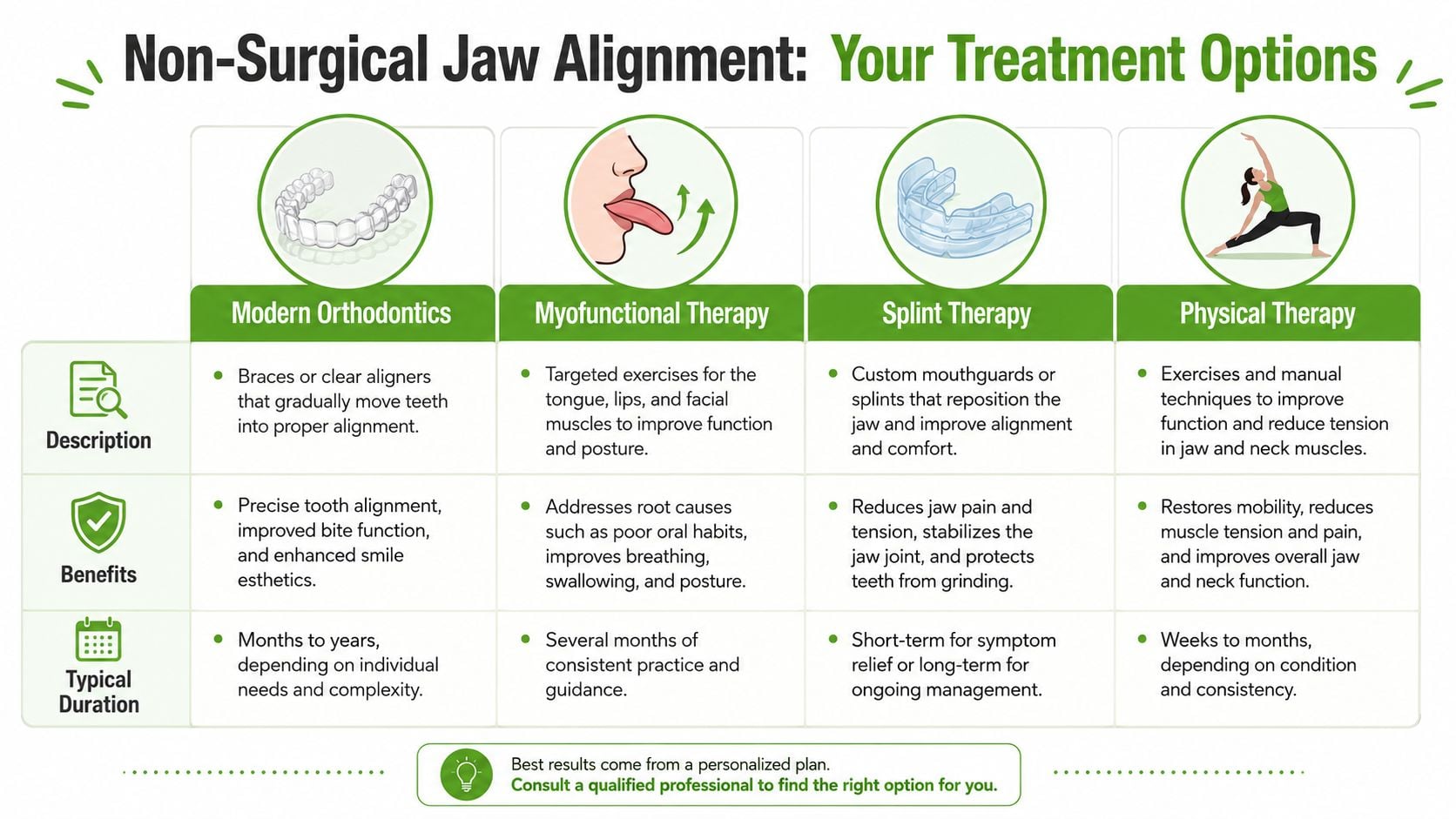
Here's a simple comparison of the main conservative options:
| Option | What it does | Best fit | Main limitation |
|---|---|---|---|
| Modern orthodontics | Moves teeth and refines bite relationship | Mild to moderate alignment issues | Doesn't solve every muscle or airway problem |
| Splint therapy | Reduces joint loading and helps stabilize bite position | TMJ pain, clenching, protective support | Usually not a tooth-moving solution |
| Myofunctional therapy | Retrains tongue posture, swallow, lip seal, breathing patterns | Mouth breathing, tongue thrust, instability | Requires active participation |
| Physical therapy | Improves mobility and reduces muscle guarding in jaw and neck | Muscle-driven tension and movement restriction | Won't correct tooth position by itself |
For many adults with mild to moderate bite problems, orthodontic treatment is measured in months, not weeks. A realistic range is often about 12 to 24 months, depending on how much tooth movement is needed, whether the joints are stable, and how well the patient can support the result with breathing and oral posture habits. The Cleveland Clinic overview of orthodontics gives a useful general timeline for adult treatment.
When orthodontics makes sense
Orthodontics works best when controlled tooth movement can improve the bite without asking the jaw joints to compensate. Braces give the most control in more complex cases. Clear aligners can work very well in simpler cases or for patients who will wear them as directed.
If you're weighing aligners and other cosmetic-friendly choices, Lumina Dental offers brace alternatives that can help you think through the pros and compromises in a practical way.
I also tell patients this early. Straight teeth and a settled jaw are related, but they are not identical outcomes. If the tongue rests low, the airway is strained, or the neck stays locked forward all day, orthodontics alone may not hold as well as expected.
Where splints fit in
A custom splint is often the first step when pain is active, the joints are irritated, or muscle guarding makes the bite inconsistent from day to day. In that setting, forcing tooth movement too early can make planning less accurate. A splint gives the jaw a more stable starting point and often helps reveal the position the muscles can tolerate.
Patients often confuse a protective appliance with a treatment appliance. This explanation of TMJ splint vs. night guard shows why those devices are not interchangeable.
A splint helps control joint and muscle loading. Braces and aligners move teeth. Each has a different job.
This short video gives a useful visual overview of non-surgical jaw correction approaches and how they differ in practice.
Why physical therapy still matters
Jaw mechanics are tied to the neck, rib cage, and shoulder girdle. A patient who breathes through the mouth, carries the head forward, and braces through the upper traps often keeps feeding tension into the muscles that control opening, closing, and chewing. That pattern can keep symptoms going even after the teeth look better.
Physical therapy helps restore motion, reduce guarding, and improve how the jaw and neck share load. In the right case, that changes daily comfort, chewing efficiency, and bite stability. It does not replace orthodontics when teeth need movement, but it often makes orthodontic results easier to tolerate and easier to keep.
Advanced Therapies for Comprehensive Healing
Traditional orthodontics can improve alignment. It can't always fix the habits and tissue strain that caused the instability in the first place. That's where advanced therapies become valuable. They work underneath the bite, at the level of function, muscle patterning, breathing, and tissue recovery.
Myofunctional therapy stabilizes what orthodontics creates
Orofacial Myofunctional Therapy, often called OMT, is best understood as physical therapy for the mouth and face. It targets low tongue posture, tongue thrust, mouth breathing, poor lip seal, and inefficient swallowing patterns. Those habits sound minor. They aren't.
Untreated myofunctional issues such as improper tongue posture and mouth breathing can undermine orthodontic outcomes by 25 to 35 percent, and 14 to 30 percent of cases may relapse within 5 years if retainers aren't worn indefinitely, according to this analysis of orthodontic treatment and jaw alignment issues. That's why function can't be an afterthought.

What OMT changes in daily life
OMT aims to normalize the patterns that act on the teeth and jaw all day and all night. That may include:
- Tongue resting posture: Keeping the tongue supported in a healthier position rather than pressing into or against the teeth
- Swallow mechanics: Reducing compensation from lips, chin, and facial muscles
- Nasal breathing habits: Helping shift from open-mouth breathing to more efficient nasal breathing where possible
- Lip seal and facial tone: Improving balance rather than overusing the chin and cheek muscles
These changes matter because the tongue is a constant force in the mouth. If it rests low or moves incorrectly with every swallow, it can work against orthodontic correction over time.
Regenerative support for irritated joints and ligaments
Some patients have another layer to the problem. Their jaw joint tissues are inflamed, the supporting ligaments are lax, or the surrounding structures are not healing well with mechanical care alone. In those situations, regenerative medicine may be considered as part of a broader plan.
Options can include Platelet-Rich Fibrin (PRF) and Prolotherapy, both aimed at stimulating the body's own repair response rather than just masking pain. These approaches aren't substitutes for diagnosis, breathing work, or bite correction. They're best viewed as support for tissues that need help recovering while the functional causes are addressed.
For readers who want a clearer picture of how these approaches fit into non-surgical care, orthobiologic therapy offers a useful overview.
Treatment lasts longer when it respects biology. Calm the joint, retrain the tongue, improve breathing, then ask the bite to hold.
The bigger holistic view
A stable jaw needs more than straight teeth. It needs a tongue that rests well, nasal breathing when possible, muscles that aren't in constant defense mode, and joints that tolerate load. When those pieces improve together, patients often notice benefits beyond the jaw itself. Chewing feels easier. Morning tension eases. Sleep can become less fragmented. The face looks more balanced because the system is working more evenly.
That's the difference between chasing symptoms and building a result that's more likely to stay.
What to Expect on Your Treatment Journey
Non-surgical correction works best when you expect a process, not a quick reset. Patients rarely present with a single issue. They have a mix of bite imbalance, joint irritation, muscle overuse, poor breathing patterns, and habits that have been reinforced for years. The treatment path reflects that complexity.
The typical sequence
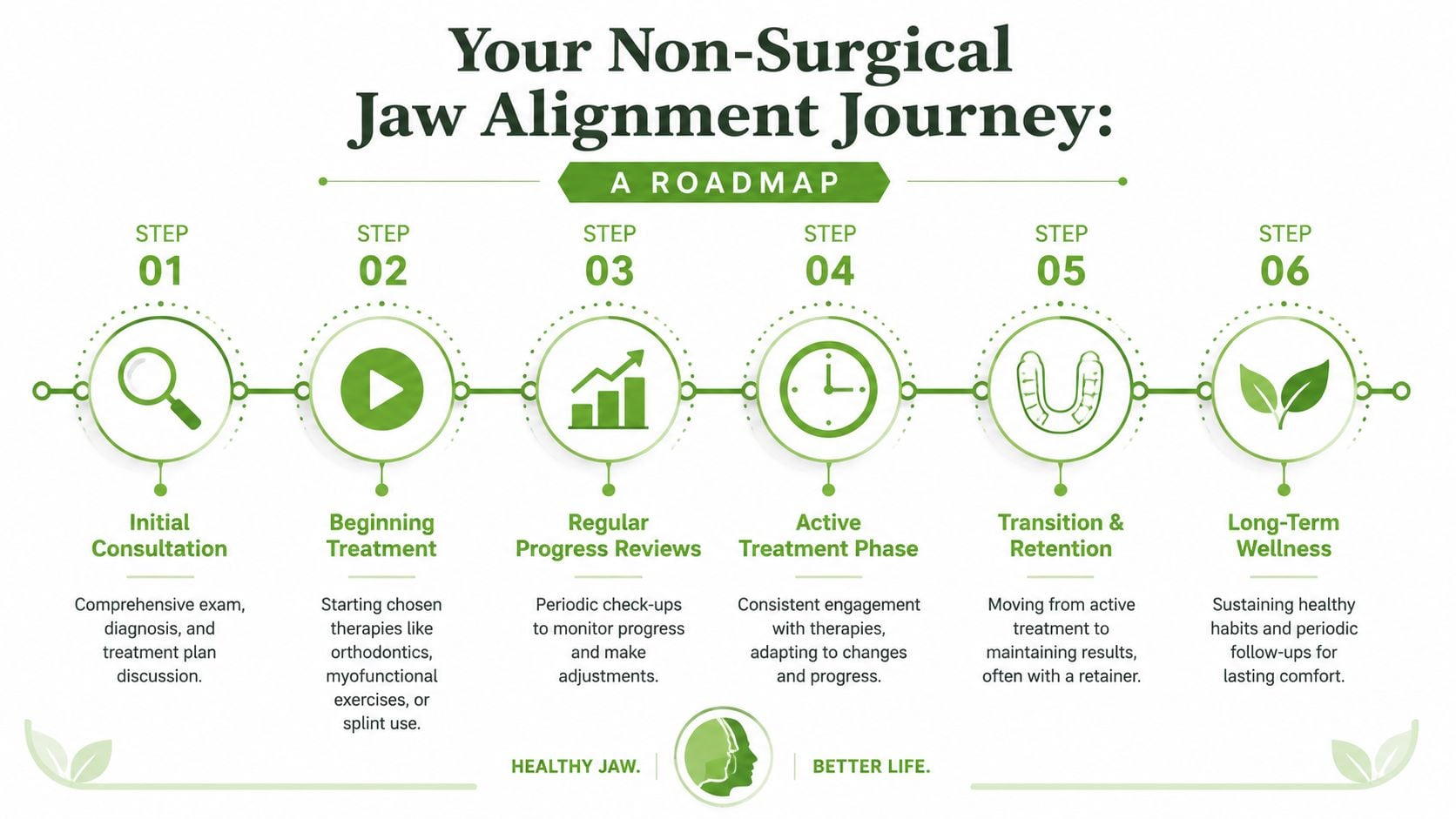
In many adult cases, the course looks something like this:
Thorough diagnosis
The first step is figuring out whether the problem is mostly dental, joint-related, muscular, airway-related, or mixed.Early stabilization
If the joints are irritated or the muscles are guarding, treatment may begin with a splint, habit changes, and targeted exercises before any tooth movement starts.Active correction
Braces, aligners, appliances, myofunctional therapy, or a combination of these begin reshaping function and bite mechanics.Progress reviews
Adjustments matter. The plan may shift as the jaw becomes less guarded and the true bite becomes clearer.Retention and maintenance
Once the correction is achieved, retainers or nighttime support help preserve it while the body adapts.
How long it usually takes
Non-surgical jaw alignment usually progresses through controlled orthodontic forces over 12 to 24 months, and clear aligners show 80 to 90 percent efficacy in mild-to-moderate cases. But if clear aligners are used for severe skeletal misalignment without adjunctive appliances, success drops to below 50 percent, according to this discussion of jaw alignment without surgery.
That's a useful reality check. The appliance doesn't determine success by itself. Case selection does.
What progress feels like
Early progress is often functional before it's cosmetic. Patients may report:
- Less morning jaw fatigue
- Easier chewing on both sides
- Reduced headaches linked to clenching
- Fewer joint noises or less catching
- Better awareness of nasal breathing and tongue posture
Those changes don't always happen in a straight line. Some weeks feel better than others. A bite may feel “strange” during transitions because the system is adapting.
Don't judge treatment by one rough week. Look for gradual trends in comfort, function, and consistency.
Why retention isn't optional
Retention is part of treatment, not an add-on. The jaw, teeth, muscles, and tongue all need time to accept the new pattern. If old habits remain in place, the body often tries to return to them. That's why the retention phase may include retainers, ongoing myofunctional exercises, breathing work, and periodic reassessment.
Patients who do well long term usually understand one thing. The final phase isn't passive. It's where the result gets protected.
Red Flags That May Indicate a Need for Surgery
Conservative care has real value, but it has limits. There are times when the most responsible recommendation is a surgical evaluation. Saying that clearly builds trust, and it protects patients from spending time on treatment that can't realistically solve the problem.
When non-surgical care may not be enough
Corrective jaw surgery is generally considered when nonsurgical treatment fails or when the underlying discrepancy is too severe to camouflage effectively. Indicators include severe misalignment causing facial asymmetry, inadequate results from prior orthodontics, chronic TMJ pain that hasn't responded to non-surgical care, or breathing difficulties where jaw position significantly restricts airflow, as outlined in this review of when surgery may be necessary.
Common red flags include:
- Marked facial asymmetry: The skeletal imbalance is visible and functionally significant
- Trauma-related structural change: The jaw healed in a compromised position after injury
- Failed conservative treatment: Braces, splints, therapy, and habit correction haven't produced a workable result
- Airway restriction tied to jaw structure: Breathing problems appear strongly linked to the position of the jaws
- Persistent severe pain: The case remains debilitating despite appropriate non-surgical care
Questions worth asking if surgery enters the discussion
If a specialist raises surgery, don't stop at “Do I need it?” Ask:
- What exact structural problem can't be corrected conservatively
- What goals are functional versus cosmetic
- What non-surgical steps have already been tried well
- How will airway, pain, and long-term stability be measured
- What orthodontic preparation or follow-up will still be needed
For patients comparing conservative and surgical pathways, this guide to surgery for jaw realignment can help frame the decision.
Surgery shouldn't be presented as failure. It's the right tool for some skeletal problems. The mistake is using it too quickly, or avoiding it too long when the anatomy clearly calls for it.
If you're dealing with jaw pain, bite changes, headaches, clenching, snoring, or unrestorative sleep, a root-cause evaluation can clarify whether your best path is orthodontic, functional, regenerative, airway-focused, or a combination of several approaches. Pain and Sleep Therapy Center specializes in TMJ disorders, facial pain, and sleep-related breathing issues with a whole-system approach that looks beyond symptoms to the underlying drivers of jaw dysfunction.