

For so many new parents, the first clue that something isn't right comes during feeding. It's supposed to be a time for bonding, but instead, it feels like a struggle. If you’re dealing with a baby who makes a clicking sound while feeding, can't seem to get a shallow latch right, or if you're experiencing significant nipple pain, you're not alone. These are often the classic first whispers of a potential tongue tie.
A baby who seems hungry all the time, even after long nursing sessions, might also be struggling to transfer milk effectively—another common side effect of a restricted tongue.
Decoding the First Signs of a Potential Tongue Tie

When feeding feels more like a battle than a peaceful bonding moment, it's natural to feel worried and exhausted. The first step is to become a bit of a detective, tuning into the subtle (and sometimes not-so-subtle) clues your baby and your own body are sending. The goal here isn't to self-diagnose, but to gather the right information so you can have a really productive conversation with a healthcare professional.
Most often, parents first sense something is off during breastfeeding. A baby with a tongue tie has a hard time creating that deep, wide latch because their tongue simply can't extend and cup the breast the way it needs to. Instead, they might "gum" or chomp down, which can be incredibly painful for mom.
Clues You Can Spot During Feedings
Beyond a painful latch, there are several other signs that can point toward an oral restriction. Try to pay close attention to the sounds your baby makes and how they behave, whether they are at the breast or on a bottle.
You might notice things like:
- A clicking or smacking sound: This usually happens when your baby loses suction because their tongue can’t maintain a proper seal.
- Milk dribbling from their mouth: That poor seal can also cause milk to leak from the corners of your baby's mouth as they eat.
- Frustration at the breast or bottle: Many babies will pull away, cry, or arch their back because they're working so hard but not getting enough milk.
- Falling asleep mid-feed: Some babies with a tongue tie get exhausted from the extra effort it takes to eat, causing them to doze off before they're full.
This condition, known medically as ankyloglossia, is actually quite common, affecting between 4% and 11% of newborns worldwide. And while nipple pain is reported in up to 75% of symptomatic cases, it’s crucial to know that many tongue-tied babies don't show obvious feeding problems. You can discover more insights about these statistics and what they mean from recent research.
Visual Cues and Physical Signs
In addition to how your baby acts during feedings, there are physical and visual signs you can look for. Next time your baby cries, try to get a good look inside their mouth at their tongue.
A tell-tale visual sign of an anterior tongue tie is a heart-shaped tongue tip. This happens because the tight frenulum is pulling on the center of the tongue, creating that little indentation.
You can also do a simple check to see if your baby can stick their tongue out past their lower gum line or lip. A restricted tongue often has very limited mobility, making this simple movement difficult or even impossible. You might also notice a persistent white coating on their tongue (that isn't thrush)—it's often just milk residue that can't be cleared away because the tongue can't lift up to the roof of the mouth.
Recognizing these signs early on empowers you to ask the right questions and seek a professional evaluation sooner rather than later.
To help you keep track of what you're seeing, here’s a quick checklist summarizing the most common signs for both you and your baby.
Quick Reference Checklist for Potential Tongue Tie Signs
| Symptom Area | Signs in Baby | Signs in Mother |
|---|---|---|
| Feeding Behaviors | Clicking or smacking sounds, shallow latch, milk dribbling, falls asleep quickly, fussy or frustrated at breast/bottle. | Painful latch, creased or blanched nipples, cracked or bleeding nipples. |
| Physical Signs | Heart-shaped tongue tip, difficulty lifting tongue to roof of mouth, inability to stick tongue out past gums, white coating on tongue. | Low milk supply due to poor milk transfer, frequent clogged ducts or mastitis. |
| General Symptoms | Poor weight gain, gassy or colicky, reflux-like symptoms, seems constantly hungry. | Emotional stress, anxiety, or frustration related to feeding difficulties. |
Seeing one or two of these signs might not be a major concern, but if you're checking off multiple items on this list, it’s a strong signal that it’s time to talk to a lactation consultant or a pediatric provider who specializes in oral ties.
Beyond the Latch: The Full Spectrum of Symptoms

While a poor latch is often the first red flag parents notice, the effects of a restrictive tongue tie can ripple outward, impacting much more than just the initial moments of feeding. The tongue is an incredibly powerful muscular system. When its movement is limited, a baby has to find clever—but often inefficient—ways to compensate. This is where a much wider range of symptoms starts to appear.
Think about the mechanics of eating. A baby needs to use their tongue to create a vacuum, draw milk from the breast or bottle, and then move that milk to the back of their throat to swallow. When a tie prevents this fluid motion, babies often recruit their jaw, lips, and cheeks to do the tongue's job. This extra effort is exhausting.
I see this all the time in my practice: a baby who constantly falls asleep at the breast isn't always just a "good, sleepy baby." More often than not, they are simply worn out from the sheer effort of trying to eat. They might nurse for 45 minutes, doze off, and then wake up hungry again a short while later because they never achieved a full, satisfying feeding.
The Connection Between Feeding and Discomfort
This inefficient feeding has a direct impact on your baby's comfort. Because they struggle to maintain a proper seal, they often swallow a significant amount of air along with their milk. This is a primary driver behind a host of other issues that are frequently mistaken for separate problems.
If you're trying to figure out how to tell if baby has tongue tie, keep an eye out for these related signs:
- Excessive Gassiness and Spitting Up: All that swallowed air has to go somewhere. This can lead to a perpetually gassy, fussy baby who spits up frequently and seems to have reflux.
- Colic-like Symptoms: The constant discomfort from trapped air can cause those inconsolable crying spells, often in the late afternoon or evening, that get labeled as colic.
- Hiccups After Every Feed: Frequent hiccups are another telltale sign that your baby is taking in too much air while trying to coordinate sucking, swallowing, and breathing.
These issues often paint a picture of a baby who is just plain uncomfortable. Recognizing this full spectrum of tongue tie symptoms is crucial for understanding what your baby is truly experiencing.
A key takeaway for parents is that symptoms like reflux, colic, and gassiness aren't always separate medical issues. They can be direct results of the dysfunctional swallowing patterns caused by a tongue tie.
While it's not always straightforward to spot, estimates show that tongue-tie is present in 3-16% of infants globally. One of the clearest signs is watching your baby's tongue mobility; if it struggles to lift to the roof of the mouth or can't extend fully over the lower lip, ankyloglossia could be the reason.
Uncovering Less Obvious Oral Signs
Beyond the immediate feeding challenges, a restricted tongue can manifest in other ways that hint at underlying oral dysfunction. These signs might seem minor on their own, but when you view them as part of a larger pattern, they offer important clues.
For example, think about a baby who just can't keep a pacifier in. If it constantly pops out, it could be because their tongue lacks the cupping and suctioning ability needed to hold it in place. Similarly, a baby who persistently breathes through their mouth may be doing so because a low-resting tongue posture—often caused by a tie—is getting in the way of their nasal airway.
Other subtle but significant indicators include:
- An Unusually Strong Gag Reflex: When the tongue can't move properly, the gag reflex can be triggered more easily during feeding or when introducing a pacifier or bottle.
- A High or Bubbled Palate: A tongue that can't rest properly against the roof of the mouth fails to apply the gentle pressure needed to help the palate form a wide, flat shape.
- Lip Blisters: Those small blisters on the upper or lower lip are often a sign of a shallow latch, where the baby is using their lips excessively to hold on.
By understanding how these seemingly disconnected issues are linked, you get a much more complete picture of your baby's oral function. This broader perspective highlights why a detailed evaluation is so important for their overall health and well-being.
Anterior vs. Posterior Tongue Ties: What You Can (and Can't) See
One of the most confusing things for parents is that not all tongue ties look the same. You might be expecting to see a very obvious, thin piece of tissue holding the tongue down, but the truth is, the most problematic restrictions are often completely hidden.
This is the key difference between an anterior tongue tie and a posterior tongue tie.
What Most People Picture vs. The Hidden Restriction
An anterior tie is the "classic" one most people think of. It's a visible band of tissue connecting the very tip of the tongue to the floor of the mouth. This is what often causes that distinct heart-shaped tongue when a baby tries to lift it. Because it's right there at the front, it's usually easier to spot.
A posterior tie, however, is a whole different story. It’s sneakier. This restriction is located further back, hidden underneath the mucous membrane, so you often can't see it with a quick peek in the mouth.
Think of it like a tight guitar string hidden under a plush carpet. You can’t see the string, but you can definitely see how it limits the carpet's movement. A posterior tongue tie is all about function, not appearance. The tightness is submucosal, meaning it’s buried in the tissue at the base of the tongue, preventing the middle and back of the tongue from lifting properly.
This is exactly why a baby can have all the tell-tale symptoms of a tongue tie—a shallow latch, clicking sounds while feeding, awful reflux—yet a quick look in their mouth shows nothing obvious.
The most important thing to understand is that a real evaluation must look at how the tongue moves, not just what it looks like. A tongue can appear totally normal at a glance but be severely restricted by a posterior tie that wrecks its ability to move up and down for effective feeding.
While some studies suggest up to 10% of newborns may have some form of tongue tie, the real issue is when it actually restricts function. A heart-shaped tongue or a baby who can't get their tongue over their bottom gum line are clear red flags, but those posterior ties are much harder to spot. You can discover more insights on spotting these signs from the Mayo Clinic.
To help you visualize the difference, here’s a simple breakdown.
Anterior vs Posterior Tongue Tie Key Differences
This table shows the main distinctions between the two types of ties. Remember, an anterior tie is about what you can easily see, while a posterior tie is about what you can feel and how the tongue functions.
| Feature | Anterior Tongue Tie | Posterior Tongue Tie |
|---|---|---|
| Visibility | Usually easy to see; a thin, membranous band at the front. | Hidden under the mucous membrane; not visible with a casual look. |
| Tongue Appearance | Often creates a "heart-shaped" tip when the tongue is lifted. | Tongue tip may look normal, but the base and mid-tongue are restricted. |
| Location | Connects the tip of the tongue to the floor of the mouth. | Located at the base of the tongue, deeper within the tissue. |
| Key Indicator | Appearance (visible membrane, heart shape). | Function (poor lift, tension, feeding issues). |
| How It's Diagnosed | Visual inspection is often enough. | Requires a functional assessment where a provider physically lifts the tongue to feel for restriction. |
Understanding these differences is crucial because it explains why so many posterior ties go undiagnosed, leaving families struggling without answers.
A Gentle At-Home Check: The Finger Sweep
You absolutely cannot diagnose a tie at home, but you can do a simple observation to feel for potential tightness. We often call this a "finger sweep." Just make sure your baby is calm and your hands are clean.
- Gently slide your pinky finger into your baby’s mouth, with the pad of your finger facing up.
- Let your baby start sucking on your finger.
- Slowly and carefully sweep your finger under their tongue, from one side to the other.
In a baby with good tongue mobility, your finger should glide smoothly. If you feel a tight band, something like a "speed bump," or a lot of tension holding your finger down, it could point to a posterior tie. Sometimes, it just feels like the whole floor of the mouth is unusually thick or rigid.
This is just an information-gathering tool—it is not a diagnosis. But telling a trained provider what you felt can be an incredibly valuable piece of the puzzle during a professional exam.
Why You Need a Specialist's Eyes (and Hands)
Identifying a posterior tongue tie requires a specific skill set that goes way beyond a standard pediatric check-up. Many wonderful doctors are trained to spot the obvious anterior ties but don't have the specialized experience to diagnose a functional restriction that has to be felt, not just seen.
A trained specialist—like a pediatric dentist or an ENT who focuses on tethered oral tissues—will do a full functional assessment. They will physically lift the tongue to properly see and feel the frenulum, checking its elasticity and range of motion. This hands-on exam is the only way to accurately identify a posterior tie and figure out if it's the true culprit behind your baby's feeding struggles.
Navigating the Professional Evaluation Process
Once you’ve connected the dots between your baby’s symptoms and a potential tongue-tie, the next step is getting a definitive answer. This can feel a little daunting, but knowing what a proper evaluation looks like will empower you to advocate for your child and find the right support.
Let me be clear: a quick glance inside your baby's mouth during a routine check-up is not enough. This is especially true when a less obvious posterior tie is suspected.
You need a provider who looks at the bigger picture—not just the little string of tissue under the tongue, but how it impacts the entire system of sucking, swallowing, and breathing. The key is finding someone who performs a functional assessment.
Finding the Right Professional
Your pediatrician is a great starting point, but it's important to know that not all providers have specialized training in identifying tethered oral tissues. For a truly detailed evaluation, you’ll want to find a professional with specific experience in this area.
Your best options often include:
- A Pediatric Dentist or ENT: Look for one who specifically mentions treating tongue-ties, often with a laser, and who works as part of a team with lactation consultants and bodyworkers.
- An International Board Certified Lactation Consultant (IBCLC): Many IBCLCs have advanced training in oral function. They are often the first to spot the issue during a feeding assessment and can refer you to a trusted release provider.
- A Speech-Language Pathologist (SLP): An SLP who specializes in infant feeding can provide an excellent functional evaluation.
Honestly, the title isn't as important as their approach. You're looking for someone who takes the time to listen to your story, observes a full feeding, and performs a hands-on physical exam.
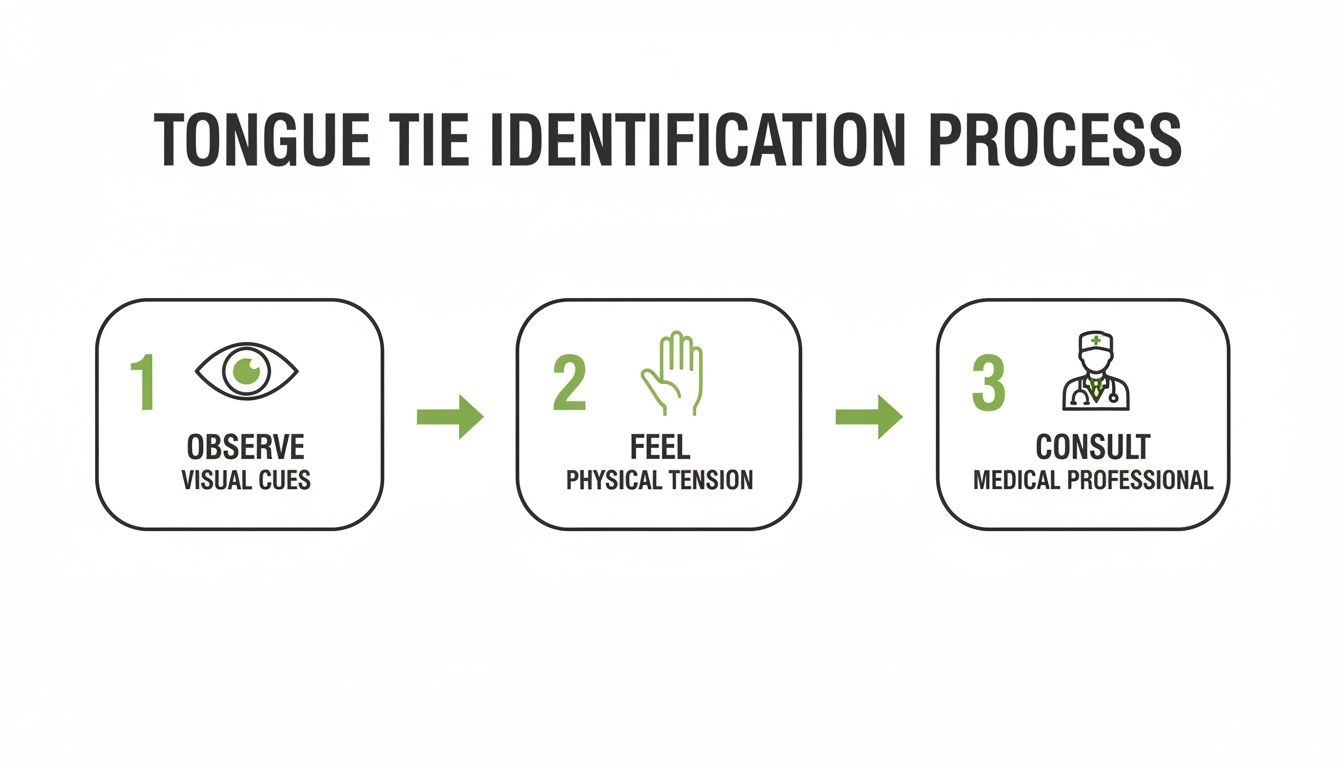
This simple breakdown shows how the journey moves from your at-home observations to a professional consultation. It always starts with you noticing the signs before a hands-on assessment confirms how oral tissues are truly affecting your baby’s function.
What a Comprehensive Exam Involves
A proper evaluation is so much more than a quick peek. It's a hands-on investigation into your baby's oral anatomy and what it can—and can't—do. The provider should be assessing multiple factors to get to the root cause of the symptoms you're seeing.
A thorough exam will include:
- A Detailed History: The provider will ask about your pregnancy, the birth, and your complete feeding journey. Be ready to share details about any pain you're feeling and your baby's specific behaviors at the breast or bottle.
- Visual Inspection: They will look at your baby's oral structures, checking things like the shape of the palate, jaw position, and the appearance of the frenulum.
- Functional Mobility Assessment: This is the most critical part. The provider will use their gloved fingers to physically lift the tongue and feel for restriction. They’ll be checking how well the tongue can move up to the palate (elevation), side-to-side (lateralization), and forward (protrusion).
A true functional restriction is felt more than it is seen. The provider is feeling for tension, checking the elasticity of the frenulum, and determining exactly how far the tongue can lift. This hands-on, tactile feedback is essential for an accurate diagnosis.
Questions to Ask Your Provider
Finding a provider who gets the functional approach is everything. To help you vet potential practitioners and make sure you’re getting the best care, go into your appointment prepared with questions. Your goal is to find a team that sees the whole child, not just the tie.
Here are some crucial questions to ask:
- How do you assess for a posterior tongue-tie?
- Do you evaluate based on function or just appearance?
- What percentage of your practice is dedicated to treating infants with oral ties?
- Who do you collaborate with for pre- and post-procedure care (like IBCLCs, bodyworkers, or myofunctional therapists)?
- What does your follow-up care look like after a frenectomy?
- Do you provide guidance on stretching exercises?
The answers will tell you a lot about their philosophy. A practitioner who emphasizes a collaborative team and post-procedure therapy is much more likely to give your baby the support needed for long-term success. At the Pain and Sleep Therapy Center, we believe in this team-based approach for our pediatric patients, ensuring every aspect of their oral function is addressed.
Modern Treatment From Frenectomy to Functional Therapy

When you finally get a definitive tongue-tie diagnosis, it can bring a wave of both relief and uncertainty. The great news is that modern treatment is a world away from a simple "snip." It’s a thoughtful, supportive approach that addresses not just the physical restriction, but also the functional habits your baby has been forced to learn.
The most common procedure to fix a tongue tie is called a frenectomy. This is where the tight frenulum is released, letting the tongue finally move freely. Many experienced providers now opt for a soft tissue laser instead of traditional scissors or a scalpel.
Laser technology brings some incredible benefits. It offers unparalleled precision, minimizes bleeding by cauterizing the tissue as it works, and often means less discomfort for your little one afterward. The procedure itself is surprisingly fast, typically taking less than a minute.
More Than Just the Procedure
It’s easy to see the frenectomy as the final step, but it’s actually just one piece of the puzzle. Releasing the tie is like removing a cast from a broken arm—the physical barrier is gone, but the muscles are weak and need to be retrained to work correctly.
For weeks, or even months, your baby has been using all the wrong muscles to eat. They’ve developed clever workarounds—like using their cheeks and lips to draw milk—simply because their tongue couldn't do the job properly. Releasing the tie doesn't magically erase these ingrained habits.
This is exactly why a complete, team-based approach is so critical. Effective treatment isn’t just about the procedure; it’s about preparing the body for the release and retraining those oral-motor patterns afterward.
A frenectomy creates the potential for normal tongue function. The real success comes from the therapy before and after the procedure that teaches the tongue how to use its new freedom.
The Role of Bodywork and Pre-Procedure Prep
Long before a frenectomy is scheduled, many specialists will recommend bodywork. Think about it this way: a tight frenulum doesn't exist in a vacuum. It often creates a ripple effect of tension throughout your baby’s entire body, from their jaw and neck right down to their shoulders and back.
Specialized therapies can help release this stored tension:
- Craniosacral Therapy (CST): A very gentle, hands-on technique that releases restrictions in the soft tissues around the central nervous system.
- Chiropractic Care: A pediatric chiropractor can perform subtle adjustments to improve alignment and reduce muscle tightness in the neck and jaw.
- Physical Therapy: A PT can help with any torticollis (head tilt) or body asymmetry that developed from their position in the womb or the tongue tie itself.
This "pre-loosening" phase helps make the frenectomy more successful and allows your baby’s body to adapt much more easily to the changes.
Retraining the Tongue After Release
After the procedure, the real work of building new, healthy habits begins. This is where functional therapy becomes the key to long-term success, and it involves two main components: post-procedure stretches and oral motor exercises.
The stretches are absolutely crucial for preventing the tissue from reattaching as it heals. Your provider will show you exactly how to do them, and being consistent is everything. On top of that, orofacial myofunctional therapy is essential for retraining the tongue and oral muscles to function properly.
While it might sound intimidating, for an infant, this therapy involves simple, playful exercises that encourage the correct tongue movements for sucking, swallowing, and even resting posture. You can learn more about how orofacial myofunctional therapy exercises are adapted for patients of all ages to improve oral function.
This comprehensive approach—combining bodywork, a precise release, and dedicated post-procedure therapy—is what ensures your baby can finally use their tongue efficiently, making feeding a comfortable and connected experience for both of you.
Your Path Forward After a Tongue-Tie Diagnosis
Navigating the world of oral restrictions can feel isolating, but just by getting here, you’ve taken a massive step forward. You've learned to connect the dots between feeding struggles, constant gassiness, and poor sleep. Now, you can actually see a clear path toward a solution.
Remember, this entire journey is about restoring function for your little one. It starts with your gut feeling that something isn't right, moves to understanding the difference between an anterior and posterior tie, and should always end with a comprehensive professional evaluation. An accurate diagnosis isn't just about making feeding easier today—it’s about preventing a cascade of future challenges down the road.
Why Early Action is So Important
Identifying and addressing a tongue-tie early can have a profound impact on your child's long-term health. The restriction really does affect more than just their ability to get milk efficiently.
Proper tongue function is absolutely critical for:
- Speech Development: A free-moving tongue is non-negotiable for forming sounds correctly.
- Dental Health: The tongue is nature's palate-expander, helping shape the jaw and influencing how teeth come in.
- Airway and Sleep Quality: A low-resting tongue posture can contribute to mouth breathing and disordered sleep later in life.
By seeking help now, you are making an investment in your child’s future well-being, giving them the best possible foundation for healthy growth.
A diagnosis isn't a label of something being "wrong" with your baby. Instead, think of it as the key that unlocks the door to better function, comfort, and development. It's an opportunity to provide the support they need to truly thrive.
Your Next Steps for Seeking an Evaluation
Feeling empowered with this knowledge, your next move is to find the right professional team. Look for a pediatric dentist, ENT, or IBCLC who specializes in tethered oral tissues and takes a functional, whole-body approach to their assessment.
When you book a consultation, be ready to share all your observations—every clicking sound, fussy feeding, and sleepless night is a valuable piece of the puzzle. For extra support and information on resolving feeding challenges, you can explore resources covering various breastfeeding issues.
Above all, trust your instincts. You know your baby better than anyone. Finding a supportive, interdisciplinary team that truly listens to your concerns is the final and most important step. With the right diagnosis and a holistic treatment plan, you can resolve these challenges and get back to what matters most: enjoying a peaceful, connected journey with your thriving baby.
Common Questions About Infant Tongue Tie
When you start learning about infant oral ties, a lot of questions—and a few persistent myths—are bound to come up. Getting clear, straightforward answers can help you feel much more confident as you figure out the best path forward for your baby.
Addressing Key Parental Concerns
One of the first things parents ask is whether a tongue tie will simply correct itself over time. While a very thin, stretchy anterior tie might loosen slightly, a functionally restrictive tie—especially a posterior one—will not resolve on its own. The tight connective tissue remains, and waiting often just gives the baby time to develop compensatory muscle patterns for sucking and swallowing that can cause other issues later.
Another common worry is whether the correction procedure is painful. A laser frenectomy is a very quick procedure, and we use a topical numbing cream to minimize any discomfort. Babies often cry during the brief moment it takes, but it’s typically from being swaddled and having someone's fingers in their mouth, not from significant pain. They almost always calm down immediately afterward, especially once they are able to nurse.
It's critical to understand that good weight gain does not automatically rule out a problematic tongue tie. Some babies compensate by working incredibly hard to feed, burning excessive calories and nursing for long, frequent sessions.
This can be exhausting for both mother and baby. A tongue tie's impact extends far beyond feeding, affecting airway development, sleep quality, and future speech patterns. A functional assessment is always recommended, even if your baby’s weight gain looks perfect on the charts. Addressing the root cause early provides the foundation for optimal long-term health.
At the Pain and Sleep Therapy Center, our interdisciplinary team provides compassionate, expert evaluations for infants to address these very concerns. Learn more about our collaborative approach to pediatric oral health by visiting https://pscharlotte.com.