
If you're dealing with jaw pain, you know how frustrating it can be. Simple, targeted movements—what we call TMJ pain treatment exercises—are designed to reduce muscle tension, improve your jaw's mobility, and strengthen the muscles that support the temporomandibular joint.
The whole point is to address the real source of the problem, like muscle fatigue or a joint imbalance, instead of just covering up the symptoms.
Understanding Why Simple TMJ Exercises Work

If jaw pain, headaches, or that annoying clicking sound are part of your daily life, you're definitely not alone. Research shows that temporomandibular joint (TMJ) disorders affect a huge chunk of the population—somewhere between 5% and 12% of adults worldwide.
The good news? A structured exercise routine can bring significant, lasting relief.
Think of your jaw as a finely tuned system of muscles, ligaments, and a delicate joint. It gets overworked. Chronic stress makes you clench. Poor posture from sitting at a desk all day strains your neck and jaw. Even seemingly harmless habits like chewing gum can throw everything off balance, leading to muscle fatigue that pulls the joint out of its happy place.
Re-educating Overworked Jaw Muscles
At its core, the idea behind TMJ exercises is what we call neuromuscular re-education. When your jaw muscles are constantly tight, they essentially "forget" how to work correctly. Gentle stretches help release all that built-up tension, while specific strengthening exercises build stability to support the joint properly.
This approach gets right to the heart of what's causing your discomfort, including:
- Muscle Fatigue: Chronically overworked muscles like the masseter and temporalis become sore. That soreness can then refer pain elsewhere, showing up as tension headaches or even earaches.
- Limited Range of Motion: When the joint is stiff, it can be painful to yawn, chew, or even talk. Mobility exercises are key to restoring that essential function.
- Joint Incoordination: That clicking or popping you hear is often a sign that the small articular disc inside the joint isn't gliding smoothly. The right exercises can improve coordination and guide the joint back into a healthier movement pattern.
The goal here isn't to force your jaw into submission. It's about gently guiding it back to its natural, relaxed state of function. By doing these movements consistently, you're retraining your body to break the cycle of tension and pain.
The Power of a Consistent Routine
And this isn't just wishful thinking—the effectiveness of these exercises is backed by solid research. A recent clinical trial highlighted just how powerful the combination of professional guidance and at-home care can be. Patients who paired their treatment with targeted physical therapy saw their Jaw Functional Limitation Scale scores improve by over 77%.
Their scores dropped from an average of 32.65 all the way down to just 7.35 after completing the program. It’s clear proof that simple, consistent movements do more than provide a temporary fix; they fundamentally improve how your jaw works.
For more complex cases, these exercises create a critical foundation for other treatments. This is where you might explore something like orofacial myofunctional therapy, a specialized field that addresses oral posture and muscle function to support overall jaw health. Ultimately, these exercises empower you to take an active role in your own recovery.
Preparing Your Body for Safe and Effective Relief
Jumping right into jaw movements without a little prep work can sometimes make your symptoms flare up. When it comes to effective tmj pain treatment exercises, the secret isn't force—it's finesse. Think of this preparation as laying a solid foundation for your routine. It helps you perform each exercise safely and get the most relief, all while sidestepping the risk of irritation.
It all starts with a quick moment of mindfulness. Before you even think about stretching, just check in with your body. Are your shoulders creeping up toward your ears? Is your jaw clenched tight without you even realizing it? These are incredibly common tension patterns that can easily undermine your efforts.
The idea is to begin from a place of calm. Just taking a few seconds to consciously let go of the tension in your face and shoulders can make a huge difference. It sets the stage for more purposeful, healing movements.
Finding Your Neutral Starting Position
Your posture is the first domino to fall when it comes to TMJ relief. If you're slouching or jutting your head forward, you're putting constant strain on your neck and jaw muscles, making them tight and sore before you even start. A good, neutral posture is your secret weapon.
Here’s how to find it:
- Sit or stand tall: Imagine a string is gently pulling the top of your head toward the ceiling, creating length in your spine.
- Align your ears over your shoulders: Gently guide your head back to correct that forward-head position. Be careful not to tilt your chin up; instead, think about making a subtle double chin.
- Relax your shoulders: Let them drop down and back, away from your ears. This helps open up your chest.
This position might feel a bit strange at first, especially if you’re used to slouching. But trust me, it’s the most efficient and least stressful alignment for your entire upper body, jaw included.
Mastering Your Tongue Posture
This is a big one. One of the most powerful—and most overlooked—pieces of the jaw health puzzle is your tongue posture. When your tongue rests in the wrong spot, like low in your mouth or pushing against your teeth, it throws off muscle balance and creates jaw tension. The correct spot is with the tip of your tongue resting gently on the roof of your mouth, just behind your front teeth.
Pro Tip: Say the letter "N." Feel where the tip of your tongue lands? That's your spot. Now, gently rest the entire front third of your tongue against that area, let your teeth float slightly apart, and close your lips. That’s the ideal resting posture.
This posture naturally cues your jaw muscles to relax, taking a ton of pressure off the joint itself. Keeping your "tongue up" throughout the day, and especially during these exercises, is a total game-changer for reducing that subconscious clenching.
The Power of Diaphragmatic Breathing
Finally, let's calm down the system that’s often driving the muscle tension in the first place: your nervous system. When we're stressed, we tend to take short, shallow breaths from the chest. This signals a "fight or flight" response, which tightens muscles all over—including the jaw. Diaphragmatic breathing, or belly breathing, does the exact opposite.
Here’s a simple way to practice it:
- Put one hand on your chest and the other on your belly.
- Breathe in slowly through your nose for about four seconds, focusing on letting your belly expand. Your chest should stay relatively still.
- Breathe out slowly through your mouth for about six seconds, feeling your belly fall.
Doing just 5-10 of these deep breaths before your routine helps release that underlying tension and prepares your body for gentle movement. It’s a simple but profound way to shift from a state of stress to one of mindful relaxation, making sure every exercise you do is truly therapeutic.
Your Core Routine of TMJ Pain Treatment Exercises
Alright, now we move from preparation to action. The real heart of your relief strategy is a consistent, thoughtful routine of tmj pain treatment exercises designed to tackle the root causes of your jaw pain.
I've found that a successful program isn't about finding one miracle movement. Instead, it’s about a smart combination of exercises that achieve different, but equally important, goals.
We're going to focus on three key pillars:
- Gentle Stretches to finally let go of that built-up tension in your overworked jaw muscles.
- Controlled Strengthening to give the joint the stability and support it needs to function correctly.
- Mobility Drills to bring back that smooth, coordinated movement you've been missing.
Every movement I'm about to show you is meant to be gentle. Remember our rule: "no pain, all gain." You should feel a mild stretch or a bit of muscle work, but never a sharp, shooting, or worsening pain. If you feel that, back off immediately.
Before you jump in, take just a moment to reset with the principles we just covered.
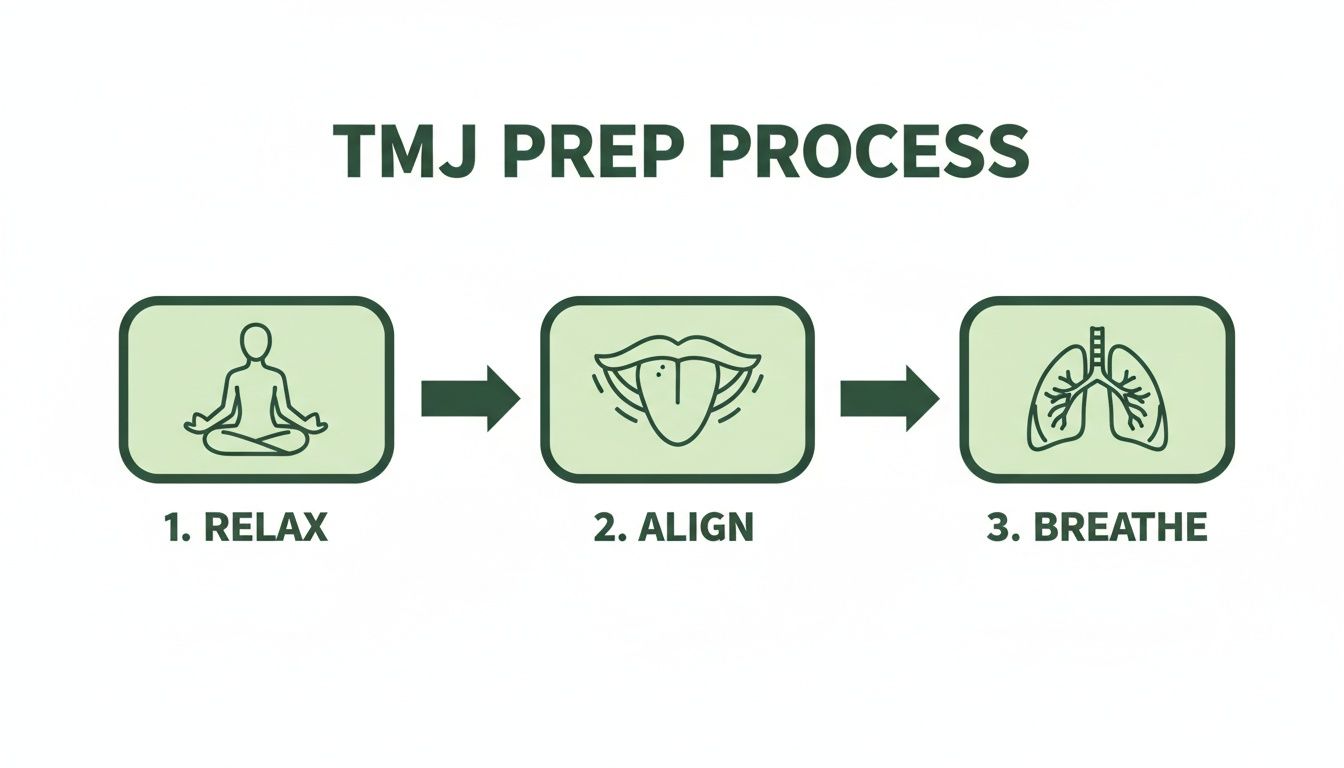
Starting with a moment to relax your body, check your posture, and focus on your breathing gets your jaw ready for safe, effective movement. It makes a bigger difference than you might think.
Gentle Stretches to Release Jaw Tension
Think of these as a long-overdue "sigh of relief" for your jaw muscles. Day-to-day stress, unconscious clenching, and nighttime grinding can make muscles like the masseter and temporalis incredibly short and tight. These simple movements help gently lengthen those muscle fibers, which boosts blood flow and eases that constant feeling of tightness.
1. The Relaxed Jaw Stretch
This is the simplest move in the book, but it's one of the most powerful.
- Start with your tongue resting lightly on the roof of your mouth.
- Let your teeth part slightly and just allow your jaw to hang, heavy and relaxed.
- Slowly let your mouth open as wide as feels comfortable, feeling a nice, easy stretch along the sides of your face.
- Hold it there for 5-10 seconds, then slowly bring it back.
Do this 6 times per session. The key here is not to force it open; let gravity do most of the work for you.
2. The Side-to-Side Stretch
This stretch gets into different muscle fibers and helps improve that side-to-side movement.
- Place something thin, like a coffee stirrer or a couple of stacked tongue depressors, between your front teeth.
- Gently and slowly glide your jaw from one side to the other.
- Keep the motion smooth and controlled. No jerky movements.
Perform 6 repetitions to each side. It's common to feel one side is tighter than the other—if that's you, feel free to hold the stretch on that tight side for an extra couple of seconds.
Controlled Strengthening to Build Stability
Stretching is fantastic for releasing tension, but strengthening is what provides real, long-term stability. When your jaw muscles are weak or uncoordinated, they can't support the joint properly, leading to instability and that all-too-familiar clicking sound.
These are isometric exercises, which means they build strength without a lot of movement, making them very safe for sensitive joints.
1. Resisted Opening
This one strengthens the muscles that help you open your mouth.
- Place your thumb or a couple of fingers under your chin.
- As you slowly start to open your jaw, apply gentle upward pressure with your thumb to create some resistance.
- Hold that tension for 3-6 seconds.
- Slowly relax and close your mouth.
Aim for 6 repetitions. The goal is light, consistent pressure that engages the muscles without causing any strain.
2. Resisted Closing
Now, let's work the closing muscles.
- Place your thumb on your chin and your index finger in the little groove between your chin and lower lip.
- Gently grip your chin and apply a light downward pressure as you slowly close your mouth.
- Hold against that resistance for 3-6 seconds.
Again, complete 6 repetitions. This movement helps retrain the powerful closing muscles, like the masseter, teaching them to work more efficiently instead of just clenching down with brute force.
The science behind combining stretching and strengthening is incredibly solid. One major review of physiotherapy for TMJ found that pairing exercises with manual therapy led to an impressive 65% reduction in pain intensity. It also helped increase maximum mouth opening by 4-6 mm—a huge deal for anyone feeling locked up.
Another trial showed that patients in a dedicated jaw exercise group saw significant drops in pain, headache frequency, and their need for pain medication compared to a control group. You can read more about the research behind these positive outcomes in jaw physiotherapy.
Mobility Drills to Restore Function
Okay, we've released tension and started building strength. The final piece of the puzzle is restoring smooth, coordinated movement. These drills are all about neuromuscular re-education—basically, retraining the joint to track correctly and reduce those clicks and pops.
The most well-known and effective drill for this is "The Goldfish."
The Goldfish Exercise (Partial Opening)
This exercise helps isolate the pure rotational movement of the TMJ, promoting better joint mechanics.
- Place your tongue on the roof of your mouth.
- Put one index finger on your chin and the other on the TMJ itself (right in front of your ear).
- Keeping your tongue up, drop your lower jaw down about halfway and then close it.
- You should feel a smooth, rotating motion in the joint under your finger.
The Goldfish Exercise (Full Opening)
This is simply the next step up.
- Keep your tongue and finger positions exactly the same.
- This time, drop your jaw all the way down and then bring it back up.
- The movement should stay smooth and controlled from start to finish.
For both versions, a great starting point is the "Rule of 6": 6 repetitions for 6 sets spread throughout the day. This frequent, gentle practice is far more effective than one long, intense session.
Important Takeaway: Consistency will always beat intensity. A few minutes dedicated to these tmj pain treatment exercises several times a day will deliver much better results than an aggressive, once-a-day routine that could easily cause a flare-up.
Structuring Your Daily Routine
Putting this all together into a daily schedule is what makes it stick. You don't need to block out a huge chunk of your day. The trick is to weave these short routines into your existing schedule—maybe while you wait for your coffee to brew or during a break from your computer.
Here’s a sample plan to show you how simple it can be.
Your Daily TMJ Exercise Routine
This beginner schedule organizes the exercises into a simple, manageable daily plan.
| Exercise Type | Exercise Name | Repetitions & Sets | Frequency |
|---|---|---|---|
| Gentle Stretch | Relaxed Jaw Stretch | 6 Reps / 1 Set | Morning, Mid-day, Evening |
| Strengthening | Resisted Opening | 6 Reps / 1 Set | Morning & Evening |
| Strengthening | Resisted Closing | 6 Reps / 1 Set | Morning & Evening |
| Mobility Drill | The Goldfish (Partial/Full) | 6 Reps / 6 Sets | Spread throughout the day |
This structure ensures you're consistently releasing tension, building support, and improving function without ever overwhelming the joint.
As you get more comfortable, you can gradually increase the hold times for the stretches and resistance exercises. But always, always listen to your body. If pain increases, scale back. This routine is your personal tool for managing your symptoms and finally taking back control of your jaw health.
Fixing Posture and Stress to Support Your Jaw
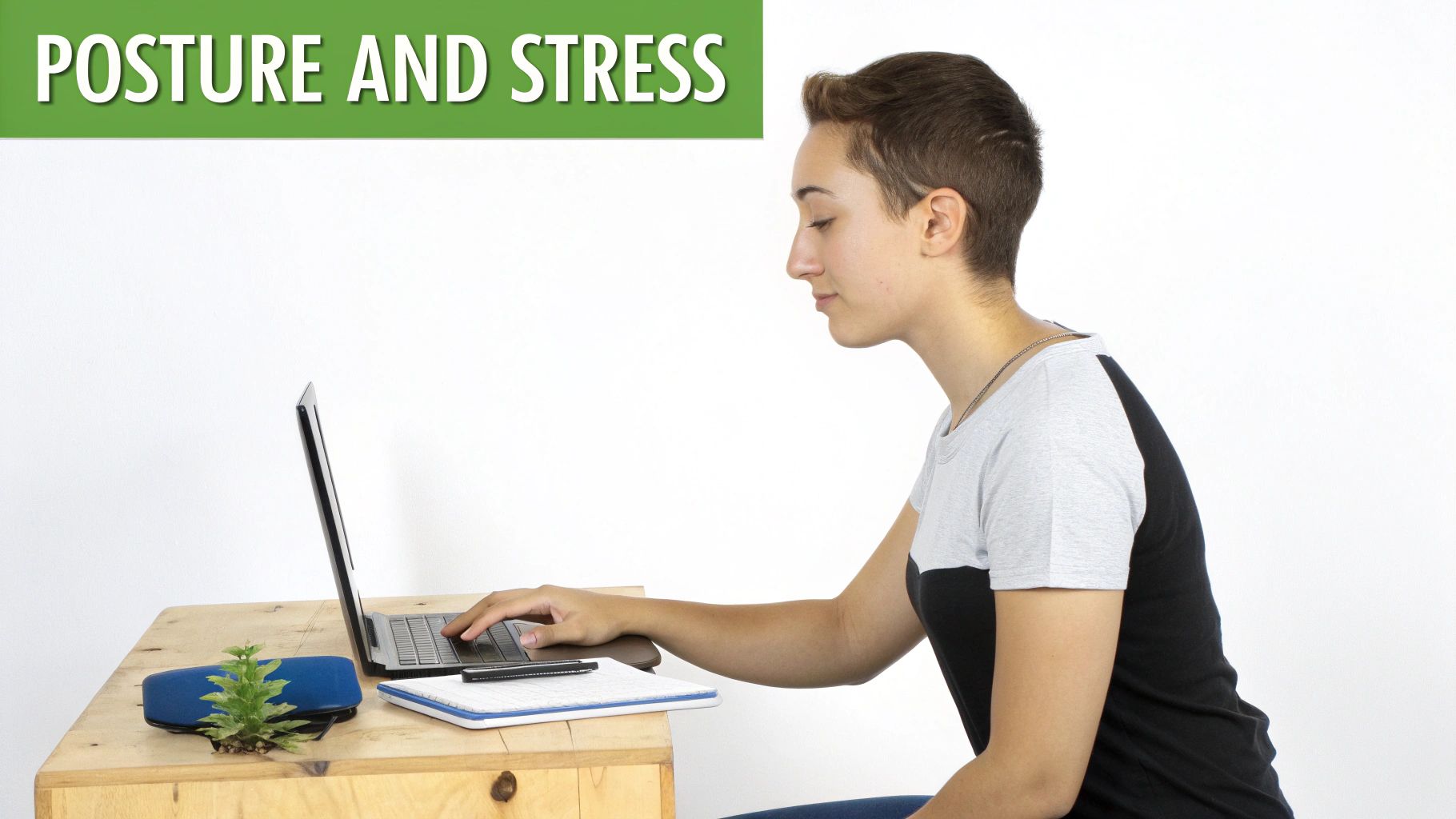
If you've been consistent with your core tmj pain treatment exercises but still feel that nagging tightness, it's time to look beyond the jaw itself. I like to think of the jaw as part of an intricate system—like a suspension bridge where your head, neck, and shoulders are the support towers. If those towers are out of alignment, the bridge will be under constant strain.
The same principle applies to your jaw. Two of the biggest culprits that destabilize this entire system are poor posture and chronic stress. They often feed off each other, creating a vicious cycle of tension that can completely undermine even the best exercise routine. Tackling these hidden triggers isn't just an optional add-on; it's a critical step toward finding real, lasting relief.
The Problem with "Tech Neck" Posture
We spend hours every day hunched over screens, pushing our heads forward and rounding our shoulders. This all-too-common posture, often called "tech neck," has a direct and damaging effect on the jaw. For every single inch your head juts forward, it adds roughly 10 pounds of extra weight for your neck and upper back muscles to carry.
That strain doesn't just stay in your neck, either. It radiates upward, tightening the very muscles that connect to and control your jaw. A forward head position actually forces your lower jaw to pull back and down, putting the TMJ into a compressed, unnatural state. This makes it nearly impossible for your jaw muscles to relax, no matter how many goldfish exercises you perform.
Correcting this imbalance is crucial. A few simple, targeted postural exercises can start to counteract the daily grind of tech neck and give your jaw the stable foundation it needs.
Here are two highly effective movements you can do right at your desk:
- Chin Tucks: Sit up tall, imagining a string gently pulling the crown of your head toward the ceiling. Without tilting your head, draw your chin straight back as if you're making a double chin. You should feel a nice stretch at the back of your neck. Hold it for 3-5 seconds and repeat 10 times.
- Shoulder Blade Squeezes: While sitting or standing, let your shoulders drop away from your ears. Now, gently squeeze your shoulder blades together like you’re trying to hold a pencil between them. Hold the squeeze for 3-5 seconds and repeat 10-15 times. This is fantastic for opening up your chest and resetting your shoulder position.
Breaking the Stress-Clenching Cycle
Stress is the other major piece of the TMJ pain puzzle. When you're stressed or anxious, your body’s “fight or flight” response kicks in, causing muscles to tighten up without you even noticing. For so many people, that tension goes straight to the jaw, leading to clenching and grinding (bruxism).
This isn't just a nighttime issue. I see patients all the time who clench their jaws throughout the day—especially when concentrating on a tough task or feeling overwhelmed. This constant muscle contraction overworks the powerful masseter and temporalis muscles, causing fatigue, soreness, and referral pain that often manifests as tension headaches. (We explore this connection more in our guide on how to treat tension headaches naturally.)
The connection is undeniable: managing your stress is a direct form of TMJ treatment. By calming your nervous system, you reduce the subconscious signals telling your jaw to tighten up.
Integrating simple relaxation techniques into your daily and nightly routines can make a world of difference. The goal here is to create moments of intentional release, re-teaching your facial muscles how to let go of that tension.
Simple Relaxation Techniques for Your Jaw
- Facial Muscle Melt: Close your eyes and take a few slow, deep breaths. On purpose, clench all the muscles in your face—squint your eyes, purse your lips, and clamp your jaw shut—for five seconds. Then, as you exhale, release everything completely. Let your jaw hang loose and heavy.
- Warm Compress: Before bed, apply a warm, moist towel to the sides of your face for 10-15 minutes. The gentle heat boosts blood flow and helps those tight muscles relax, making it easier to fall asleep without clenching.
- Mindful Bedtime Routine: For the last 30 minutes before you plan to sleep, put away the screens. Try listening to calming music, doing some light stretching, or practicing deep diaphragmatic breathing. This helps shift your nervous system out of "go mode" and into a restful state, reducing the chances of nighttime grinding.
By combining these postural and relaxation strategies with your targeted tmj pain treatment exercises, you create a much more complete and effective approach. You’re no longer just chasing symptoms in your jaw; you’re addressing the root causes found in your daily habits and environment. This is how you build a resilient, pain-free system from the ground up.
When to Combine Exercises with Professional Care
A consistent routine of TMJ pain treatment exercises is an incredibly powerful tool. It puts you in the driver’s seat, giving you direct control over your recovery. But it’s just as important to recognize that exercises are one piece of a much larger puzzle.
Knowing when to bring in a professional isn’t a sign of failure—it’s about being smart and strategic with your health. While you can manage mild discomfort or muscle fatigue at home, some symptoms are your body's way of telling you that something more complex is going on under the surface.
Recognizing Urgent Red Flags
If you experience any of the following, it’s time to pause the home routine and schedule a professional evaluation right away:
- A Locked Jaw: This is a big one. If your jaw gets stuck open or closed, it’s a clear indicator of a significant joint issue.
- Severe, Worsening Pain: Gentle movement shouldn't make things worse. If your exercises cause the pain to become sharper or more intense, stop immediately.
- A Sudden Change in Your Bite: Your teeth suddenly don't seem to fit together correctly? This could point to a change within the joint structure itself.
- Significant Clicking Paired with Pain: Painless clicking is common and often not a major concern. But when that click is accompanied by a sharp pain, it can suggest a displaced or damaged articular disc.
These aren't things to push through. They often point to underlying problems that exercises alone can't fix, like internal joint damage, severe inflammation, or significant disc displacement.
Why a Professional Diagnosis Is Key
Getting a thorough diagnosis from a specialist does more than just confirm you have TMJ dysfunction; it uncovers the why.
For instance, that chronic jaw pain might actually be linked to an undiagnosed sleep-related breathing disorder, where your jaw is working overtime all night just to keep your airway open. Or maybe it stems from grinding your teeth in your sleep, a habit you might not even be aware of. You can learn more about that in our guide on how to stop teeth grinding at night.
A specialist can connect the dots between your jaw pain and other factors like airway health, posture, and sleep quality. This detailed assessment ensures your treatment plan addresses the root cause, not just the symptoms.
Exercises are most effective when they're part of a targeted strategy built on an accurate diagnosis. They become the perfect complement to other non-surgical therapies.
For example, after regenerative treatments like Platelet-Rich Fibrin (PRF) injections or prolotherapy, these very exercises are vital for stabilizing the joint and maintaining progress. They help make sure the results from advanced therapies are long-lasting. When you work with a professional, your home routine becomes a collaborative, guided part of your complete recovery plan.
Your Top Questions About TMJ Exercises, Answered
As you start working these movements into your day, you're bound to have some questions. That's a good thing—it means you're paying attention to your body. Let's tackle some of the most common things people ask when starting TMJ pain treatment exercises.
How Long Until I Feel Relief from TMJ Exercises?
This is usually the first question on everyone's mind, and the honest answer is: it's different for everyone. That said, most people feel a noticeable reduction in muscle tension and tightness within the first one to two weeks of doing the exercises consistently every day.
More significant changes, like fewer headaches or smoother jaw function, often take a bit longer to show up. You can typically expect to see those kinds of improvements within 4 to 8 weeks. The single biggest factor here is consistency. A few gentle sessions spread throughout the day will always be more effective than one long, intense session once in a while.
Should I Feel Pain When Doing These Exercises?
Absolutely not. You might feel a gentle stretch or notice the muscles working, but you should never feel sharp, shooting, or worsening pain. The old "no pain, no gain" mantra has no place in TMJ therapy. Pain is your body's way of saying, "stop."
If a particular movement hurts, the first thing to do is back off. Try making the movement smaller or using less pressure. If it still causes pain, skip that exercise for now and consider getting a professional opinion. These movements are meant to bring relief, not add stress.
Remember, the goal of these exercises is to calm and re-educate your neuromuscular system. Pushing through pain can create more inflammation and set back your progress.
Can Exercises Really Help My Jaw Clicking and Popping?
Yes, in many cases, they can. That clicking or popping sound you hear is often the small articular disc inside your jaw joint slipping slightly out of place as you move. It’s a sign of poor coordination.
By consistently performing these exercises, you're working on two key things:
- Strengthening the tiny muscles that help stabilize the joint.
- Improving the overall coordination of how your jaw moves.
This one-two punch helps the disc track more smoothly with the joint, which can dramatically reduce—or even eliminate—the noise over time. However, if your clicking is accompanied by pain or your jaw gets stuck (locks), it's crucial to see a specialist to make sure there isn't a more serious internal joint issue.
Will I Have to Do These Exercises Forever?
Think of it less as a forever chore and more like good physical maintenance, similar to how you might stretch to keep your back healthy. In the beginning, you'll need to be diligent to help retrain your muscles and get your symptoms under control.
Once your jaw is feeling and functioning better, you can usually scale back to a maintenance routine. This might mean doing the exercises just a few times a week to keep the joint mobile and the muscles strong. The real key to long-term success is integrating good posture and stress management into your daily life to keep symptoms from coming back.
At the Pain and Sleep Therapy Center, we specialize in diagnosing the root causes of jaw pain to create a treatment plan that goes beyond temporary relief. If your symptoms persist or you need expert guidance, visit us at https://pscharlotte.com to schedule a comprehensive evaluation.