For a lot of people, the nightly CPAP machine ritual feels more like a burden than a solution. You know you need it, but the thought of wrestling with the mask, hose, and noise is exhausting. While Continuous Positive Airway Pressure (CPAP) is the most well-known treatment, it’s far from the only one. There are highly effective sleep apnea treatment options without CPAP, including custom-fit oral appliances, specialized exercises, and even advanced nerve stimulation that can give you back your freedom.
Exploring Life Beyond the CPAP Mask
If you’re frustrated with your CPAP, you are definitely not alone. The constant hum, the claustrophobic feeling of the mask, and the strap marks in the morning are all common complaints that push people to look for a better way. It’s a tough spot to be in: you need to treat your obstructive sleep apnea (OSA) for your health, but the solution itself feels impossible to live with. This isn't a failure on your part; it's a sign that your treatment needs to fit your life and your anatomy.
The great news is that a world of comfortable, effective solutions exists beyond the mask. Think of OSA as a physical problem, like a garden hose getting kinked. CPAP works by forcing air through the kink to open it up. Other methods work by preventing the hose from kinking in the first place. This guide is your map to exploring those alternatives.
A New Approach to Restful Sleep
Instead of a one-size-fits-all prescription, modern sleep medicine focuses on finding a personalized solution that you can actually stick with long-term. At the end of the day, consistency is what matters most for managing sleep apnea and protecting your health. These non-CPAP treatments are designed to fit into your life, not make it more complicated.
We’re going to walk through several powerful alternatives that can be matched to different needs, anatomies, and levels of OSA severity.
- Oral Appliance Therapy (OAT): Imagine a custom-made mouthguard that you wear only at night. It gently shifts your lower jaw forward just enough to keep your airway naturally open while you sleep. It’s silent and simple.
- Orofacial Myofunctional Therapy (OMT): This is like physical therapy for the muscles of your tongue, throat, and face. These simple, targeted exercises strengthen the muscles that support your airway, addressing one of the root causes of its collapse.
- Buteyko Breathing: This technique retrains your breathing patterns to be calmer and more efficient. It helps improve your body’s oxygen levels and reduces the stress that disordered breathing puts on your system overnight.
- Advanced Interventions: For certain cases, options like hypoglossal nerve stimulation (Inspire) or surgical referrals can provide a permanent solution by directly correcting anatomical blockages.
The best sleep apnea treatment is the one you will actually use every night. CPAP compliance is a major hurdle for so many people, which makes exploring these alternatives a critical step toward getting healthy, restorative sleep.
This guide will give you the knowledge you need to have a meaningful conversation with a specialist about sleep apnea treatment options without CPAP. Once you understand the full range of possibilities, you can confidently find a path forward. A better night’s sleep isn’t just a dream—it’s an achievable reality.
Why CPAP Is Not Always the Perfect Fit
For decades, Continuous Positive Airway Pressure (CPAP) has been considered the "gold standard" for treating obstructive sleep apnea (OSA). For many people, it is truly life-changing, finally restoring healthy, restful breathing through the night.
The machine works by pushing a steady stream of pressurized air through a mask, which acts like an invisible support to keep your airway from collapsing. Think of your airway as a flexible garden hose that gets kinked when you lie down. CPAP forces air through that hose to pop the kink open, allowing air to flow freely again.
While this approach is incredibly effective at preventing the collapse, it doesn’t actually address why the hose is kinking in the first place. This is a critical distinction, because while the principle is solid, the real-world experience of using a CPAP machine every single night doesn't work for everyone.
Moving Beyond the Mask and Hose
The reasons people struggle with CPAP are deeply personal and incredibly varied. For some, it’s the sheer physical discomfort of the mask, which can lead to skin irritation, sores, or a suffocating feeling of claustrophobia. For others, the constant air pressure leaves them with a painfully dry mouth or nose, even with a humidifier.
The noise from the machine can be a major disruption for both the user and their partner, turning the bedroom from a peaceful sanctuary into a medical zone. Beyond that, the sheer inconvenience of packing a bulky machine for travel or trying to find a power source while camping makes it an impractical choice for anyone with an active lifestyle.
These are not minor complaints. They are significant daily hurdles that lead an estimated 30-60% of users to stop using their CPAP machine consistently, if at all.
Finding the right treatment isn’t a matter of willpower; it’s about matching a solution to your specific anatomy, lifestyle, and comfort. Struggling with CPAP isn't a personal failure—it’s a clear signal that a different approach is needed.
Finding a Solution That Fits Your Life
When we understand these very real challenges, we can reframe the conversation around sleep apnea treatment options without CPAP. The focus shifts from simply forcing compliance with a difficult therapy to finding a solution that fits seamlessly and comfortably into your life. The real goal is to uncover a treatment that gets to the root cause of your airway collapse.
This is exactly why a personalized assessment is so important. Is your sleep apnea caused by your tongue falling back into your throat? Is it the anatomy of your soft palate? Or does it only happen when you sleep in a certain position? Each of these root causes points toward a different, more effective non-CPAP solution.
For example, if your airway collapses because of your jaw position, a custom-fitted oral appliance might be the most direct and comfortable fix. If the problem is due to weak muscles in and around the airway, targeted exercises could strengthen them. This tailored approach dramatically increases the odds of finding a treatment you can stick with for the long haul.
Common CPAP Issues and Their Corresponding Alternatives
To help you connect the dots between your specific CPAP challenges and a potential solution, we've put together this table. It's designed to show you how different non-CPAP therapies directly address the most common complaints about CPAP.
| CPAP Challenge | Potential Cause | Effective Non-CPAP Solution |
|---|---|---|
| Mask Discomfort/Claustrophobia | Feeling restricted by the mask, straps, and headgear. | Oral Appliance Therapy offers a small, discreet, in-mouth device with no external parts. |
| Air Pressure Intolerance | Difficulty exhaling against the air, aerophagia (air swallowing), bloating. | Buteyko Breathing retrains breathing patterns to be lighter and more efficient, reducing the need for forced air. |
| Noise Disruption | The machine's sound disturbs you or your bed partner. | Oral Appliance Therapy and Myofunctional Therapy are silent solutions. |
| Travel Inconvenience | The machine is bulky, requires electricity, and is hard to pack. | Oral Appliance Therapy is small enough to fit in your pocket and requires no power. |
| Dry Mouth or Nose | Constant airflow dries out the nasal and oral passages. | Myofunctional Therapy and Buteyko Breathing promote proper nasal breathing, which naturally humidifies air. |
| Inconsistent Use/Adherence | The therapy feels like too much of a hassle to use every night. | All non-CPAP options (Oral Appliances, Myofunctional Therapy, Inspire) are designed for greater comfort and ease of use, leading to better long-term adherence. |
Ultimately, recognizing that CPAP isn't a one-size-fits-all solution is empowering. It validates your experience and opens the door to exploring other proven therapies designed for comfort, portability, and consistency. Your journey to better sleep doesn't have to be a battle with your treatment; it can be a partnership with a solution that truly works for you.
Oral Appliance Therapy: The Leading CPAP Alternative
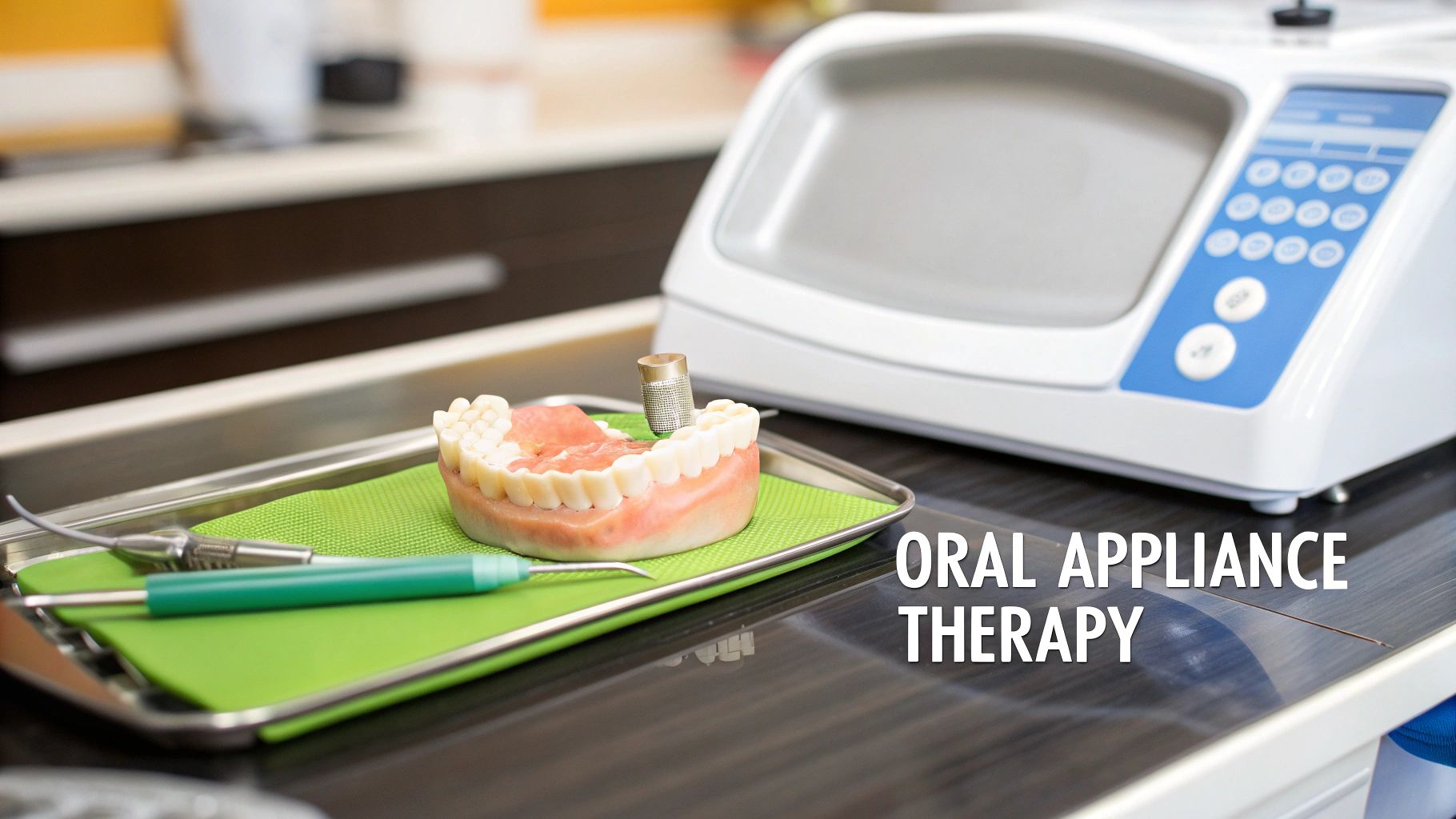
When people start looking for sleep apnea treatment options without CPAP, the first thing they almost always find is Oral Appliance Therapy (OAT). It’s widely known as the go-to alternative, and for good reason—it offers a powerful combination of clinical effectiveness and real-world comfort that many patients find absolutely liberating.
Think of a custom-fit mouthguard, sort of like an orthodontic retainer but far more sophisticated. A professionally made oral appliance is engineered with incredible precision to gently shift your lower jaw (the mandible) slightly forward while you sleep.
This subtle repositioning is just enough to open up space at the back of your throat. It prevents your tongue and other soft tissues from collapsing backward and blocking your airway. It’s a simple, elegant, mechanical solution to what is, at its core, a mechanical problem.
By keeping the airway stable, the appliance lets you breathe easily and continuously all night long. No mask, no hose, no noisy machine.
The Patient Journey: From Consultation to Comfort
Getting started with an oral appliance is a refreshingly straightforward process when you're guided by a specialist. This isn't a one-size-fits-all device; your therapy is built entirely around your unique anatomy.
- Comprehensive Evaluation: It all starts with a detailed assessment. We’ll review your sleep study results, examine your jaw, teeth, and airway, and have a real conversation about your symptoms and lifestyle.
- Precise Digital Impressions: Gone are the days of goopy, uncomfortable physical molds. We use quick and comfortable 3D digital scanners to create a perfect, pinpoint-accurate model of your mouth.
- Custom Fabrication: Those digital scans are then sent to a specialized dental lab where your FDA-approved appliance is meticulously crafted from high-quality, medical-grade materials.
- Fitting and Titration: When your appliance is ready, you'll come in for a fitting to make sure it’s comfortable and secure. We’ll show you exactly how to use it and make the initial adjustments. Over the next few weeks, you'll gradually advance the jaw position—a process called titration—to find that "sweet spot" where your airway gets maximum support with minimum strain.
This careful, personalized approach is the key to success. You can find out more about what to look for when choosing a sleep apnea dentist near me to ensure you receive true expert care.
Why Patients Choose Oral Appliances
The appeal of OAT goes far beyond just not being a CPAP. Patients consistently report a better quality of life because of a few key advantages that make them actually want to use their device every night.
- Complete Silence: No motors, no pumps, no humming. It's a totally silent solution for both you and your bed partner.
- Ultimate Portability: The device is small enough to fit in your pocket. Traveling is a breeze—no extra bags, no searching for power outlets.
- Ease of Use: Cleaning and maintenance are incredibly simple, just like caring for a retainer. This lack of hassle is a huge reason for high compliance rates.
For many people with mild to moderate obstructive sleep apnea, Oral Appliance Therapy strikes the perfect balance of effectiveness, comfort, and convenience. It makes consistent treatment an achievable reality, not a nightly chore.
The data backs this up. Studies show that in well-suited candidates, OAT can slash the Apnea-Hypopnea Index (AHI) by 50-70%. Even more importantly, patient adherence rates often soar above 80%—a number that blows typical long-term CPAP compliance out of the water.
The Critical Difference: Why a Custom Fit is Non-Negotiable
It is absolutely vital to understand the night-and-day difference between a professionally prescribed oral appliance and the cheap "boil-and-bite" mouthguards you see online.
Those over-the-counter devices are not FDA-approved for treating sleep apnea and can be genuinely risky. They fit poorly, can cause jaw pain or even shift your teeth, and offer no way to make the precise adjustments needed for effective therapy.
A custom-fabricated, titratable appliance from a qualified specialist is the only way to ensure your treatment is both safe and effective. That personalized fit is the cornerstone of successful Oral Appliance Therapy, making it a top-tier choice for anyone ready to live a life free from the CPAP mask.
Strengthening Your Airway With Therapeutic Exercises
While devices and appliances do a great job of supporting your airway, some of the most empowering sleep apnea treatment options without CPAP involve actively strengthening the very muscles that are supposed to keep it open in the first place.
Think of it like physical therapy for your breathing. Instead of just propping the airway open, these methods build its natural strength and stability from the inside out.
Two powerful, non-invasive approaches lead the way here: Orofacial Myofunctional Therapy (OMT) and Buteyko Breathing. These therapies aren’t just quick fixes; they’re lifelong skills that give you back control over your breathing mechanics.
They work incredibly well on their own for many people and can also be combined with treatments like oral appliances to make them even more effective. At their core, these exercises get to the root causes of airway collapse, like poor tongue posture, weak throat muscles, and dysfunctional breathing patterns.
Orofacial Myofunctional Therapy: Building a Stronger Airway
Orofacial Myofunctional Therapy (OMT) is a series of targeted exercises for the muscles of your tongue, lips, cheeks, and throat. The main goal is to correct poor muscle habits and promote a healthy resting posture—especially getting your tongue to rest gently against the roof of your mouth, right where it belongs.
When your tongue rests low in your mouth, it’s much more likely to fall back and block your airway during sleep. OMT strengthens the tongue and surrounding muscles, essentially teaching them to stay in their proper place and prevent that collapse. It’s a proactive strategy that directly addresses the "why" behind the blockage.
This approach has gotten a lot of attention for just how well it works. Myofunctional therapy offers a natural, exercise-based alternative that can reduce AHI (the number of apnea events per hour) by an average of 50%.
One major review of over 20 studies found that participants cut their apnea events from an average of 15-20 per hour down to just 7-10. On top of that, 62% reported feeling less sleepy during the day. It’s a powerful tool for rebuilding your airway’s natural support system.
Buteyko Breathing: Retraining Your Breathing Patterns
While OMT focuses on muscle strength and posture, Buteyko Breathing zeroes in on how you breathe. Many people with sleep-disordered breathing actually tend to over-breathe, or subtly hyperventilate, especially at night. It sounds backward, but breathing too much or too quickly can throw off the delicate balance of oxygen and carbon dioxide in your blood, making your airway less stable.
The Buteyko Method teaches you to restore a calmer, lighter, and more efficient breathing pattern, primarily through your nose.
The core idea behind Buteyko is simple but profound: by normalizing your breathing volume, you improve your body's oxygen delivery and stabilize your entire respiratory system. This takes a lot of stress off your airway at night.
This retraining involves simple exercises that help you become more aware of your breathing so you can consciously make it quieter and slower. The benefits often include:
- Improved Nasal Breathing: It encourages you to breathe through your nose, which naturally filters, warms, and humidifies the air.
- Reduced Hyperventilation: This calms your respiratory system and prevents the chaotic breathing that can trigger apneas.
- Increased CO2 Tolerance: It helps your body become more efficient at using oxygen, leading to much more stable breathing while you sleep.
Both OMT and Buteyko Breathing are incredible tools that put you in the driver's seat. They require commitment, but the payoff is a stronger, more stable airway and a real sense of control over your health. For a closer look at specific exercises, check out our guide on the best exercises for sleep apnea.
Advanced and Surgical Options for Lasting Relief
Sometimes, lifestyle changes, specific exercises, or even custom oral appliances don't quite get you across the finish line. When that happens, it’s not the end of the road. For some people, a more advanced or surgical approach is actually the most direct path to finally resolving their obstructive sleep apnea.
These treatments are usually considered when there's a specific anatomical reason for the airway collapse, or when other non-invasive therapies just haven't delivered the results you need. Stepping into this territory is a big decision, and it always starts with a thorough evaluation from a specialist to see if you’re a good candidate. It's a team effort, focused on matching the right solution to your unique airway and health profile.
Hypoglossal Nerve Stimulation: A Pacemaker for Your Tongue
One of the most incredible sleep apnea treatment options without CPAP is hypoglossal nerve stimulation, known best by its brand name, Inspire. Think of it as a smart pacemaker, but for your tongue. It’s an implantable device that works with your body’s own breathing rhythm to keep your airway open while you sleep.
Here’s the breakdown: a small generator, similar to a pacemaker, is placed under the skin in your upper chest. This is connected to two leads. One senses your breathing patterns, and the other sends a gentle pulse to the hypoglossal nerve—the nerve that controls your tongue’s movement.
When you take a breath in, the device stimulates the nerve just enough to move your tongue forward, preventing it from falling back and blocking your airway. The stimulation is timed perfectly with your own breathing and is so subtle that it doesn’t wake you or your partner. It’s simply there in the background, keeping things open so you can breathe naturally all night long.
Hypoglossal nerve stimulation is a game-changer for many people with moderate to severe OSA who just can't get along with CPAP. It gets to the root cause of tongue-based airway collapse without any mask, hose, or machine on your nightstand.
Getting approved for this therapy involves a careful screening process, which usually includes a drug-induced sleep endoscopy (DISE). This procedure lets a doctor see exactly how and where your airway is collapsing while you're asleep, confirming that the base of your tongue is the main culprit.
Surgical Solutions for Anatomical Issues
In some cases, the problem isn’t a floppy tongue but a distinct anatomical feature that’s physically blocking the airway. When that's the case, surgery can be a highly targeted and effective fix. These aren't one-size-fits-all procedures; they are specific interventions designed to correct the physical structures causing your sleep apnea.
The whole point of surgery is to permanently enlarge or stabilize your airway. A few of the most common surgical options include:
- Uvulopalatopharyngoplasty (UPPP): This procedure is all about creating more space at the back of your throat by removing or reshaping extra tissue from the soft palate and uvula.
- Maxillomandibular Advancement (MMA): This is a more involved surgery where a surgeon repositions both the upper and lower jaws forward. It sounds intense, but it dramatically opens up the entire airway and has one of the highest success rates for treating severe OSA.
- Nasal Surgery: Sometimes the issue is higher up. Procedures like a septoplasty (to fix a deviated septum) or turbinate reduction can clear blockages in your nasal passages. While nasal surgery alone rarely cures OSA, opening up the nose can make other treatments, like oral appliances, work much, much better.
Deciding to go the route of an advanced or surgical option is a significant step. It demands expert guidance and a comprehensive evaluation to make sure the benefits are worth it for your specific situation. Here at the Pain and Sleep Therapy Center, we help coordinate your care with top surgical specialists, ensuring you have a crystal-clear understanding of all your options on the path to better sleep.
Finding Your Personalized Treatment Plan
The journey to beating sleep apnea isn't about finding a single magic bullet; it's about building a personalized strategy. A successful outcome depends on a plan that is as unique as you are, one that gets to the specific reasons why your airway is collapsing at night. This approach moves beyond just managing symptoms to actually correcting the root cause.
It all starts with a diagnostic process that goes deeper than a standard sleep study. While a sleep study is great for telling us if you have apnea and how severe it is, it doesn't always tell us the "why." A truly comprehensive evaluation also looks at your jaw function, your specific airway anatomy, and even your unique breathing patterns.
This detailed analysis is what allows a specialist to create your personalized treatment roadmap.
Building Your Treatment Roadmap
Think of this process like a detective investigating a case. The initial clues from your sleep study are important, but the real breakthrough comes from examining all the evidence. Is your tongue falling back and blocking your airway? Are weak throat muscles the real culprit? Or is it the actual structure of your jaw?
Once we pinpoint the primary cause, we can select the right tools for the job. Your roadmap might involve a single, targeted therapy or a strategic combination of solutions.
- For Jaw-Related Collapse: Oral Appliance Therapy (OAT) is often the most direct and effective solution.
- For Weak Airway Muscles: A combination of OAT and Orofacial Myofunctional Therapy can provide both immediate support and long-term strength.
- For Complex Breathing Patterns: Adding Buteyko Breathing techniques can help stabilize your respiratory system, making other treatments even more successful.
The goal is to build a plan that not only works but that you can realistically stick with for the long term. This root-cause methodology is designed to deliver sustainable health outcomes, not just a temporary fix. By understanding precisely what is causing your sleep apnea, we can craft a solution that feels natural and integrates seamlessly into your life.
Navigating Your Treatment Decisions
Making these choices can feel overwhelming, but a clear diagnostic path makes the decision-making process much simpler. The following decision tree shows a simplified view of how different factors guide the selection of advanced sleep apnea treatment options without CPAP.
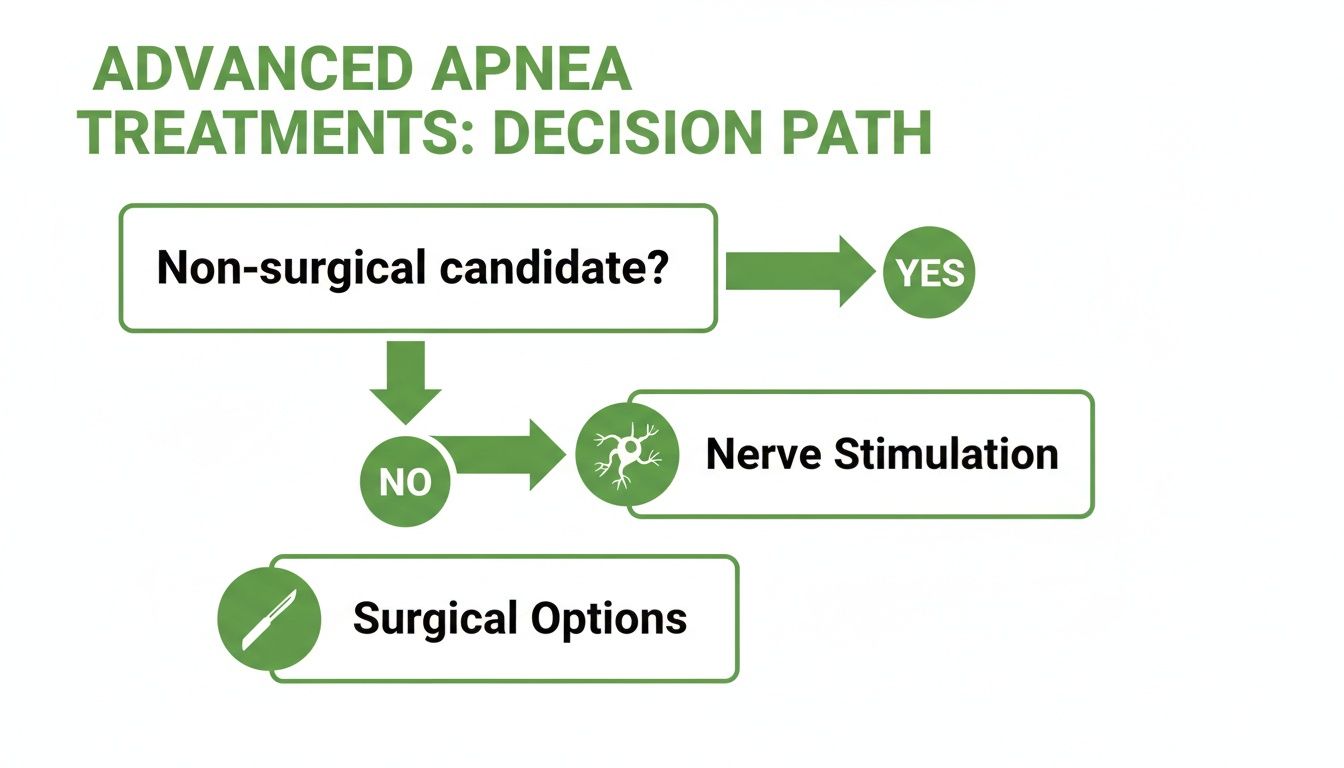
This visual highlights how your candidacy for non-surgical versus surgical interventions creates two distinct pathways toward finding lasting relief.
Ultimately, this deep-dive approach builds confidence and trust, ensuring you feel empowered and informed every step of the way. When you're ready to start this journey, finding the right expert is the most important first step. You can learn more about what this process looks like by connecting with a qualified sleep disorder specialist near me. Your path to restful sleep is clearer than you think.
Your Questions About CPAP Alternatives, Answered
When you start exploring life beyond a CPAP machine, it’s natural to have a lot of questions. It's a big step, and you want to be sure you're making the right choice for your health. Below, we've answered some of the most common questions we hear from patients looking for effective sleep apnea treatment options without CPAP.
Can You Really Treat Sleep Apnea Without a CPAP?
Yes, absolutely. For many people, especially those with mild to moderate obstructive sleep apnea, there are fantastic alternatives that can be just as effective as CPAP. The whole key is finding out why your airway is collapsing and matching the treatment to that root cause.
Success isn't a matter of luck; it's about good diagnostics. Once we understand the mechanics behind your specific airway obstruction, we can turn to proven, evidence-based methods like oral appliances, myofunctional therapy, or even simple positional aids that get the job done without a mask and hose.
What Is the Most Common Alternative to CPAP?
By far, the most common and well-regarded alternative is Oral Appliance Therapy (OAT). Think of it like a highly sophisticated, custom-fitted retainer that you wear only while sleeping. It works by gently shifting your jaw forward just enough to keep your airway open all night long.
Patients consistently tell us they prefer oral appliances because they're silent, comfortable, and easy to travel with. That simplicity is powerful—it leads to much higher rates of long-term use compared to CPAP, which means you're getting consistent, effective treatment night after night.
Do Over-the-Counter Mouthguards Work for Sleep Apnea?
No, and this is a critical point. Store-bought "boil-and-bite" guards are not a safe or effective substitute for a medical device. While they might claim to quiet your snoring, they are not FDA-approved to treat sleep apnea and lack the precision and adjustability needed for true therapy.
Trying to use a one-size-fits-all guard can actually cause more problems, including:
- Chronic jaw pain or TMJ disorders
- Shifting your teeth into the wrong position
- Giving you a false sense of security while your sleep apnea goes untreated
Only a custom-fabricated oral appliance, prescribed and managed by a qualified specialist, can safely and effectively treat your condition.
How Do I Know if a CPAP Alternative Is Actually Working?
The goal of any treatment is to help you feel and function better. The first signs that an alternative is working are the ones you'll notice yourself—waking up feeling more rested, having more energy throughout the day, and your partner reporting less (or no) snoring.
But feeling better is just one piece of the puzzle. The only way to be certain the treatment is working on a physiological level is through follow-up testing. A post-treatment sleep study gives us the hard data, showing that your Apnea-Hypopnea Index (AHI) has dropped and your oxygen levels are stable. That's how we know the treatment isn't just improving your symptoms; it's protecting your long-term health.
At the Pain and Sleep Therapy Center, we specialize in looking beyond one-size-fits-all solutions to create a personalized plan that works for you. If you're ready to explore comfortable, effective, and sustainable ways to treat your sleep apnea, we're here to help you find the right path forward. Learn more and schedule your consultation with our team.