You wake up with a sore jaw, a dull temple headache, and that same click when you chew breakfast. Maybe you've already started wondering if this is something you'll have to “fix” with an operation. That fear is often ahead of the evidence, because tmj treatment without surgery is still the standard starting point for the vast majority of patients with temporomandibular pain and dysfunction, and conservative care has long been the default approach in clinical practice PubMed review.
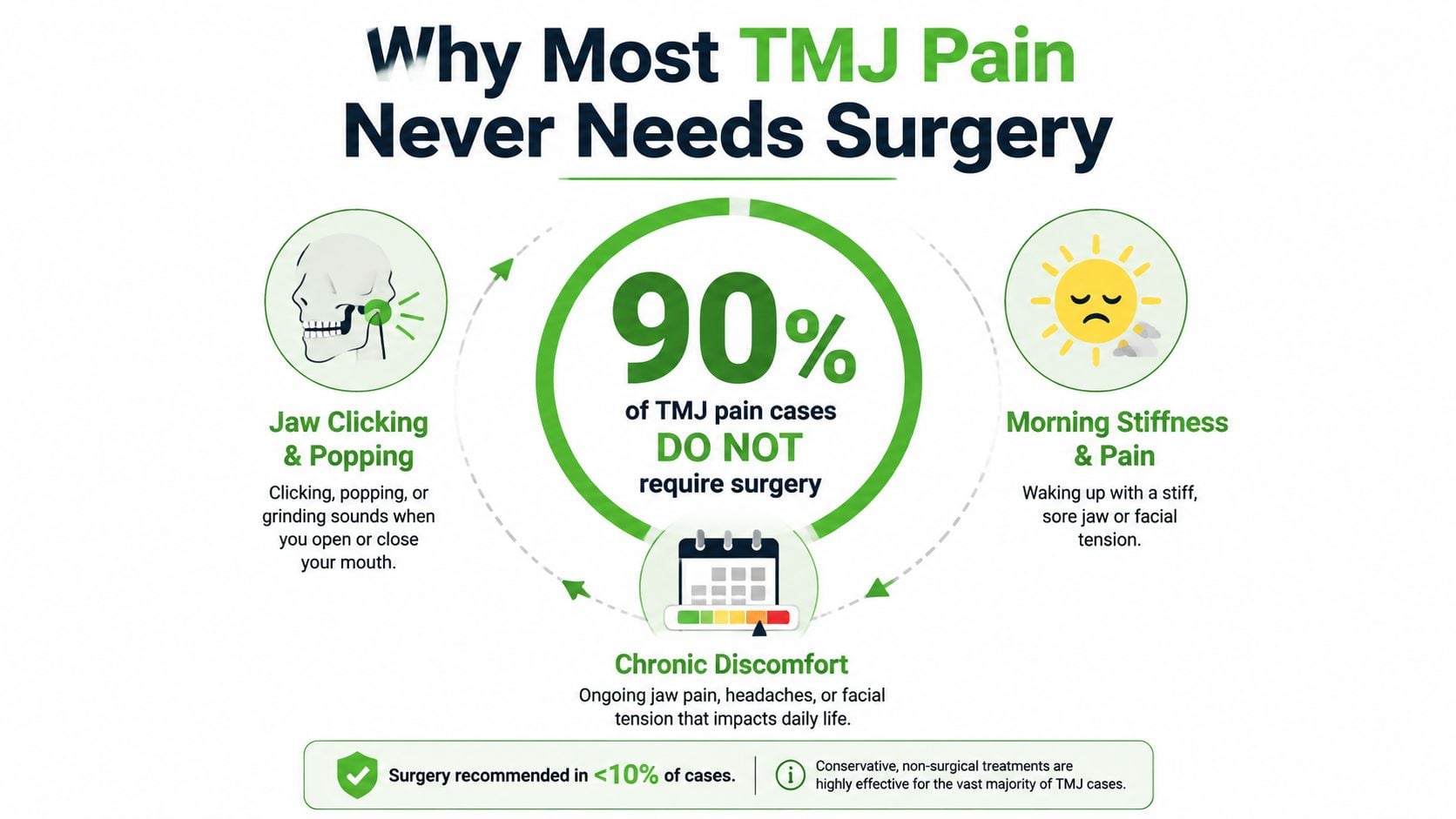
The reason this matters is simple. A 2015 AAFP review noted that only 5% to 10% of patients require treatment at all, 40% experience spontaneous symptom resolution, and long-term follow-up studies found 50% to 90% of patients had pain relief after conservative therapy. The same review reserved surgery for trauma, fracture, or persistent severe dysfunction lasting more than three to six months, which is why most patients should be thinking about reversible care first AAFP review.
That's also why a symptom like jaw clicking doesn't automatically point to surgery. In practice, I see many people improve once the joint load drops and the clenching cycle is interrupted. If you're looking for a parallel in how conservative care works elsewhere in the body, PosturaZen's nonsurgical scoliosis guide shows the same general principle, start with the least invasive approach that addresses the mechanical problem.
Why Most TMJ Pain Never Needs Surgery
A patient walks in convinced the jaw is “out of place” and needs an operation. In many cases, the problem is less dramatic than it feels. TMJ symptoms can look severe, with morning stiffness, popping, facial soreness, or headaches, yet the joint is often behaving like an overloaded system rather than a damaged one that needs a scalpel. That is why non-surgical care stays the first move in practice, especially when the goal is to calm pain and restore function without creating new problems.
What the evidence actually supports
Conservative care is not a placeholder. It is the main treatment path for most patients because it lowers joint load, reduces muscle guarding, and interrupts the habits that keep pain cycling. Early clinical guidance already pointed in that direction, and the practical lesson still holds: a large share of people with temporomandibular pain and dysfunction improve without surgery AAFP 2023 review.
Modern reviews support the same approach. A systematic review found that nonsurgical care, including occlusal splints, pharmacological treatments, exercise, posture training, and low-level laser therapy, can reduce pain, improve pain-free opening, and lessen dysfunction systematic review. The point is not to force a perfect jaw overnight. The goal is steadier chewing, less guarding, fewer flares, and a mouth that works more predictably day to day.
Practical rule: If the jaw still moves, even if it hurts, conservative care usually deserves a real trial before surgery enters the conversation.
Why surgery stays in the background
Surgery belongs in a narrower set of situations, such as trauma, fracture, or severe dysfunction that does not respond to months of appropriate conservative care review. It also carries real trade-offs. For some TMJ problems, the procedure can leave pain unchanged or create more dysfunction than the original complaint.
The better question is not whether the jaw sounds abnormal. It is what subtype is driving the symptoms. A clicking jaw with morning tightness points in one direction. A suddenly locked jaw after injury points in another. Muscle-driven pain, disc displacement, and closed lock do not respond the same way, so the treatment plan should match the pattern, not the label.
That is why I start by sorting the problem, then choosing the least invasive option that fits the actual subtype. The aim is a jaw that hurts less, moves better, and lets daily life feel manageable again.
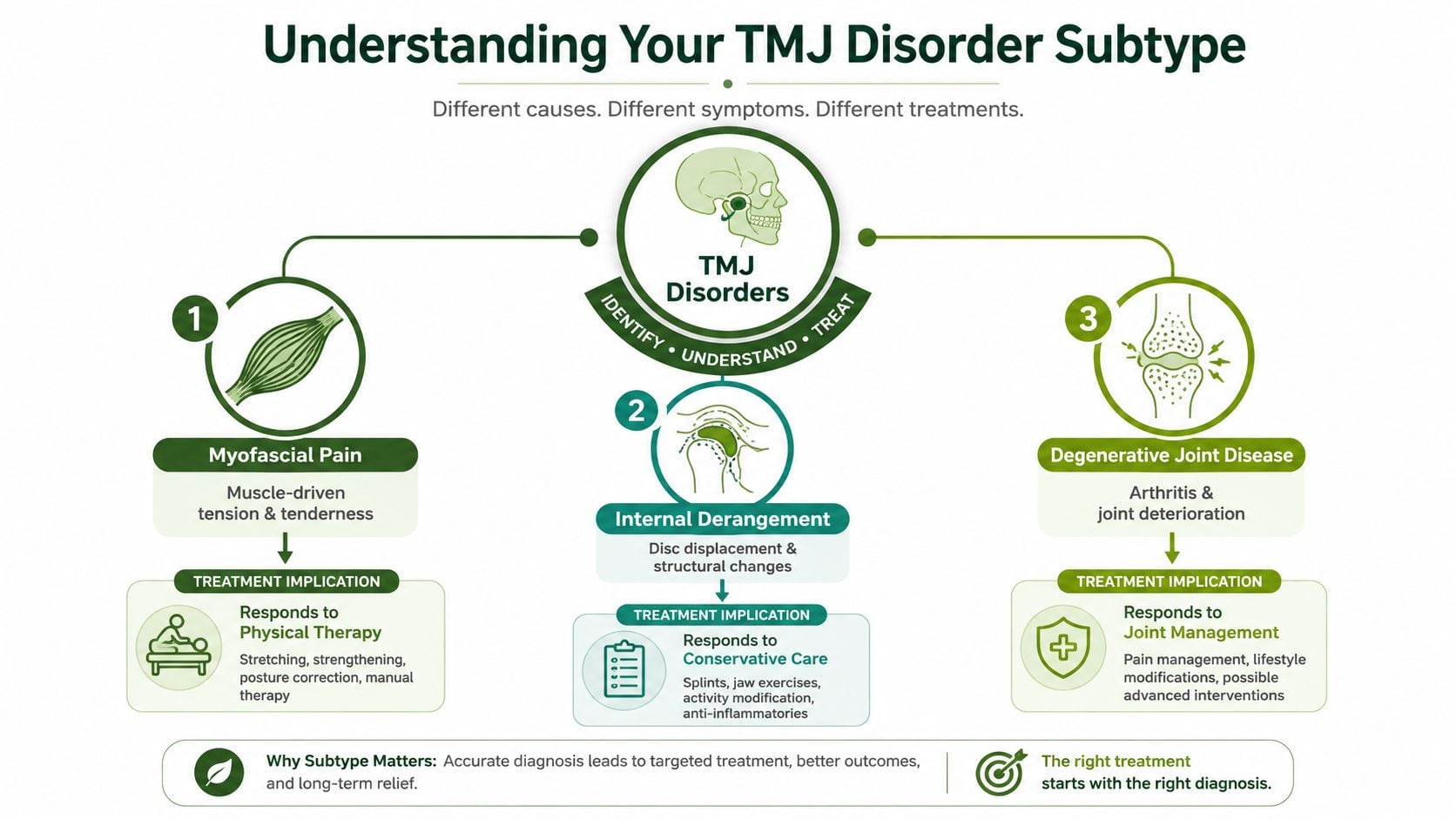
Understanding Your TMJ Disorder Subtype
A patient comes in saying, “My TMJ hurts.” That usually means more than one thing is happening. The joint, the disc inside it, and the surrounding muscles can each drive symptoms in different ways, and the right non-surgical plan depends on which structure is causing the problem. Generic lists of treatments miss that point and leave people trying random fixes.
Muscle-driven pain
This is the pattern I see most often in practice. Patients describe tightness in the cheeks, pain near the temples, tenderness on waking, or soreness after stressful days, and the jaw usually feels overworked rather than mechanically stuck. In plain terms, the muscles are carrying too much load for too long.
For this subtype, the most useful non-surgical tools are the ones that lower muscle demand. Education, habit correction, reducing clenching, physical therapy, and a well-fitted oral appliance can all help when nighttime grinding is part of the picture. For some patients, I also discuss ways to ease muscle tension with CBD if they are looking for an adjunct that fits into a broader conservative plan. The evidence base for conservative care fits this pattern well because the aim is to reduce strain and calm the system, which is the same logic behind the exercise approach outlined in this physical therapy TMJ exercises guide.
Joint derangement
Internal derangement usually means the disc is not moving in the smooth, coordinated way it should. Patients often notice clicking, catching, or intermittent deviation when opening. The problem can feel structural, and it is, but structural does not automatically mean surgical.
The joint here behaves like a hinge with a cushion that is no longer tracking neatly. The cushion, meaning the disc, can shift without destroying function. Conservative care still matters because pain often comes from the surrounding tissues reacting to abnormal mechanics, not from catastrophic joint failure. The evidence supports non-surgical care for improving pain and mouth opening in many of these cases, which is the functional outcome patients care about most meta-analysis.
Closed lock
Closed lock is the subtype that gets attention quickly because the jaw can feel abruptly restricted. Opening may be limited, the joint may feel stuck, and daily activities like eating or yawning become frustrating. Careful evaluation matters most here, because not every “locked” jaw has the same cause.
Even in this setting, surgery is not the default first move. A randomized effectiveness study of TMJ closed lock found no between-group difference in the main outcomes across four therapeutic strategies, and 55% of patients initially treated with medical management alone had symptom resolution trial. The treatment plan should match the pattern, muscle-driven pain gets muscle-focused care, derangement gets load management and motion control, and closed lock gets closer monitoring with a more deliberate escalation path.
The better question is which pattern is driving your pain and which reversible treatment matches it.
Conservative Self-Care and Physical Therapy Foundations
A patient with jaw pain from tmj treatment without surgery often improves fastest when the early plan matches the actual pain pattern. A muscle-driven case responds to load reduction, jaw relaxation, and retraining. A joint-driven flare, especially one with catching or restricted opening, needs more careful motion control and closer follow-up. The point is simple, the right conservative plan depends on what is irritating the system, not on a generic checklist. That is why formal guidance still starts with self-care before anything more invasive is considered.
What patients can start today
The first changes are usually the most practical ones:
- Soften the chewing load: Choose softer foods for a period of time, and avoid wide bites that force the joint to work harder.
- Stop the hidden triggers: Clenching, gum chewing, nail biting, and resting your chin on your hand all keep the jaw irritated.
- Use heat or cold intentionally: Heat is often more helpful for tight, aching muscles, while cold can calm an irritated flare-up.
- Build a resting jaw posture: Lips together, teeth apart, tongue relaxed against the palate. Small corrections here matter more than patients expect.
These steps do not solve every case on their own, but they change the mechanical environment enough for other treatments to work. If someone keeps chewing hard foods and bracing the jaw all day, recovery stays slower no matter how good the rest of the plan is.
Physical therapy and guided exercises
A therapist who understands temporomandibular pain does more than hand out generic stretches. The work usually focuses on controlled jaw opening, trigger point release, neck posture, and retraining movement so the joint is not fighting the surrounding muscles. That is the reason physical therapy TMJ exercises can help, they are meant to restore motion without repeatedly provoking the pain cycle.
Behavior changes matter just as much as exercise. Stress often shows up as daytime clenching, and once that pattern becomes automatic, patients need conscious retraining to interrupt it. Sleep quality also affects how hard the jaw works overnight, which is one reason jaw care and breathing care often belong in the same conversation.
If muscle tension is part of your pattern, some people also ask about short-term adjuncts, including products marketed for relaxation. If you are considering anything like that, treat it as support rather than the plan itself, and keep the focus on reducing jaw load instead of chasing a quick fix. Some patients read about ease muscle tension with CBD as an added option for muscle-related discomfort.
Oral Appliances, Regenerative Injections, and Advanced Modalities
A patient who still wakes with jaw pain after the basics are in place usually needs a more specific plan, not a more dramatic one. The useful comparison is whether the treatment matches the underlying problem. Muscle-driven pain, joint irritation, and a true closed lock do not respond the same way, so the next step should be chosen with that in mind.
| Treatment | Best For | Typical Timeline | Key Benefit |
|---|---|---|---|
| Custom oral appliance | Night clenching, grinding, muscle overload | Usually wears in over days to weeks, with progress judged over months | Reduces tooth contact and lowers joint or muscle strain |
| PRF or prolotherapy | Persistent joint or soft-tissue irritation | Usually planned as a series and reassessed over time | Aims to support tissue healing without surgery |
| Low-level laser therapy | Painful, inflamed, motion-limited cases | Typically delivered across repeated visits | Helps reduce pain and improve mouth opening in some patients |
How the main options differ
A custom occlusal splint or repositioning device is still one of the most practical tools I use when clenching or grinding is part of the picture. The goal is to lower the force applied at night and reduce the soreness that shows up the next day. Fit matters, because a poorly made device can create new problems instead of calming the system.
Regenerative care is a different conversation. Clinics may discuss Platelet-Rich Fibrin (PRF) or prolotherapy when the aim is to support tissue healing without surgery, especially when the joint lining or nearby soft tissue seems to stay irritated. These treatments belong in the same general family as orthobiologic therapy, but they are not a replacement for diagnosis, and they are not the right move for every subtype of TMJ disorder.
Low-level laser therapy, also called cold laser therapy, has a place because evidence reviews report improvements in pain and mouth opening with nonsurgical care meta-analysis. I use it as an adjunct, not a stand-alone answer. It tends to fit best when inflammation, tenderness, and motion restriction show up together.
What to expect from a good plan
The best non-surgical plans do not stack interventions at random. They are sequenced around the problem in front of you. Muscle-dominant pain usually starts with load reduction and behavior change. Joint-dominant pain calls for closer attention to appliance design and motion control. A stubborn case may justify adjunctive therapies after the basics are already in place.
There is also a real trade-off patients should hear clearly. A treatment can sound advanced and still miss the target if it does not match the subtype driving the pain. A splint that quiets clenching may help one patient and barely move the needle for another with a locked joint, and an injection that supports tissue repair will not fix constant daytime bracing by itself.
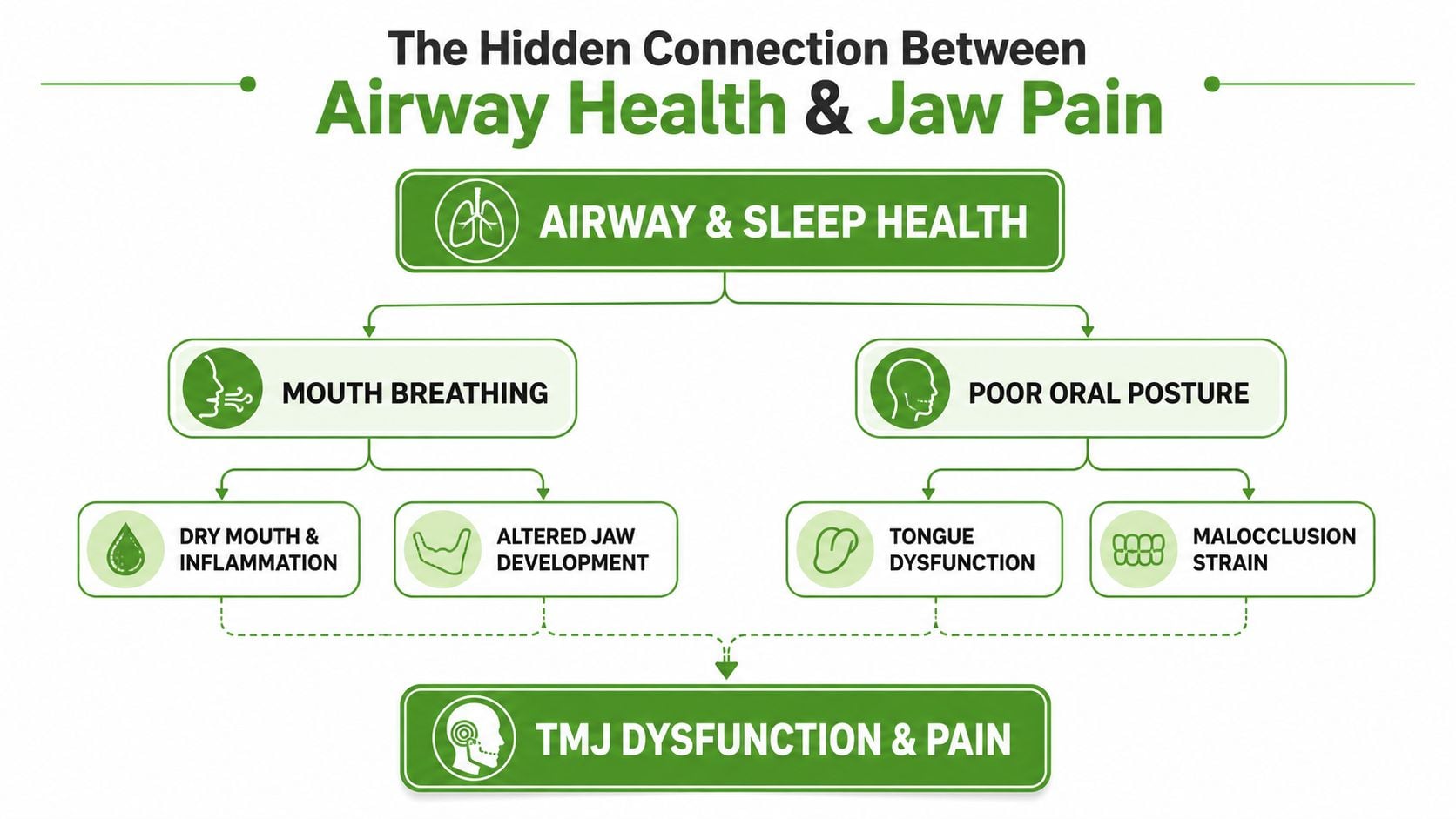
The Hidden Connection Between Airway Health and Jaw Pain
A jaw that hurts every morning sometimes has a breathing problem underneath it. Mouth breathing, poor oral posture, and sleep-disordered breathing can keep the jaw and surrounding muscles under constant strain, especially overnight when the system should be recovering. If the airway stays compromised, the jaw often keeps compensating.
Why breathing changes jaw mechanics
When someone habitually breathes through the mouth, the tongue posture and oral seal change. That alters how the jaw rests, how the face stabilizes, and how much strain lands on the muscles that close the mouth. Over time, that can feed a cycle of tension that looks like a “jaw problem” but really reflects a broader airway issue.
That's one reason I like a thorough evaluation rather than a narrow symptom chase. If the airway is part of the problem, jaw treatment alone can improve symptoms temporarily and still leave the trigger in place. A provider who understands this will look at sleep quality, oral posture, and breathing habits as part of the same clinical picture.
How root-cause care changes the plan
Myofunctional therapy and breathing retraining can be useful when oral posture and airway habits are contributing to strain. In some patients, the work includes nasal breathing restoration, tongue posture training, and strategies to reduce the overuse pattern that keeps the jaw braced at night. Airway-focused orthodontics can also be relevant when dentofacial development and airway space are part of the case.
The point isn't that every TMJ case is airway-driven. It's that persistent symptoms deserve a broader look when the usual jaw-only care hasn't held. If someone snores, wakes unrefreshed, or breathes through the mouth much of the time, I think that deserves attention during a TMJ evaluation.
When to Seek Specialty Care and What to Expect
A jaw that aches for a few days and then settles is one thing. Pain that keeps coming back, limits opening, or changes the way a person eats and speaks points to a different problem. At that stage, a specialty evaluation can prevent months of trial and error.
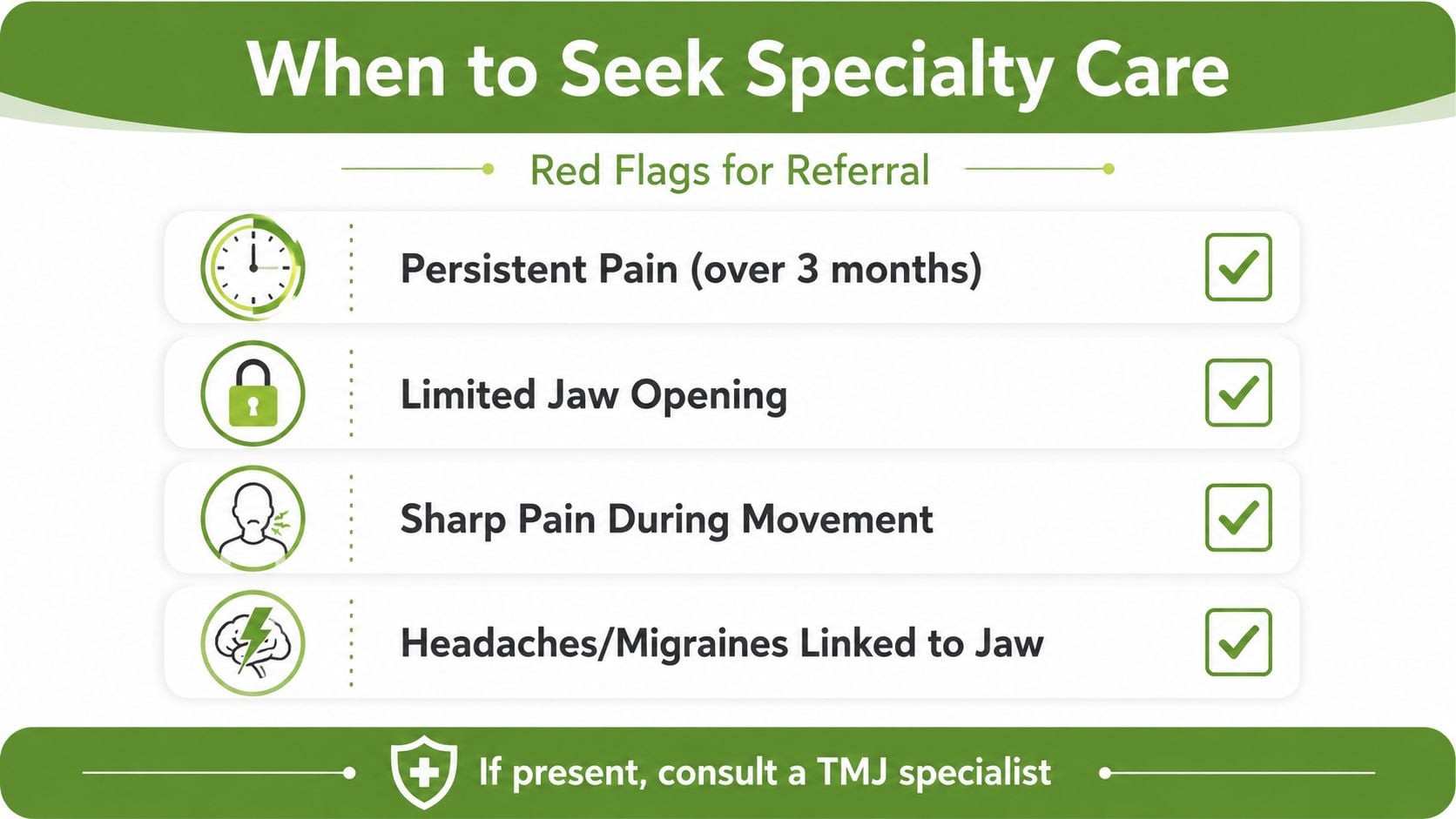
Signs it's time to escalate
A specialty visit is reasonable when the pattern stops behaving like a short-lived flare and starts behaving like an ongoing disorder.
- Persistent pain: Symptoms that keep returning after self-care, or that never really settle, deserve a closer look.
- Limited opening or locking: A jaw that opens less freely, catches, or locks needs prompt assessment.
- Sharp pain with movement: Pain that rises with chewing, opening, or yawning often means the current plan is missing the main driver.
- Headache patterns tied to the jaw: Headaches that track with jaw soreness, clenching, or chewing can reflect the same disorder.
Surgery is usually not the next step. The AAFP review notes that operative treatment is generally reserved for trauma, fracture, or ongoing severe dysfunction that does not respond to conservative care. A specialty visit is about sorting out the cause, not sending every patient to an operating room.
What a strong clinic visit should include
A useful TMJ evaluation starts with a history that separates muscle-driven pain from joint pain and from a closed-lock pattern. The exam should check opening, joint motion, tenderness, bite changes, and whether the symptoms fit a muscle spasm problem, a disc derangement, or a more fixed joint limitation. That distinction changes treatment.
Board certification in orofacial pain is worth asking about, because it points to focused training in these disorders. A clinic that also evaluates sleep, oral posture, and breathing is looking for the source of the strain, not only the sore spot. That matters when the jaw has been treated as a local problem and the symptoms keep coming back.
Pain and Sleep Therapy Center is one example of a clinic that works in that model, with TMJ care, sleep-related breathing evaluation, and non-surgical options such as PRF, prolotherapy, and cold laser therapy. For many patients, the practical value is having one team decide whether the pain is muscular, joint-based, airway-related, or a mix of those factors.
Your Path to Lasting TMJ Relief Starts Here
If your jaw has been aching, clicking, or locking, the odds are still in your favor with non-surgical care. The evidence consistently supports conservative treatment first, and the skill is matching the plan to the subtype, not throwing every available option at every patient. Muscle-driven pain, joint derangement, and closed lock each call for a different sequence of care.
A sensible next step is to track symptoms, reduce obvious triggers for a short stretch, and notice whether the jaw feels better or worse with eating, clenching, or sleep. If things aren't moving in the right direction, a specialty evaluation can separate the cases that respond to self-care from the ones that need appliances, therapy, or airway-focused treatment.
The goal isn't to live around jaw pain. It's to get back to normal meals, normal sleep, and normal conversations without guarding every movement.
If you're ready for a careful TMJ workup that looks beyond symptoms and focuses on the actual cause, Pain and Sleep Therapy Center offers non-surgical TMJ evaluation, sleep-related breathing assessment, and customized treatment planning in one place. Their team can help you sort out whether your pain is muscle-driven, joint-related, or tied to airway and sleep issues, and then build a plan around that finding.