You're waiting on a familiar verdict. The machine is on the nightstand, the dental device is in the bathroom, or the breathing exercises are sitting in your phone notes, and the question is still the same, is this working? People don't care about one tidy number in isolation. They want better mornings, less snoring, fewer headaches, and some proof that the therapy is doing more than just occupying space on the bedside table.
That's the right lens for sleep apnea treatment results. A good result has two sides, what the sleep test shows and what daily life feels like. If you want a simple companion guide for habits that can support sleep quality while treatment gets sorted out, Tyner Furniture's piece on restful sleep techniques to try is a practical place to start, and for a broader treatment overview, the clinic's own page on sleep apnea treatment benefits is worth reading.
Practical rule: judge treatment by both the numbers and the morning you wake up to. If one improves and the other doesn't, you've learned something useful, not failed.
Starting Therapy and Wondering What Success Looks Like
A patient starting treatment usually asks a version of the same question in different words. Will I sleep through the night? Will my partner stop nudging me awake? Will this lower the strain on my body, or just give me another device to manage?
That's why I think of treatment success in two layers. The first layer is objective, the breathing data from the sleep study or device report. The second layer is subjective, the way you feel during the day, including energy, alertness, snoring, mood, and how often you wake up.
What patients usually notice first
Some changes show up quickly, especially when therapy is well matched and used consistently. Other changes creep in more slowly, and some never show up unless the underlying cause of sleep fragmentation is addressed along with the airway problem.
A useful way to read your progress is this:
- Nighttime breathing, does the airway stay open more consistently?
- Morning function, do you wake up less groggy and less dragged down?
- Partner feedback, is snoring quieter or gone?
- Health markers, are things like blood pressure and oxygenation trending the right way?
If you're trying to build better sleep habits while treatment gets optimized, a few simple routines can help the body settle into the process. That doesn't replace therapy, but it can make the first few weeks easier to live through.
Bottom line: the best sleep apnea treatment results are not only about a lower score, they're about a better day.
The Two Scores That Define Sleep Apnea Treatment Results
Before any therapy can be judged, you have to know what the report is measuring. The two most common score families are the breathing-event score and the sleepiness score, and they answer different questions.
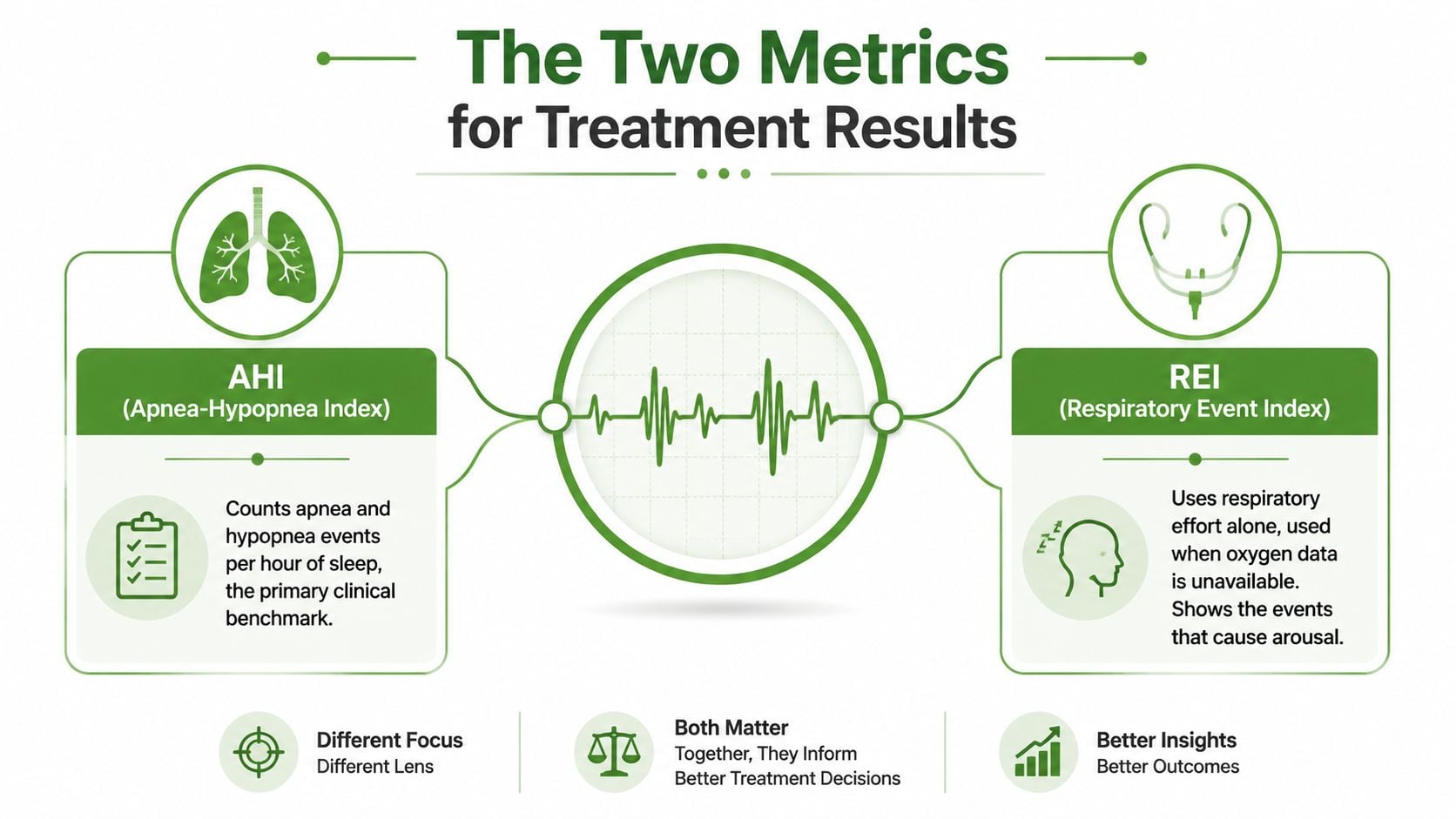
AHI and REI are the breathing counters
AHI, the apnea-hypopnea index, is the standard count of breathing disruptions per hour of sleep. REI, the respiratory event index, is similar, but it can be used when full oxygen data aren't available. Think of them as a snore-and-gasp counter for the night.
When those numbers fall, the airway is usually staying open more often. That matters because the point of treatment is not only to reduce noise, it's to reduce the repeated stress of airway collapse.
ESS is the daytime sleepiness score
The Epworth Sleepiness Scale, ESS, is a patient-reported measure of how likely you are to doze off in ordinary situations. It's less about breathing mechanics and more about your doze-off risk score during daily life.
That's why oxygen nadir matters too, along with quality-of-life tools such as sleep questionnaires. A person can have a dramatic AHI improvement and still feel lousy if insomnia, pain, or sleep fragmentation are still stealing recovery.
What to ask at follow-up
When you review results, ask whether the plan improved:
- AHI or REI, the breathing burden
- Oxygen saturation, how your levels dropped overnight
- ESS, how sleepy you feel in the day
- Snoring and bed-partner sleep, whether the household noise changed
- Function, whether mornings are more usable
A lower number is encouraging. A lower number plus better daytime function is the result that changes a life.
CPAP Results in Adherent Users and the Adherence Gap
A patient starts CPAP, gets a good mask fit, and sees the numbers drop on the download report. That early mismatch between what the machine shows and what the person feels is common, and it is the reason follow-up has to look at both the breathing data and the day-to-day response.
CPAP remains the most reliable first-line therapy for moderate to severe obstructive sleep apnea when it is used consistently. In a major 2024 cohort of 4,907 adults, 4,134 patients, 84.3%, adopted PAP therapy, and 3,332 of those adopters, 80.6%, met 90-day CMS adherence criteria. In that same study, mean baseline REI/AHI was 38.33 events per hour, and it fell to 1.82 events per hour within 90 days, staying below 2 events per hour through 1, 2, and 3 years in those who persisted with treatment, which is about as clean a demonstration as you will see of what PAP can do when it is worn (PMC12713843).
What those numbers mean in plain language
That is the difference between ongoing airway collapse and near-normal breathing indices. The key word is adherent, because the machine can only help when it is on the face and running through the night.
The same study also reported 82.6% adherence at more than 1 year and 74.2% persistence at more than 2 years among PAP adopters (PMC12713843). That gives a realistic benchmark for long-term care, not a marketing headline.
If dry air or nasal irritation is making PAP harder to tolerate, a bedroom humidifier can be part of the comfort conversation. It will not replace titration or mask fitting, but it can make the device easier to live with, and patients who want to read more about the comfort side can review sleeping with a humidifier benefits.
The gap between lab performance and real life
The same reviewer class of papers that discuss PAP also note that real-world adherence is often only 30% to 60% (Cleveland Clinic Journal of Medicine). That gap explains why one person says CPAP changed everything while another says it sat unused after two weeks.
The lesson is blunt. PAP efficacy is excellent, adherence is the bottleneck. If the mask leaks, the pressure feels intolerable, or the person stops using it, the result collapses even if the prescription was technically correct.
Oral Appliance Therapy Compared to CPAP
Oral appliance therapy, usually a mandibular advancement device, MAD, has a clear place in sleep apnea care because it is less intrusive and many patients find it easier to wear through the night. That does not make it better in every case, but it does make it a different tool with different strengths and limits.
What MADs tend to deliver
Evidence syntheses show that oral appliance therapy can produce meaningful improvement, especially in mild to moderate disease. One review found a success rate of 54% when success meant reducing AHI below 10, and another 21% of patients achieved at least a 50% AHI reduction even if AHI stayed above 10 (PMC1794626). More recent clinical data showed mean AHI falling from 27.6 to 10.3 events per hour, a 59.6% improvement, with treatment effectiveness in 66.7% of patients.
The snoring effect matters too. In randomized crossover placebo-controlled studies, snoring was reduced by 45%. For many couples, that is the first sign that treatment is helping.
CPAP vs Oral Appliance Therapy Outcomes
| Outcome | CPAP | Oral Appliance (MAD) |
|---|---|---|
| Breathing control | Strongest event elimination when worn | Meaningful reduction, often less complete |
| Long-term success | 94% in analyzed users at 10 years | 86% in analyzed users at 10 years |
| Blood pressure effect | Systolic 2.5 mm Hg lower, diastolic 2.0 mm Hg lower versus control | Systolic 2.1 mm Hg lower, diastolic 1.9 mm Hg lower versus control |
| Tolerability | Can be limited by mask and pressure issues | Often easier to wear nightly |
| Best fit | More severe disease, high event burden | Selected patients, often milder or less intrusive pathway |
Those long-term data keep the discussion grounded. In a 10-year follow-up, both CPAP and MAD therapy produced durable objective and symptomatic improvements, with treatment success in 94% of analyzed CPAP users and 86% of analyzed MAD users (PMC7075089). The choice is often less about which treatment is theoretically stronger and more about which one the patient will consistently use.
Practical rule: if the patient can wear CPAP consistently, it usually wins on event control. If the patient will not wear CPAP, a well-fit oral appliance often beats an unused machine.
The JAMA meta-analysis also matters because it ties treatment to cardiometabolic risk. Compared with inactive control, CPAP lowered systolic blood pressure by 2.5 mm Hg and diastolic by 2.0 mm Hg, while MADs lowered systolic by 2.1 mm Hg and diastolic by 1.9 mm Hg (JAMA). Those are modest shifts for one person, but they matter when treatment is used across a population with OSA.
For readers comparing options directly, the clinic's summary on sleep apnea oral appliance vs CPAP gives a practical side-by-side view.
Myofunctional Therapy, Buteyko Breathing, and Regenerative Approaches
Some airway problems respond poorly to a machine alone, and some patients cannot tolerate a jaw device until the surrounding muscles, breathing pattern, or painful tissues are addressed first. In clinic, that usually means matching the therapy to the barrier in front of us, whether that barrier is tongue posture, habitual mouth breathing, or a sore jaw joint.
Myofunctional therapy changes the airway's habits
Orofacial myofunctional therapy focuses on tongue posture, lip seal, nasal breathing, and swallowing patterns. A systematic review cited in the practice background reports that it may reduce AHI by about 50%. That is not a guarantee of cure, but it does show that airway mechanics can shift when the muscle pattern around the airway is trained well.
The effect is usually gradual. Patients who do the work consistently tend to notice small changes first, such as better tongue awareness, less mouth opening at night, or less snoring, while the formal sleep study may improve later. The therapy also works better when it is paired with another treatment that holds the airway open during sleep, rather than used by itself.
Buteyko breathing and regenerative care fit a different role
Buteyko-style breathing is used to support calmer, more nasal breathing during waking hours. In practical terms, it can help patients reduce over-breathing and pay closer attention to nasal airflow, which matters when daytime habits reinforce nighttime airway collapse.
Regenerative options such as Prolotherapy, Platelet-Rich Fibrin injections, and cold laser therapy are aimed at the tissues and joints that can contribute to pain, inflammation, or poor airway mechanics. They are not stand-alone cures for obstructive sleep apnea. They are used as part of a broader airway-focused plan.
At Pain and Sleep Therapy Center, that broader model includes myofunctional therapy as a core piece of care, especially when tongue posture or oral habits are part of the picture. The team's myofunctional therapy for sleep apnea page fits that approach well.
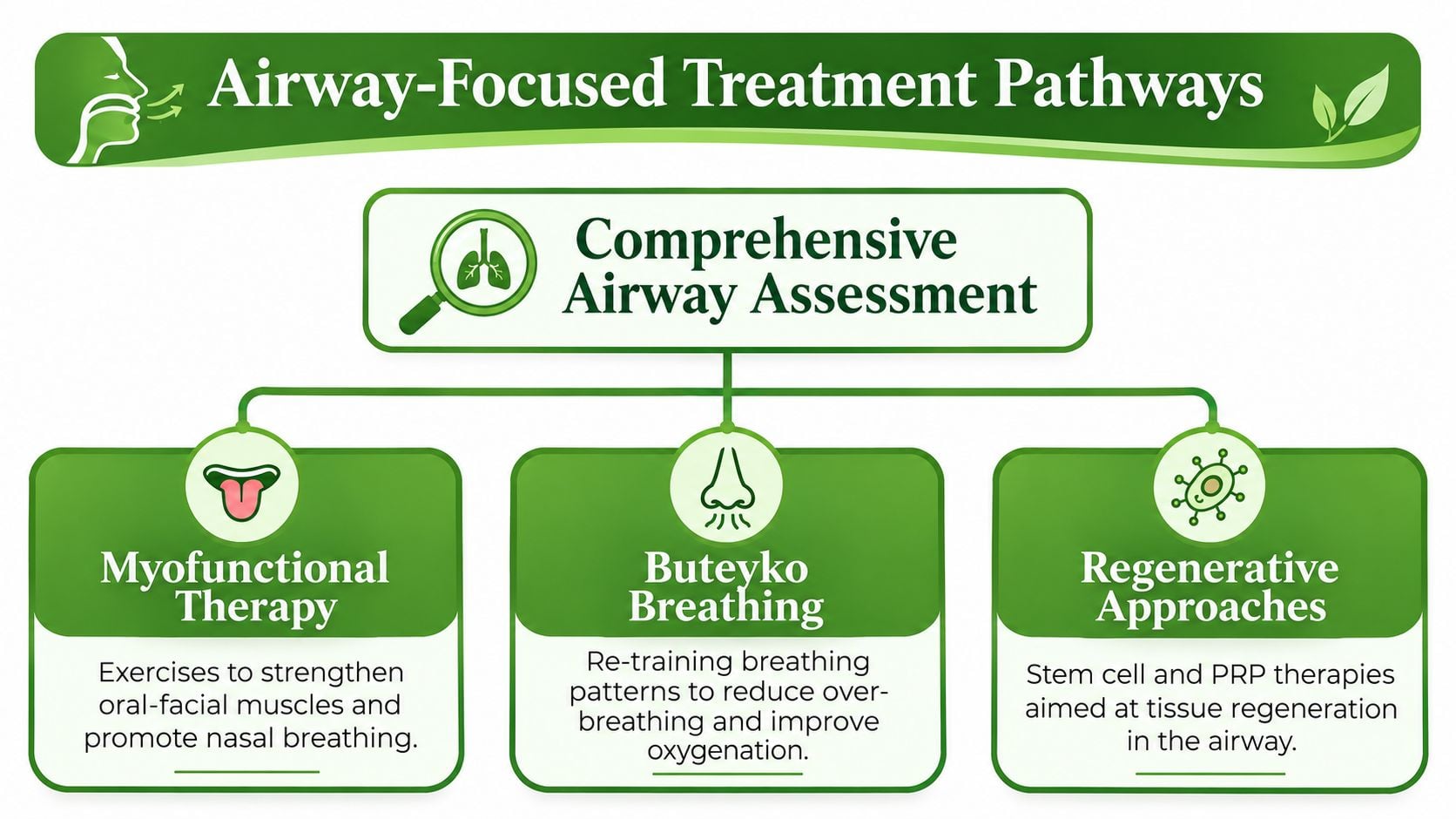
Clinical insight: these approaches work best as a stack, not as rival religions. The airway often improves more when muscle function, breathing pattern, and tissue health are addressed together.
Realistic Timelines for Improvement by Treatment
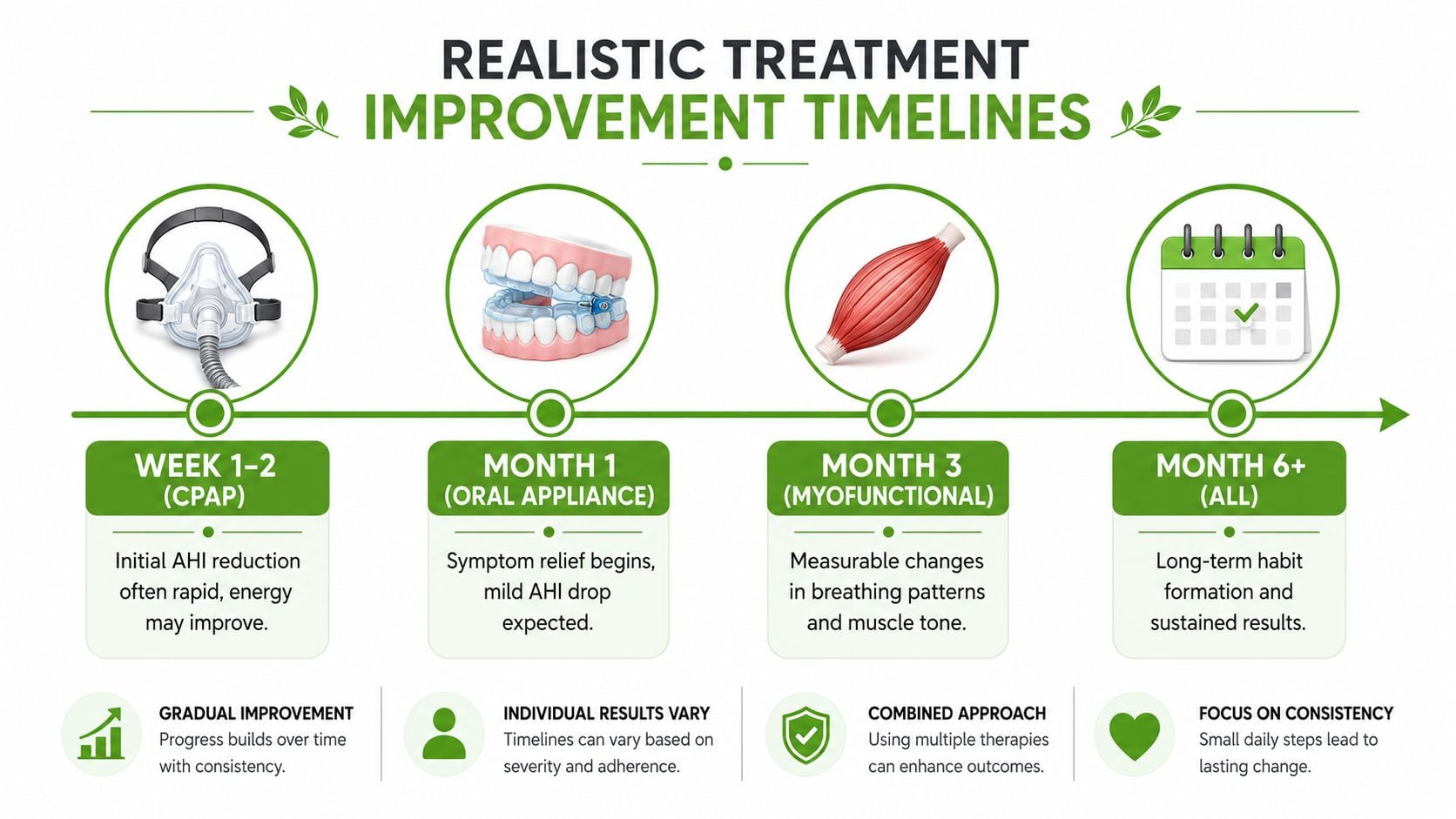
A patient may feel the first real sign of progress before the numbers look perfect. That can mean quieter snoring, less morning fog, or getting through the night with less effort. Each therapy reaches those goals on its own schedule, and the difference matters when people are deciding whether to keep going.
The first weeks look different by therapy
CPAP can reduce breathing events quickly once the mask seal is stable and the pressure is set correctly. For adherent users, the objective response can appear early, while daytime sleepiness often improves more gradually as the body adjusts to more consistent sleep.
Oral appliances usually move through a fitting and titration phase before the airway effect is where it needs to be. The device has to be comfortable enough to wear through the night, and the bite position often needs fine-tuning before the breathing benefit is fully clear.
Timeline of what tends to change first
- CPAP, breathing metrics often improve first, then alertness follows if the patient can tolerate the mask and pressure.
- MAD, snoring may improve before the follow-up sleep study shows the full effect on airway events.
- Myofunctional therapy, changes usually build slowly and depend on daily practice and consistency.
- Regenerative care, the response is more tied to tissue comfort and joint recovery than to an overnight shift in breathing numbers.
That last point matters because pain-focused care does not behave like a pressure device. It is usually judged by comfort, function, and whether it helps other airway therapies stay usable over time.
The early adjustment period matters most. If something feels off, that is the time to refine the mask, the appliance, the exercise plan, or the support strategy before bad habits set in.
For myofunctional therapy, Buteyko-style breathing, and regenerative options at Pain and Sleep Therapy Center, the practical timeline is even more dependent on adherence. Daytime breathing work and tissue-focused care can support the airway, but the daily-life changes patients care about, energy, snoring, mood, and fewer awakenings, usually lag behind the first objective improvements. The treatment pattern is different for each person, and the gap between a better test result and a better morning is often where the most important work happens.
Why Lower AHI Does Not Always Mean Feeling Better
A lower AHI looks great on paper, but it doesn't automatically mean the patient feels transformed. Some people still wake tired even when the breathing numbers improve, and others feel much better before the sleep study is fully normalized.
Why the mismatch happens
Sleep fragmentation can persist from comorbid insomnia, pain, mood disorders, or a high arousal tendency that keeps the brain half-awake. If the airway is better but the sleep remains light and broken, the morning can still feel bad.
TMJ pain can also matter, especially in patients wearing oral appliances or clenching through the night. A device that improves the breathing score but worsens jaw comfort is not a real win.
What to watch for in the trade-off zone
- CPAP issues, mask leaks, pressure intolerance, aerophagia
- Oral appliance issues, bite changes, jaw soreness, temporomandibular discomfort
- Exercise or retraining issues, fatigue from daily myofunctional work
Careful follow-up matters more than a one-time prescription. A patient can have a good breathing result and still need treatment adjustments to make the therapy livable.
The useful question isn't only, “Did the AHI drop?” It's, “Did the drop create a better morning, a quieter night, and a treatment I can actually keep using?”
The YouTube resource below is worth watching if you want a patient-facing explanation of how these trade-offs show up in real clinic conversations.
Choosing the Right Path and Tracking Results Over Time
The best sleep apnea plan usually starts with a detailed airway assessment and ends with a therapy that the patient can keep using. For some adults, that's CPAP. For others, it's a mandibular device, a muscle retraining plan, or a combination that includes breathing work and regenerative support.
At Pain and Sleep Therapy Center, the process is shaped by Dr. Greg D. Larson and an interdisciplinary team that includes dental sleep medicine, orofacial myofunctional therapy, Buteyko breathing, neurology, and pediatric oral health. That kind of coordination matters because sleep apnea rarely lives in one silo, especially when TMJ pain, headaches, tongue posture, or nasal breathing issues are part of the story.
What follow-up should actually look like
A good tracking plan is simple and specific:
- Two weeks, check comfort, leaks, soreness, and basic adherence
- One month, review symptoms and whether the plan feels sustainable
- Three months, compare ESS, morning energy, and bed-partner feedback
- Three to six months, repeat a home sleep test or polysomnography if needed
If weight management is part of the picture, the clinic may also discuss broader lifestyle support. For readers wanting a practical overview of that angle, weight loss for sleep apnea is a helpful supplemental resource.
What good results look like
Good results are not just a lower device report. They're a patient who wakes up more functional, a bed partner who reports less snoring, and a follow-up study that confirms the airway is staying open more reliably.
For families, the same airway logic can apply upstream in children when tongue-tie, nasal obstruction, or oral posture issues are part of the problem. Pediatric airway evaluation and laser frenectomy may be appropriate in selected cases, especially when the goal is prevention rather than rescue.
If you're trying to figure out which treatment path fits your breathing pattern, comfort level, and daily life, Pain and Sleep Therapy Center can evaluate the airway, TMJ, and sleep symptoms together and build a plan around what you'll use. Visit Pain and Sleep Therapy Center to review options for CPAP alternatives, oral appliance therapy, myofunctional care, and follow-up testing.