
When you're dealing with jaw discomfort, targeted TMJ pain relief exercises are one of the most effective, evidence-backed tools you can have. These specific movements aren't about brute force; they're designed to gently ease pain, calm inflammation, and help bring your jaw back to its natural, healthy function.
With a little consistency and mindful effort, you really can find lasting relief.
Your Starting Point for TMJ Pain Relief
If your jaw clicks, pops, or just plain aches, you are definitely not alone. Millions of people live with temporomandibular joint (TMJ) disorders, which can cause disruptive pain that gets in the way of simple things like talking, eating, or getting a good night's sleep.
The good news? You can take an active role in feeling better. A structured, gentle exercise program is a powerful, non-invasive first step toward reclaiming your comfort.
The whole idea is to bring balance back to the intricate system of muscles and ligaments controlling your jaw. This isn't a workout—it's about mindful, controlled movements.
What a Good TMJ Exercise Plan Includes
A well-rounded routine usually brings together a few key elements to address the problem from all sides:
- Gentle Stretches: These are designed to release that frustrating tightness and carefully improve your jaw’s range of motion.
- Strengthening Movements: Think of these as building a better support system for the joint itself, creating stability where it's needed most.
- Relaxation Techniques: So much TMJ pain is driven by unconscious clenching and tension. These exercises help you break that cycle.
To help you understand how these components work together, here's a quick overview of what each type of exercise aims to accomplish.
Quick Guide to TMJ Exercise Types and Benefits
| Exercise Category | Primary Goal | Key Benefit Example |
|---|---|---|
| Stretching | Increase Flexibility & Mobility | Easing that "locked" feeling when opening your mouth. |
| Strengthening | Build Joint Stability & Control | Reducing painful clicking by improving muscle coordination. |
| Relaxation | Decrease Muscle Tension | Breaking the habit of clenching your jaw during stressful moments. |
| Postural | Correct Head & Neck Alignment | Lessening strain on jaw muscles from a forward-head posture. |
| Breathing | Calm the Nervous System | Lowering overall stress that contributes to jaw tightness. |
As you can see, it's not just about the jaw. A truly effective plan considers how your entire body—from your posture to your stress levels—plays a role in your discomfort.
But Do These Exercises Actually Work?
It’s fair to wonder if a few simple movements can really fix such a persistent problem. The clinical evidence is overwhelmingly on your side. Exercise therapy has become a cornerstone of modern TMJ treatment, and study after study confirms it works.
A major systematic review discovered that a consistent exercise routine can slash pain intensity for TMJ patients by an average of 35-50% over just eight weeks. The research specifically pointed to coordination exercises as being a game-changer for providing relief.
This means those small, daily efforts aren't just wishful thinking; they're backed by solid science. The goal is to move past temporary fixes and address the root functional issues that are causing your pain in the first place.
Setting the Right Expectations
Starting a new exercise routine is the beginning of a healing process, not an overnight fix. These movements are designed to gradually retrain your muscles, soothe inflammation, and restore how the joint is supposed to work.
By combining stretching, strengthening, and relaxation, you're creating a supportive environment for your jaw to heal itself. As you work through this guide, the most important thing is to be patient and listen to your body.
Here at the Pain and Sleep Therapy Center, we often explain how TMJ, head, and facial pain are all interconnected, which is why a mindful, holistic approach is so critical. Real progress is built on consistency, not intensity.
Gentle Stretches to Improve Jaw Mobility
When your jaw feels stiff, tight, or just won't move the way it should, gentle stretching is the best place to start. I think of these movements as a way to carefully untangle knotted muscles and reintroduce healthy motion to a very sensitive joint. The key here is to always move slowly and never, ever push into sharp pain.
Before you jump into any TMJ pain relief exercises, it’s a really good idea to warm up the area first. Try applying a warm, moist compress to the sides of your face for 5-10 minutes. This simple step helps relax the muscles, making them much more receptive to stretching and preventing any extra irritation.
The Relaxed Jaw Stretch
This is a foundational exercise that helps your jaw find its proper resting position, which in turn reduces that subconscious tension we all carry. It's incredibly simple but don't underestimate how effective it is.
- Gently rest the tip of your tongue on the roof of your mouth, right behind your front teeth.
- Let your teeth drift apart while keeping your lips softly closed.
- Now, just let your jaw muscles completely relax and hang loose.
Hold this for a few deep, slow breaths. The real magic happens when you start remembering to do this throughout the day—while you're working at your computer, driving, or even just watching TV. It’s a powerful way to break the clenching cycle.
The Goldfish Exercise
This is a classic movement for a reason—it’s fantastic for improving jaw mobility and control. It works by guiding the joint's movement in a more coordinated way, which cuts down on the strain that often leads to pain.
There are two variations to try.
- Partial Opening: Place one finger on your chin and another right on the TMJ itself (that little spot just in front of your ear). Let your jaw drop about halfway down, then close it. You're looking for a smooth, even motion here.
- Full Opening: Keep your fingers in the same position, but this time, let your jaw drop down as far as it can comfortably go. Then close it.
For both versions, aim for just one set of six repetitions, and you can do this routine up to six times a day. The movement should always be slow and deliberate, never forced.
This simple process shows how intentional movement can lead directly to relief.
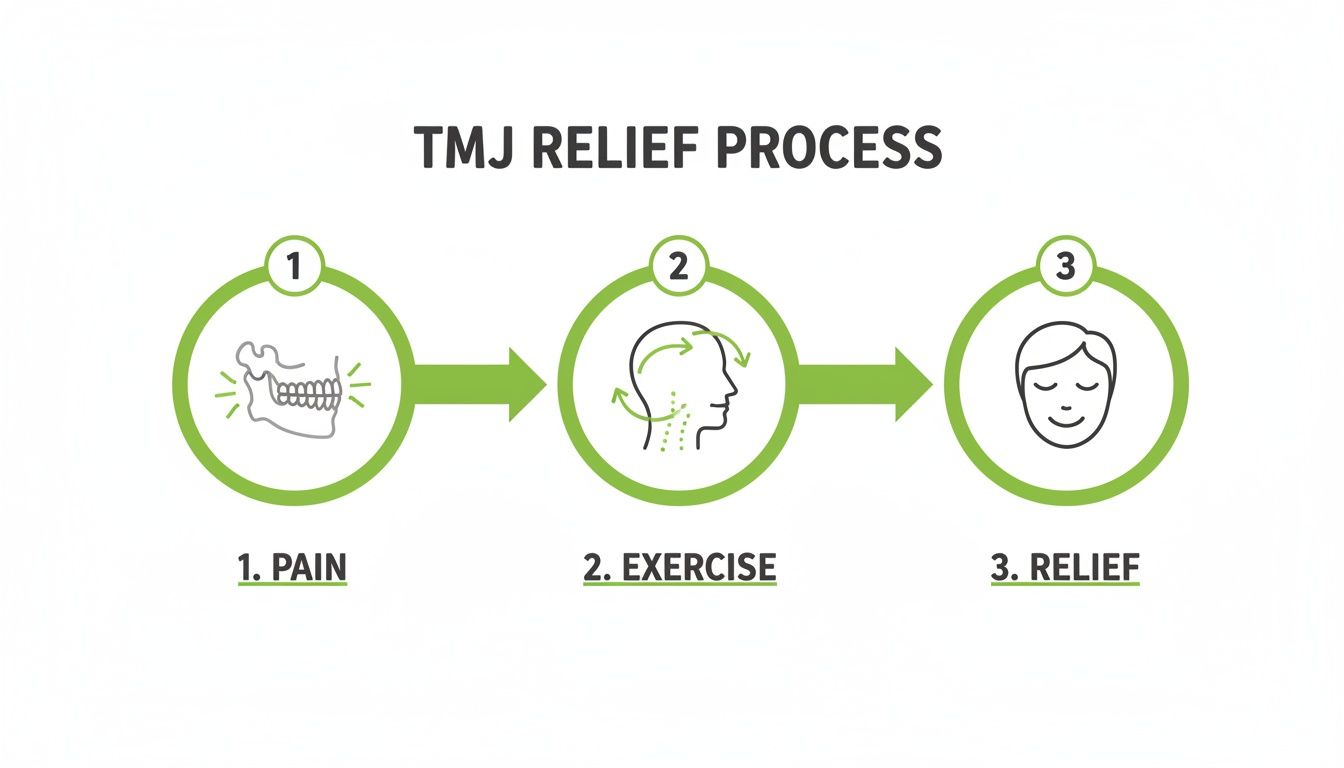
This visual really gets to the heart of TMJ recovery: targeted exercise is the bridge that takes you from a state of constant pain to one of genuine relief.
Side-to-Side Jaw Stretch
A limited side-to-side glide is a huge complaint for many people with TMJ disorders. This stretch is designed to gently restore that specific flexibility.
Start by placing a thin object—about a quarter-inch thick, like a few stacked tongue depressors or even a pen—between your front teeth. Slowly and very gently, move your jaw from one side to the other. As this gets easier over time, you can gradually increase the thickness of the object to keep challenging and improving your range of motion.
An Important Note: The goal with any of these stretches is a feeling of gentle release, not pain. If you feel anything sharp, shooting, or a definite increase in your usual pain, stop immediately. That’s your body’s signal that the muscle or joint isn't ready for that motion yet.
Remember, consistency is far more important than intensity. Making these gentle stretches a part of your daily routine, maybe once in the morning and again before bed, can gradually release chronic tension, improve your jaw’s mobility, and set you up for lasting pain relief.
Building a Stronger and More Stable Jaw
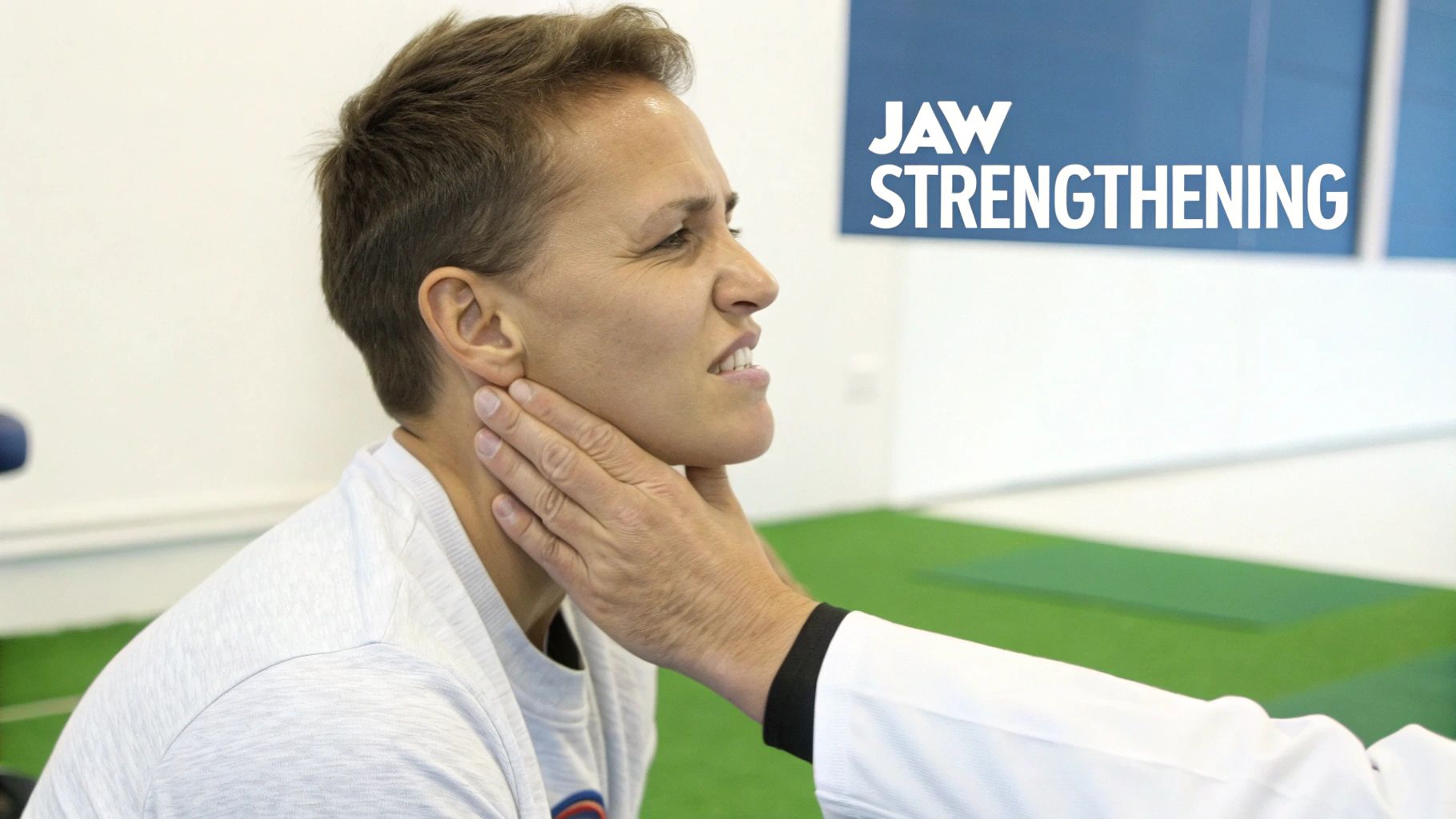
While stretching is fantastic for mobility and quick relief, building real, long-term jaw stability requires a different game plan. This is where strengthening exercises come in. Think of this as moving beyond just quieting the pain and starting to proactively prevent future flare-ups. You're essentially creating a reliable support system for your temporomandibular joint.
These movements aren’t about brute force; they're all about control and coordination. By adding just a bit of gentle resistance, you're retraining the muscles to fire correctly and work together, which helps stabilize the joint and reduce that frustrating clicking and popping.
Controlled Resistance for Jaw Opening
This exercise specifically targets the muscles that open your mouth, teaching them to work against a light, steady force. The key here is to keep the movement slow and ensure your jaw tracks straight down, not veering off to one side.
- Your setup: Place your thumb or two fingers gently right under your chin.
- The movement: Slowly start to open your mouth while applying a light upward pressure with your thumb.
- The goal: Hold this gentle resistance for about 3-5 seconds, then slowly close your mouth.
Try to do 5-10 repetitions of this controlled movement. If you feel any sharp pain or notice your jaw trembling, just ease up on the pressure or do fewer reps. Listen to your body.
Resisted Jaw Closing for Added Stability
Now we'll work the opposing muscles—the powerful ones you use for chewing and closing your mouth. Strengthening these helps create a much-needed balance, preventing one muscle group from overpowering another, which is a very common source of TMJ pain.
- Your setup: Open your mouth just a bit. Place your thumb under your chin and your index finger on the bony ridge between your lower lip and chin.
- The movement: Gently squeeze your thumb and index finger to get a soft grip. Now, try to close your mouth while lightly resisting the motion with your hand.
- The goal: Hold this tension for 3-5 seconds before relaxing.
Once again, aim for 5-10 repetitions. Remember, the force should be minimal—just enough to feel the muscles engage without causing any strain.
These strengthening exercises are a cornerstone of effective TMJ therapy. The focus on coordination and muscle retraining is supported by a growing body of scientific evidence. By focusing on multiple components—stretching, strengthening, and posture—you're aligning with what works.
Research continues to back the power of exercise-based programs for TMJ disorders. In fact, comprehensive analyses show that well-rounded routines consistently produce positive results, with some studies demonstrating a pain reduction of 35-50% over an 8-week period. You can learn more about the scientific consensus on TMJ exercise therapy.
By weaving these simple yet powerful moves into your routine, you are empowering your jaw to function the way it was designed to. This proactive approach builds a foundation of strength and stability, making your jaw far more resilient to the stresses of daily life.
How Posture and Relaxation Impact Jaw Pain
Your temporomandibular joint doesn't operate on an island. It’s deeply connected to the network of muscles in your neck, shoulders, and even your upper back. This means that seemingly unrelated habits, like the way you sit at your desk, can be a direct line to jaw pain and tension.
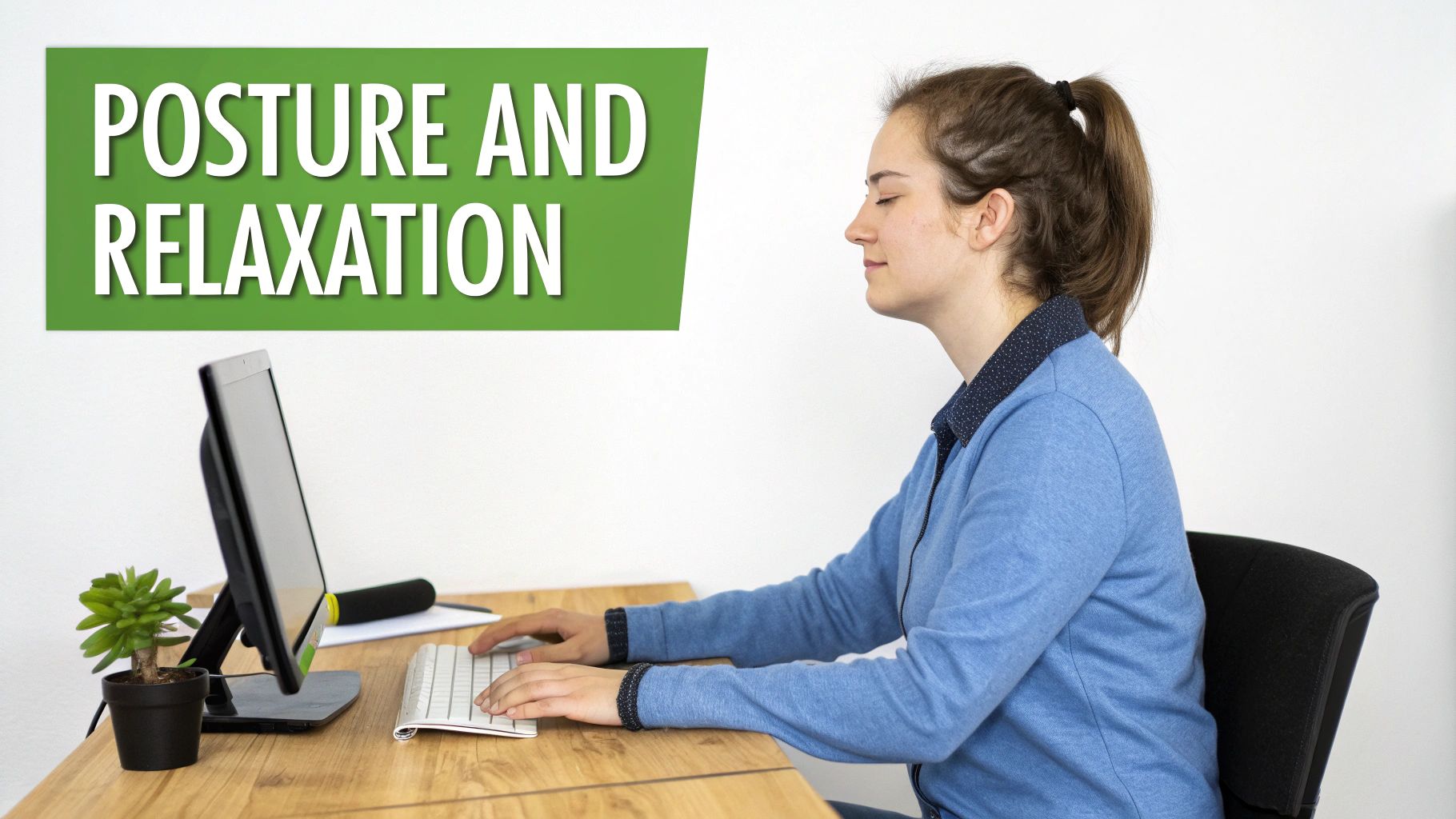
Think about what happens when your head drifts forward while you're focused on a screen—a classic case of forward head posture. This puts a huge amount of strain on your neck and shoulder muscles. To compensate and keep your head up, your jaw muscles often clench and tighten, locking you into a painful cycle that simple jaw stretches alone won't fix.
This is exactly why a good routine of tmj pain relief exercises has to look beyond just the jaw itself.
Correcting Your Posture for Lasting Relief
The good news is you can start to counteract the effects of poor posture with some simple, targeted movements. One of my go-to exercises for patients is the chin tuck. It’s incredibly effective because it helps retrain the deep muscles in your neck to pull your head back into a healthier alignment.
Here’s how to do it right:
- Start by sitting or standing tall, looking straight ahead. Keep your shoulders down and relaxed.
- Gently draw your chin straight back, almost like you’re trying to make a "double chin." You're not tucking your chin down to your chest, but pulling it back horizontally.
- You should feel a light stretch at the back of your neck. Hold this position for 3-5 seconds.
- Slowly release and repeat 10 times.
I always tell my patients to try and sprinkle this exercise throughout their day, especially during breaks from computer work. It can dramatically reduce that background tension that creeps up into your jaw.
Finding Your Jaw's Natural Resting Spot
Just as important as your posture is teaching your jaw muscles how to truly relax. So many of us hold tension in our jaw without even realizing it. The goal is to find the relaxed jaw position and make it your new normal.
It’s simpler than you think. Gently place the tip of your tongue on the roof of your mouth, right behind your front teeth. Let your teeth float slightly apart and keep your lips lightly closed. This small shift encourages your jaw muscles to let go.
Becoming mindful of this position is a powerful habit. I suggest setting a quiet reminder on your phone or putting a sticky note on your monitor to check in and reset your jaw. This is especially helpful during stressful moments when you're most likely to clench.
This small adjustment is almost like a passive exercise, reinforcing relaxation and taking away the constant strain that feeds TMJ pain. Pairing this with simple breathing exercises—like inhaling slowly through your nose for four counts and exhaling for six—can also calm your nervous system and reduce the stress that triggers clenching in the first place.
Building these small habits into your daily life can make a world of difference. To help you stay on track, I've put together a simple checklist.
Daily Habits Checklist for TMJ Health
A simple checklist to help you integrate posture and relaxation habits into your daily routine for sustained TMJ pain relief.
| Habit | Frequency | Quick Tip |
|---|---|---|
| Chin Tucks | 2-3 times per day | Do a set of 10 every time you take a break from your desk. |
| Jaw Position Check | Hourly | Use a sticky note on your monitor as a visual reminder. |
| Postural Reset | Every 30 minutes | Sit up tall, roll your shoulders back and down. |
| Mindful Breathing | 1-2 times per day | Take 5 deep breaths (4-second inhale, 6-second exhale) when you feel stressed. |
Using a checklist like this helps turn these exercises from a chore into an automatic part of your day, giving you more control over your TMJ symptoms.
When at-Home Exercises Are Not Enough
While consistent, gentle exercises are a powerful first-line defense against jaw pain, they aren't a cure-all for every situation. It’s absolutely essential to recognize the signs that your condition requires a deeper, professional evaluation. Pushing through certain symptoms can unfortunately make things worse.
Think of at-home TMJ pain relief exercises as one tool in a larger toolkit. They are fantastic for addressing muscle tension and minor joint stiffness. But if the root cause is something more complex, like a displaced articular disc or an underlying inflammatory condition, exercises alone just won't be enough to provide lasting relief. This is where expert guidance becomes non-negotiable.
Red Flags That Signal a Need for Professional Help
If you experience any of the following, it’s time to pause your home routine and schedule a consultation with a TMJ specialist. These symptoms often point to issues that self-care alone cannot resolve.
- A Locked Jaw: This is a big one. If your jaw gets stuck in either an open or closed position, you need to seek immediate care.
- Severe, Unrelenting Pain: Pain that doesn't improve with gentle exercise, rest, or warm compresses is a clear red flag. Pain that wakes you up at night is another.
- Sudden Changes in Your Bite: If your teeth suddenly don't seem to fit together correctly, it could indicate a change within the joint itself.
- Painful Clicking or Grating Sounds: While painless clicking can be common, any new or painful sound suggests potential joint damage that needs to be checked out.
- Numbness or Tingling: Any feelings of numbness in your jaw, chin, or face should be evaluated by a professional right away.
Ignoring these signals can lead to more significant problems down the line. A proper diagnosis is the first and most critical step toward getting the right treatment. Our guide on what you need to know before choosing a TMJ specialist can help you find the right expert for your needs.
The Value of a Professional Diagnosis
Even when exercises provide some relief, it’s worth noting just how effective and cost-efficient they can be when used correctly. One study found that patients using a jaw exercise regimen required fewer appointments and less treatment time than those using a stabilization appliance—all while achieving similar pain relief.
The exercise group also saw a 50% reduction in pain medication use and a 28% decrease in tension headaches. You can discover more about the economic benefits of TMJ exercise therapy in that study.
This highlights that while exercises are powerful, a specialist can confirm they are the right tool for you. A professional diagnosis uncovers the specific "why" behind your pain, ensuring your treatment plan—whether it's exercises, oral appliances, or regenerative therapies—is perfectly matched to your condition.
When you've hit a plateau or are dealing with persistent symptoms, seeking expert care is a proactive step toward true, long-term healing. It ensures you’re not just managing symptoms but actually addressing the core of the problem.
Common Questions About TMJ Exercises
It’s completely normal to have questions when you start a new routine for TMJ pain relief exercises. You're dealing with a sensitive, complex joint, and being informed is the first step toward healing safely and effectively.
Let's walk through some of the most common questions we hear from patients. Getting clear answers will help you move forward with confidence.
How Often Should I Do These Exercises?
Think consistency, not intensity. Gentle stretches are best done in 1-2 short sessions per day—almost like a morning and evening ritual to undo the day's tension.
For strengthening exercises that add a bit of resistance, take it slower. Aim for every other day. This gives your jaw muscles the downtime they need to recover and get stronger, just like any other muscle you'd work out.
You'll likely notice small wins, like less stiffness, within the first 2 to 4 weeks. But the real, lasting relief builds over time. Many clinical studies show that an 8-week timeframe is where patients see significant pain reduction, sometimes by as much as 35-50%.
The single most important rule? Listen to your body. If pain gets worse, that’s a signal to ease up, not to push through it. Progress is a marathon, not a sprint.
This steady, patient approach is what prevents flare-ups and allows the joint to truly heal.
Can TMJ Exercises Make My Pain Worse?
When done correctly, no, they shouldn't. The golden rule is to always stay within a pain-free range of motion. If you feel a sharp, shooting, or escalating pain, stop immediately. That’s your body telling you the muscle or joint isn't ready for that movement.
The biggest mistake we see is people getting too aggressive, too fast. They stretch too far or use too much resistance, thinking "more is better." It isn't.
- Start with fewer reps than you think you need.
- Begin with a smaller, more conservative range of movement.
- Only increase the intensity when you feel comfortable and remain completely pain-free.
If your pain keeps getting worse even with a gentle approach, that’s a red flag. It's time for a professional evaluation to see what else might be going on.
What Should I Do About Clicking or Popping Sounds?
An occasional click or pop without any pain isn't necessarily a cause for alarm. It happens to a lot of people. The time to pay attention is when the sound is new, frequent, or comes with a dose of pain.
If a specific exercise consistently causes a painful click, skip it. That sound can be related to the position of the articular disc inside your jaw joint, and forcing the movement can just make things worse.
This is another one of those moments where seeing a TMJ specialist is your best bet. They can figure out exactly why it's happening and make sure your exercise plan is safe and tailored to your specific jaw mechanics. Jaw pain and headaches are often intertwined, and a specialist can help you understand the hidden link between jaw pain and headaches.
At the Pain and Sleep Therapy Center, we specialize in accurate diagnoses and personalized treatment plans that go far beyond generic exercises. If your symptoms are persistent or just plain confusing, we’re here to provide the clarity and expert care you need. Contact us to schedule your consultation and take a definitive step toward lasting relief. Find out more at https://pscharlotte.com.