Jaw pain is so much more than a minor inconvenience. It gets in the way of eating, talking, and just living your life. The good news is that a specific set of TMJ pain management exercises can offer a powerful, non-invasive way to get that relief you’re looking for.
These aren't just random movements; they're controlled exercises designed to retrain tight muscles, improve how your jaw joint moves, and calm down the inflammation that's causing all that discomfort.
Understanding Your Jaw Pain and How Exercises Help
Living with temporomandibular joint (TMJ) pain often feels like a frustrating cycle of discomfort, clicking, and tension you can't seem to shake. The TMJ is a surprisingly complex hinge that connects your jaw to your skull, surrounded by a whole network of muscles that let you talk, chew, and yawn.
When those muscles get overworked or the joint itself becomes misaligned, it triggers the all-too-familiar symptoms of temporomandibular disorders (TMD).
But you don’t have to just put up with it. The whole point of a targeted exercise program is to bring back normal function by getting to the root of the mechanical issues. It’s less about aggressive stretching and much more about re-educating your jaw muscles to move correctly and efficiently.
The Science of Movement as Medicine
Think of these exercises as physical therapy, but specifically for your jaw. Just like you'd rehab a knee or shoulder injury, your jaw benefits immensely from specific, controlled movements that:
- Release Muscle Tension: Gentle exercises help relax the powerful chewing muscles that are often stuck in a state of chronic tightness from clenching or grinding.
- Improve Joint Mobility: Coordinated movements encourage the jaw joint to glide smoothly again, cutting down on stiffness and preventing that scary locking sensation.
- Enhance Coordination: A lot of TMJ problems come down to improper movement patterns. These exercises essentially retrain your brain and muscles to start working together in harmony.
This approach puts you in the driver's seat of your own healing. And the research really backs this up.
In fact, a 2023 systematic review found that coordination exercises—the kind involving active, controlled jaw motions—are the most effective physical therapy for reducing pain and improving mobility in people with TMD. The data, which analyzed 209 participants, showed a significant drop in muscle pain in the jaw. You can read the full research about these TMD exercise findings and see the data for yourself.
To get a clearer picture, it helps to connect specific symptoms to what these exercises are designed to do.
How TMJ Exercises Target Specific Symptoms
| Pain Symptom | Primary Cause | How Exercises Provide Relief |
|---|---|---|
| Dull, Aching Facial Pain | Chronic muscle tension from clenching or grinding (bruxism). | Gentle stretches and relaxation techniques release overworked muscles, reducing persistent ache. |
| Sharp Pain When Chewing | Joint inflammation or disc displacement inside the TMJ. | Controlled mobility exercises improve the joint's gliding motion and reduce irritation during movement. |
| Jaw Clicking or Popping | The articular disc is slipping out of place during movement. | Coordination exercises help stabilize the joint and retrain muscles to guide the jaw in a smoother path. |
| Limited Opening / Locking | Severe muscle tightness (spasm) or a displaced disc blocking movement. | Gradual, assisted opening exercises can help release muscle guarding and gently improve range of motion. |
| Tension Headaches | Radiating pain from tight jaw and neck muscles. | Exercises focused on releasing the masseter and temporalis muscles reduce the tension that triggers headaches. |
These exercises target the source of the pain, not just the symptom, which is why they can be so effective for long-term comfort.
Key Takeaway: The goal of TMJ pain management exercises isn't to force movement but to restore balance. By focusing on gentle, precise motions, you can calm inflammation, retrain dysfunctional muscles, and regain control over your jaw's function.
Understanding what causes TMJ to flare up is another crucial piece of the puzzle. When you combine that knowledge with a consistent exercise routine, you create a powerful strategy for lasting relief. These exercises lay the groundwork for a healthier, more comfortable jaw, perfectly complementing professional treatments by tackling the core functional problems head-on.
The 6 Core Exercises for Easing TMJ Discomfort
When it comes to TMJ pain management exercises, consistency is your best friend. I tell my patients to think of this routine as a daily tune-up for their jaw—it’s a simple way to gently restore function, release that deep, built-up tension, and retrain overworked muscles to finally relax.
Before you start, find a comfortable spot where you can sit or stand with good posture. Let your shoulders drop, keep your head level, and rest your tongue lightly on the roof of your mouth, just behind your front teeth.
This simple approach is all about using intentional movement to address the source of the pain, not just mask it.
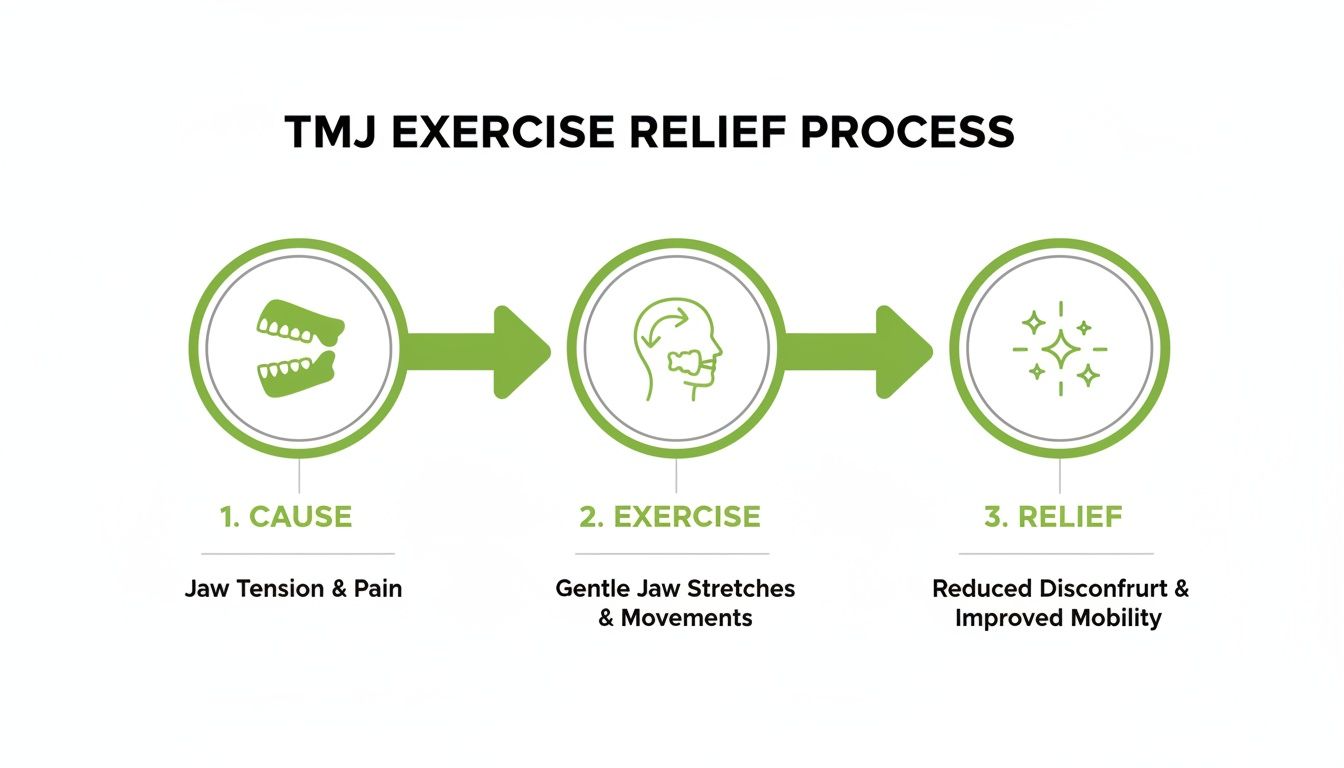
As you can see, the path is straightforward: we start with the tension and work our way toward functional, pain-free movement.
1. The Relaxed Jaw Opener
This is our starting point. The goal here is pure, pain-free mobility. We want to get the joint moving smoothly without calling on those overworked chewing muscles that are often the main culprits of discomfort.
With your tongue resting on the roof of your mouth, slowly lower your bottom jaw as far as it will comfortably go. Don't push through pain or a loud click. Then, slowly bring it back up.
- Repetitions: Do this 6 times.
- Frequency: Aim for 6 sets spread throughout the day.
Why This Works: Keeping your tongue up helps stabilize the joint, encouraging a healthy, hinge-like rotation instead of an irritating forward glide. This simple move lubricates the joint and gently stretches the tight tissues around it.
2. Side-to-Side Jaw Glide
Many people I see with TMJ pain have restricted side-to-side movement, which forces their jaw to compensate and leads to more strain. Restoring this lateral glide is crucial for balanced function.
Place something thin between your front teeth—a couple of stacked tongue depressors or even a pen will do. Now, gently glide your jaw from one side to the other. Keep the movement slow and deliberate.
- Repetitions: Aim for 10-15 glides in each direction.
- Frequency: Do this 2-3 times daily.
Why This Works: This exercise targets the lateral pterygoid muscles, which are key players in jaw movement. By strengthening and coordinating them, we help ensure the articular disc—that little cushion inside your TMJ—is tracking correctly.
My Clinical Tip: You'll likely notice one side feels tighter or doesn't move as far. That's normal. Give that tighter side a little extra focus. The long-term goal is to achieve smooth, symmetrical movement.
3. Forward Jaw Protrusion
This next move targets the muscles responsible for pulling your jaw forward. When these are weak or uncoordinated, it can be a major contributor to joint clicking and poor mechanics.
Start with your jaw in a neutral, relaxed position. Slowly slide your bottom jaw straight forward until your bottom teeth are in front of your top teeth. Hold it for a moment, then gently return to the starting position.
- Repetitions: Perform 6 repetitions.
- Frequency: Complete 6 sets throughout the day.
Why This Works: A controlled forward glide is essential for wide opening and chewing. By conditioning these muscles, we can often help recapture a slightly displaced disc and reduce some of those clicking or popping sounds.
4. Resisted Opening and Closing
Once you're comfortable with the basic movements, adding a bit of gentle resistance is the next step to build real strength and stability. This is key for preventing future flare-ups.
- For Resisted Opening: Place your thumb under your chin. As you slowly open your mouth, apply gentle upward pressure with your thumb.
- For Resisted Closing: Place your index finger on your chin with your thumb on the ridge just below your lower lip. Apply gentle downward pressure as you slowly close your mouth.
Repetitions: Hold each movement against the resistance for 3-5 seconds. Repeat 10 times.
Frequency: Perform this once daily.
Why This Works: This is an isometric exercise, meaning it strengthens the jaw-opening and closing muscles without putting a lot of stress on the joint itself. Stronger muscles provide better support for the TMJ during everyday activities like talking and eating.
5. Chin Tucks for Posture
Never underestimate the power of posture! I see it in the clinic all the time—a forward-head position puts a massive strain on the TMJ and surrounding muscles, making pain significantly worse.
Sit up straight and imagine a string is gently pulling the top of your head toward the ceiling. From there, gently tuck your chin in, like you’re trying to make a double chin. You should feel a nice stretch in the back of your neck. Hold for 3 seconds.
- Repetitions: Do 10 repetitions at a time.
- Frequency: Squeeze this in several times a day, especially if you work at a desk.
Why This Works: Correcting your head posture aligns the spine and immediately reduces the gravitational pull on your jaw. This simple move helps deactivate those overworked neck muscles that so often refer pain to the jaw and temples.
6. Tongue Up and Swallow
This final exercise is all about retraining your tongue to rest in its proper position, which is fundamental to good jaw and airway health.
Start by pressing the entire surface of your tongue flat against the roof of your mouth. While holding it there, open and close your mouth slowly 6 times. Then, keeping your tongue pressed up, simply swallow.
- Repetitions: Repeat this entire sequence 6 times.
- Frequency: Practice this 6 times per day.
Why This Works: Proper tongue posture acts like a natural support system for the jaw from the inside. This exercise not only strengthens the tongue but also helps establish a correct swallowing pattern, which reduces chronic strain on the TMJ over time.
Soothing Jaw Clicks and Improving Function
That tell-tale click, pop, or grating sound you hear when you chew or yawn isn't just an annoyance—it's a clear signal that the delicate mechanics inside your jaw joint are off. These sounds usually happen when the articular disc, a small piece of cartilage that acts as a shock absorber in your TMJ, slips out of its sweet spot. Think of it like a door hinge that’s slightly out of alignment; it's going to make a noise every time you move it.
For many of the patients I see, these sounds are a constant source of anxiety. I've had people tell me they avoid certain foods or skip meals with friends because they’re worried their jaw will make a loud, embarrassing pop. The good news is that specific TMJ pain management exercises are designed to tackle this exact problem by improving how the joint moves and stabilizing the muscles around it.

Promoting Smoother Joint Movement
The point of these exercises isn’t to force the joint into silence overnight. Instead, we’re retraining the muscles that guide its movement. When these muscles are balanced and working together, they help keep that little disc where it belongs, leading to a much smoother, quieter gliding motion. Movements like the Side-to-Side Jaw Glide and Forward Jaw Protrusion are especially great for this.
These controlled motions strengthen the small, stabilizing muscles that are so crucial for proper joint function. With consistent practice, you're essentially teaching your jaw a more harmonious way to move, which can dramatically reduce how often and how loudly it clicks over time.
A Real-World Scenario: Picture someone who clenches their jaw at their desk all day due to stress. That constant tension can pull the articular disc slightly forward, causing a click every time they open their mouth. By practicing gentle, controlled exercises throughout the workday, they can release that muscle tightness and help guide the disc back into a healthier position, quieting the click and easing the discomfort that comes with it.
The research really backs this approach up. Can you imagine achieving a 50% or greater improvement in TMJ clicking just from professionally supervised jaw exercises? It's entirely possible. A key 2019 study showed that in a group performing these exercises under supervision, about two-thirds of participants reported at least a 30% improvement in their TMJ sounds, with half of them hitting that 50% reduction mark. You can learn more about these exercise program findings, which also showed a drop in pain and neck disability. This is exactly why expert guidance is so important—it ensures you're performing the movements correctly to fix the issue, not accidentally make it worse.
Breaking the Cycle of Headaches and Neck Tension
If your TMJ pain rarely stays confined to your jaw, you're not alone. Many of my patients describe a frustrating ripple effect where jaw trouble quickly spirals into tension headaches, a stiff neck, and even facial fatigue. This isn't just a coincidence; it's a direct result of how interconnected these muscle groups are.
When the powerful muscles that control your jaw get overworked from clenching or grinding, they don’t keep their distress to themselves. They start sending out referred pain signals to other areas—most often the temples, forehead, and the sensitive muscles in your neck. This is precisely why that dull throb behind your eyes might actually be starting in your jaw.

How Jaw Exercises Interrupt the Pain Signals
The great news is that by performing targeted TMJ pain management exercises, you can directly interrupt this painful cycle. When you release tension in the jaw muscles, you cut off the source of the referred pain. This offers a sustainable path to relief that doesn't just rely on popping another painkiller.
Think about a common scenario I see all the time: an office worker who unconsciously clenches their jaw during stressful moments, leading to a predictable afternoon headache. Taking just a few minutes for gentle jaw stretches can release that built-up tension before it has a chance to radiate upward. This proactive approach can make a huge difference in how often and how intensely headaches strike.
The clinical evidence backing this up is compelling. Research consistently shows that a regular jaw exercise routine can slash headache frequency and reduce the need for analgesics. A 2022 randomized controlled trial found that patients in the exercise group had a significant drop in tension-type headache frequency (P = .028) and took fewer painkillers (P = .007) compared to those who did nothing.
Key Takeaway: Headaches and neck pain are often secondary symptoms of a primary jaw problem. By addressing the root cause with targeted exercises, you can achieve far more effective and lasting relief than by only treating the headache itself.
Connecting Neck Posture to Jaw Comfort
Your head's position plays a massive role in your jaw’s health. When you slouch or hold a forward-head posture—something almost everyone with a desk job is guilty of—it puts immense strain on your neck and, by extension, your TMJ. Simple postural exercises, like chin tucks, help realign your spine and take the pressure off these overworked muscles.
Try these simple adjustments throughout your day:
- Lengthen Your Spine: Imagine a string is gently pulling the crown of your head toward the ceiling.
- Tuck Your Chin: Gently pull your chin back as if you're trying to make a double chin. You should feel a nice, gentle stretch in the back of your neck.
- Drop Your Shoulders: Consciously relax your shoulders, letting them fall down and away from your ears.
By integrating these small postural tweaks into your daily routine, you create a healthier foundation for your jaw to function. For those struggling with persistent tension, it's also incredibly helpful to learn more about how to treat tension headaches naturally. Combining these strategies creates a powerful, multi-faceted approach to breaking the pain cycle for good.
When to Combine Exercises with Professional Care
While the TMJ pain management exercises in this guide are a fantastic starting point, they truly shine when they're part of a bigger picture—a complete treatment plan guided by a professional. Think of these exercises as your daily homework. They build the foundation, but an expert provides the roadmap to make sure everything you're doing leads to real, lasting stability.
The most important first step is getting a proper diagnosis. TMJ pain isn't a single condition; it can be caused by muscle issues (myofascial pain), joint problems (internal derangement), or often, a mix of both. An expert can pinpoint the exact source of your pain, which is critical for making sure you're doing the right exercises. The wrong movements for your specific issue could be ineffective at best, or even make the problem worse.
Integrating Exercises into Advanced Therapies
Once we know what we're dealing with, your exercise routine becomes an incredibly powerful tool that supports more advanced clinical treatments. It essentially preps your muscles and joints, making them more receptive to therapies designed to fix the root cause of the problem.
For instance, these exercises are often a prerequisite for Orofacial Myofunctional Therapy (OMT), a specialized program we use to retrain poor habits in breathing, chewing, and swallowing that put a ton of strain on the jaw. Your daily exercises build the muscle awareness and coordination needed to make OMT stick.
It’s a similar story if you're a candidate for regenerative treatments like Platelet-Rich Fibrin (PRF) injections. A consistent exercise routine is key to maintaining the improved joint function and mobility these therapies help restore.
Professional guidance ensures you’re not just chasing symptoms but actively healing the underlying cause of your TMJ disorder. This team approach gets you faster, more meaningful, and more sustainable relief.
Knowing When Self-Care Isn't Enough
It’s crucial to recognize the signs that your TMJ issues need more than just at-home care. It’s time to schedule an evaluation with a specialist if you're experiencing any of these red flags:
- Pain that's stubborn or getting worse: Your pain isn't getting better with gentle exercises, or it’s actually intensifying.
- Serious functional problems: Your jaw locks open or shut, or you have major trouble chewing or even talking.
- Pain that started after an injury: Your jaw issues began following an accident or an injury to your head or neck.
- Other neurological symptoms: The pain is accompanied by persistent dizziness, ringing in your ears (tinnitus), or numbness in your face.
These symptoms point to a more complex problem that really needs a comprehensive evaluation. If you're looking for a specialist who can provide that in-depth diagnosis, you can learn more about finding a facial pain specialist near you and start the journey toward targeted, effective care.
Your Questions About TMJ Exercises Answered
It's natural to have questions when you start any new routine, especially one for managing pain. You want to know if you're on the right track and what to expect. Let's walk through some of the most common questions we hear from patients.
How Long Until I See Results from These TMJ Exercises?
This is probably the number one question people ask, and the honest answer is: it takes time. While you might feel some initial relief from muscle tension in just a few days, real, lasting improvement in your pain and jaw mobility is a gradual process.
Think of it like physical therapy for any other part of your body. You should plan on sticking with the routine for at least 8 to 12 weeks to see a significant difference. Consistency is everything—it's the daily practice that slowly retrains your jaw muscles and allows the joint to heal.
Should I Feel Pain When Doing These Exercises?
No. The goal here is gentle movement and tension release, not forcing anything. You should never feel sharp, stabbing, or intense pain.
It’s completely normal to feel a mild stretching sensation or even light muscle fatigue, but if an exercise causes a sudden spike in pain or makes your jaw feel like it's about to lock up, stop immediately.
Pain is your body’s way of saying "back off." Pushing through it can easily make the inflammation worse and set you back. Always listen to what your jaw is telling you.
Can I Do These Exercises If I Use a TMJ Splint?
Yes, in most cases, these exercises are meant to complement splint therapy. A splint helps decompress the jaw joint and calm the surrounding muscles, creating an ideal state for these gentle exercises to be even more effective.
However, you absolutely need to confirm this with your provider. They’ll give you specific guidance on whether to do the exercises with your splint in or out and how to best coordinate the two for the fastest, safest results.
When Is It Time to See a Doctor?
At-home exercises are a fantastic first-line defense, but they aren't a substitute for professional care in certain situations. It’s time to schedule an evaluation with a specialist if you're experiencing any of the following:
- The pain is severe, constant, or getting worse even with the exercises.
- Your jaw frequently locks open or closed.
- You have significant trouble chewing, swallowing, or talking.
- Your symptoms started right after an injury to your head, face, or neck.
- The jaw pain comes with dizziness, constant ringing in your ears, or numbness in your face.
These symptoms can point to a more complex issue that needs an accurate diagnosis before you can find the right path to relief.
At Pain and Sleep Therapy Center, we specialize in getting to the root cause of your discomfort to create a personalized recovery plan that works. If you're ready to move beyond temporary fixes, we invite you to schedule a consultation with our expert team.