Orofacial myofunctional therapy exercises are a series of targeted movements designed to correct the way your tongue, lips, and jaw muscles work together. It’s all about retraining your mouth for proper breathing, swallowing, and resting postures to get at the root causes of a surprising number of health issues.
Why Orofacial Myofunctional Therapy Is a Game Changer

It’s easy to think of snoring, jaw pain, and even crooked teeth as separate, unrelated problems. But what if they all share a common origin? They often do, and it comes down to dysfunctional muscle patterns in your face and mouth. Orofacial Myofunctional Therapy (OMT) isn't just a set of random facial movements; it’s a structured way to retrain these critical muscles.
Think of it as physical therapy for your mouth, face, and throat. The goal is to correct poor habits that have often developed over a lifetime, like mouth breathing or letting your tongue rest in the wrong spot.
When your tongue doesn't rest properly against the roof of your mouth, for example, it fails to provide the internal support needed for proper jaw and airway development. This single issue can set off a chain reaction of problems.
Connecting the Dots to Common Ailments
The link between these subtle habits and major health concerns is surprisingly direct. An open-mouth posture, for instance, almost always leads to mouth breathing. This alone is linked to everything from sleep apnea to noticeable changes in a child's facial structure.
Here’s how these issues are all intertwined:
- Jaw Pain and TMJ Disorders: Incorrect swallowing patterns—where the tongue shoves against the teeth instead of pressing up on the palate—put a tremendous amount of strain on the jaw joints.
- Sleep Apnea and Snoring: A weak tongue and soft palate can actually collapse into the airway during sleep, causing an obstruction. OMT strengthens these tissues, helping to keep the airway open all night long.
- Dental and Orthodontic Problems: A low-resting tongue or a "tongue thrust" can push teeth out of alignment with constant, gentle pressure. This is often the reason people see their teeth shift again after getting their braces off.
This isn't a new idea. Experts have been connecting facial muscle function to dental health for over a century. In 1918, orthodontist Alfred Rogers presented his first paper on myofunctional therapy. Even earlier, in 1907, the "Father of Orthodontics," Edward H. Angle, called mouth breathing the single biggest contributor to malocclusion.
A Root-Cause Solution
By focusing on restoring proper function, OMT provides a powerful, root-cause solution instead of just chasing symptoms. It helps re-establish nasal breathing, correct tongue posture, and ensure a proper lip seal.
The core idea is simple: when the muscles of your face, mouth, and throat function correctly, they support proper alignment, clear airways, and stable dental health.
This therapy empowers you to take control of foundational bodily functions that have a massive impact on your overall well-being. Understanding the "why" behind the exercises makes it so much easier to commit to the "how" and create lasting change. If you're looking into treatments for facial pain or related issues, it's worth seeing how different types of orofacial therapy can help at https://pscharlotte.com/tag/orofacial-therapy/.
Mastering the Four Foundational Goals of OMT

Before jumping into specific drills, it’s critical to understand the "why" behind them. Orofacial myofunctional therapy isn't just about strengthening muscles; it’s about reprogramming deep-seated habits that affect your health every single day.
Think of it this way: every successful OMT program is built on four interconnected pillars. Master these, and you restore natural, healthy function to your face and airway. Understanding these goals gives you a personal roadmap, helping you see where your own patterns might be falling short and how each exercise fits into the bigger picture.
Goal 1: Nasal Breathing
This is the big one. The most fundamental goal of OMT is to achieve consistent, quiet nasal breathing. Our noses are incredible filtration and humidification systems, perfectly designed to prepare air for our lungs in a way the mouth simply cannot.
When we breathe through our mouths, we bypass that entire process. This seemingly harmless habit can kick off a cascade of issues, from dry mouth and a higher risk of cavities to changes in facial development. Chronic mouth breathing is often a red flag for underlying airway issues and is closely linked to snoring and sleep problems.
The first step in any OMT journey is reclaiming the nose as the primary path for breathing, day and night.
OMT operates on a simple principle: the mouth is for eating and speaking, while the nose is for breathing. Getting back to this natural pattern is the foundation for everything else.
This is why modern therapy often starts with ensuring a clear nasal airway and training a consistent lip seal. In sleep and TMJ clinics, we frequently pair orofacial myofunctional therapy with other treatments to stabilize function, showing just how foundational this goal is.
Goal 2: Correct Tongue Posture
Once you're breathing through your nose, the next mission is mastering where your tongue rests. Ideally, your tongue should be gently suctioned against the roof of your mouth (your palate), with the tip resting just behind your upper front teeth—never pushing against them.
This "tongue-up" posture is a game-changer. It acts like a natural palate expander, providing the internal support your upper jaw needs to develop a wide, healthy dental arch.
When the tongue rests low in the mouth, it can lead to a high, narrow palate, which in turn restricts nasal airway space and contributes to crowded teeth. Think of your tongue as a powerful muscular scaffold; in the right place, it supports healthy jaw growth, but in the wrong place, it can actively work against it.
Goal 3: Proper Lip Seal
A proper lip seal is the gatekeeper of nasal breathing. The goal is simple: keep your lips gently closed whenever you aren't eating or talking. Your teeth should be slightly apart, not clenched together.
This small habit has huge implications. A consistent lip seal prevents mouth breathing, reinforces correct tongue posture, and encourages balanced facial muscle development. On the flip side, an open-mouth posture is one of the most common visual cues of orofacial muscle dysfunction.
- Quick Tip: Check in with yourself a few times today. Are your lips together? Is your breathing silent and through your nose? Awareness is the first step toward changing the habit.
Goal 4: A Healthy Swallowing Pattern
Finally, OMT works to retrain your swallow. Many people develop what we call a "tongue thrust," where the tongue pushes forward or sideways against the teeth when swallowing. Since you swallow hundreds of times a day, that constant, repetitive pressure can easily move teeth out of alignment.
A correct swallow is a beautiful, wave-like motion where the tongue presses upward and backward against the palate to move food and liquid down your throat. The lips and facial muscles should stay relaxed and still. This pattern not only protects your dental alignment but also strengthens the tongue and supports jaw stability.
The Four Core Goals of Orofacial Myofunctional Therapy
Here’s a quick breakdown of these four goals and why they are so critical to your overall health.
| Therapy Goal | Why It Matters | Quick Self-Check |
|---|---|---|
| Nasal Breathing | Filters and humidifies air, supports proper jaw growth, and improves sleep quality. | Is your mouth closed when you are at rest or concentrating? |
| Correct Tongue Posture | Acts as a natural palate expander, promoting a wide dental arch and open airway. | Where is your tongue resting right now? Low or on the roof? |
| Proper Lip Seal | Prevents mouth breathing and supports the balance of facial muscles. | Do you often find your lips parted during the day or night? |
| Correct Swallowing | Prevents tongue thrust, which can lead to dental misalignment and jaw strain. | Do your lips or cheeks move when you swallow a sip of water? |
Mastering these four pillars with dedicated orofacial myofunctional therapy exercises doesn’t just patch up symptoms—it addresses the root cause of the dysfunction. The result is lasting stability and a significant boost to your overall health.
Your Core OMT Exercise Protocol
Alright, this is where the rubber meets the road. We're moving from theory to practice with the foundational exercises that build healthy new habits from the ground up. We'll start with simple awareness and work our way up to active muscle training.
The goal here is for you to feel confident and ready to practice effectively at home. And remember, consistency is far more important than intensity. Think of it this way: short, frequent sessions will always beat one long, exhausting workout.
Establishing Your Foundational Posture
Before we get into any active movements, we need to establish the correct "home base" for your tongue and lips. This is the neutral resting position you'll aim to return to all day, every day. Getting this right is truly half the battle.
Here’s how to find it:
- Find "The Spot": Gently run the tip of your tongue along the roof of your mouth, right behind your upper front teeth. Can you feel that slightly bumpy ridge? That’s your target, known as the incisive papilla.
- Lift and Rest: Now, practice lifting the entire front two-thirds of your tongue so it rests flat against the roof of your mouth. Your tip should be gently touching "the spot," not pushing hard against your teeth.
- Seal the Lips: Close your lips gently. Don't clench your teeth—there should be a tiny bit of space between your upper and lower molars.
- Breathe: Finally, just breathe. In and out, through your nose.
This complete posture—tongue up, lips sealed, teeth slightly apart, and nasal breathing—is your new normal.
I tell my patients to set reminders on their phones or put a little sticker on their computer monitor. Anything that prompts you to check in on your posture throughout the day. Building that awareness is the first and most critical step in reprogramming your muscles.
Tongue Strengthening and Coordination Exercises
A strong, coordinated tongue is a game-changer for proper swallowing, breathing, and even supporting your jaw. These exercises are designed to build that essential strength and control.
Palate Sweeps
This movement helps you map out your entire palate while teaching your tongue to move independently from your jaw.
- Purpose: To train the tongue's full range of motion against the roof of the mouth.
- How to do it: Start with the tip of your tongue on "the spot." Now, slowly and firmly sweep the tip backward along the roof of your mouth, going as far as you can. Then, bring it slowly forward again. The key is to keep your jaw completely still.
- Repetitions: Aim for 15-20 sweeps, twice a day.
- Pro-Tip: I like to tell people to imagine they're painting the roof of their mouth with their tongue. The movement should be deliberate and controlled, never rushed.
Tongue Suction Holds (Tongue Pops)
This one is a real powerhouse. It strengthens the middle and back of the tongue, which is crucial for maintaining that resting posture and keeping your airway open while you sleep.
- Purpose: To build strength in the body of the tongue and create a solid "palatal seal."
- How to do it: Press your entire tongue flat against the roof of your mouth. Use a sucking motion to create a strong seal, pulling the whole tongue upward. Hold that suction for 5-10 seconds. To finish, release the suction with a loud "pop."
- Repetitions: Perform 15-20 pops, twice daily.
- Pro-Tip: Make sure that pop comes from releasing the suction in the middle of your tongue, not just the tip. A strong, clear pop tells you you’ve created a good seal.
Lip and Cheek Muscle Training
Strong lip muscles are the gatekeepers to consistent nasal breathing. Toned cheek muscles also play a huge role in proper chewing and swallowing.
The Button Pull
This is a classic OMT exercise for a reason. It directly targets the muscles around your lips (orbicularis oris) and helps you maintain a natural lip seal without even thinking about it.
- Purpose: To strengthen the lip muscles for a consistent, relaxed seal.
- How to do it: You’ll need a flat button (about the size of a quarter) and some dental floss. Thread the floss through the buttonholes and tie a knot. Place the button just inside your mouth, between your teeth and your lips. Now, gently pull on the floss while using your lip muscles to resist and keep the button from slipping out.
- Repetitions: Hold that resistance for 10 seconds, relax, and repeat 10 times. Once a day is plenty.
- Pro-Tip: The trick is to use only your lip muscles. Try not to puff out your cheeks or engage your chin. All the work should be isolated right around your mouth.
These exercises aren't just about building brute strength; they're about re-educating your entire neuromuscular system. You're carving out new pathways in your brain that will eventually make correct posture and function feel automatic. This process is hugely beneficial, especially for those looking to ease jaw tension. For individuals experiencing discomfort, exploring specific TMJ pain relief exercises can provide additional, targeted support alongside this core protocol.
Swallowing Retraining
The final piece of the puzzle is retraining how you swallow. An incorrect swallowing pattern, often called a "tongue thrust," can undo orthodontic work and contribute to a lot of strain on the jaw.
The "Sip and Seal" Swallow
This drill helps isolate the correct swallowing motion, teaching your tongue to move up and back instead of pushing forward against your teeth.
- Purpose: To correct a tongue thrust and establish a mature, efficient swallowing pattern.
- How to do it: Take a small sip of water and hold it in your mouth. Get into your "home base" posture: lips sealed, teeth slightly apart, tongue tip on "the spot." Now, squeeze the water from the front of your mouth by pressing your tongue firmly up against your palate to complete the swallow.
- Repetitions: Practice this with 10-15 sips of water every day.
- Pro-Tip: Your lips and facial muscles should stay completely still. If you see your lips purse or your cheeks tense up, you're compensating. I sometimes have patients place their fingertips gently on their lips to make sure they stay relaxed. It should feel like a wave rolling from the front of your tongue to the back.
Working Through Common Roadblocks and Adapting for Kids
Starting orofacial myofunctional therapy is a fantastic first step, but let's be realistic—the road isn't always perfectly straight. It's totally normal to hit a few bumps when you're retraining muscles that have been on autopilot your entire life. Knowing what to expect and how to pivot is the key to staying on track and getting those results to stick.
The whole point of this therapy is to rewire the fundamental functions of your tongue, lips, and swallowing. It’s a big job, but absolutely doable.
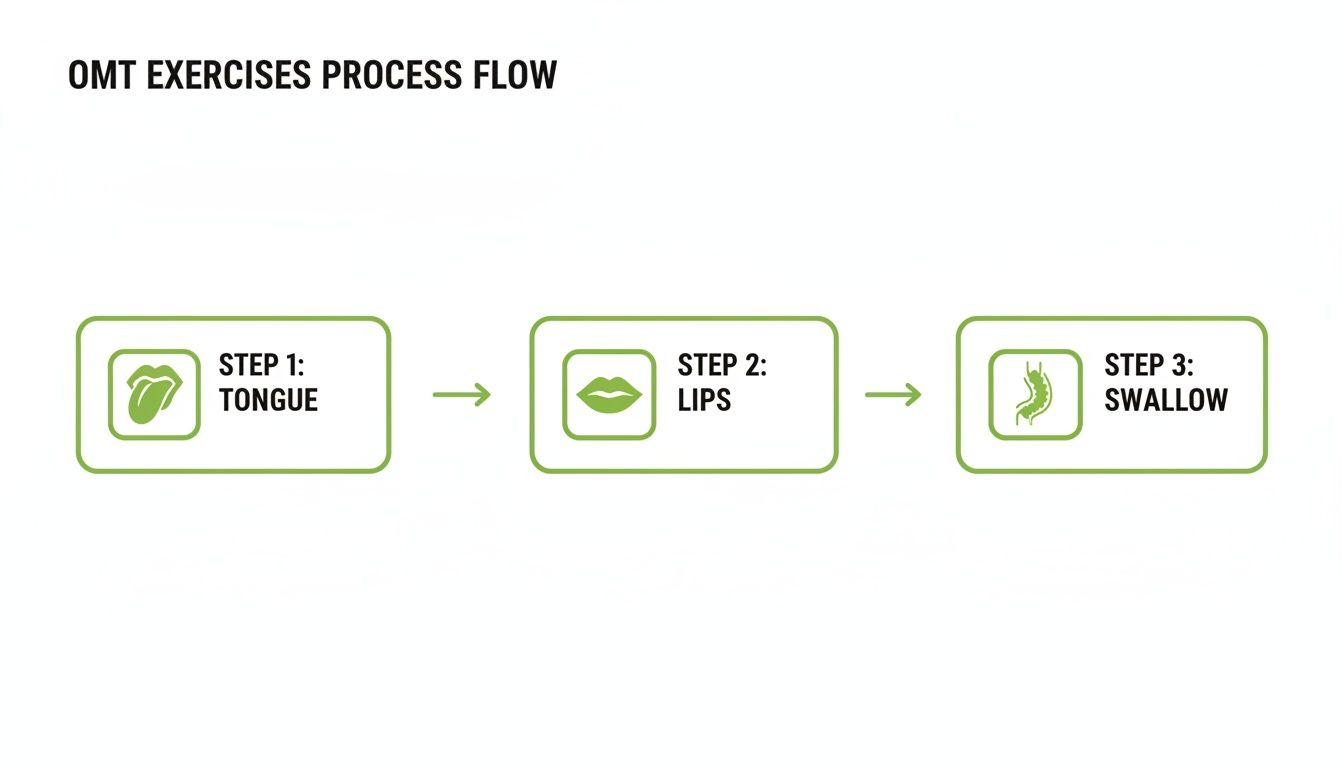
As you can see, OMT exercises follow a logical path, starting with retraining the tongue, then establishing a good lip seal, and finally, correcting the swallow itself.
Troubleshooting Common Hurdles for Adults
Even the most dedicated adults run into challenges. The trick is to see them as part of the process, not as a sign that you're failing.
One of the first things people struggle with is keeping their lips sealed all night. You might wake up with a parched, dry mouth, which is a dead giveaway that your mouth fell open while you were sleeping. A simple but effective tool here is a gentle, porous mouth tape made for this exact purpose. It acts as a light reminder for your muscles to stay closed, helping you stick with nasal breathing while you sleep.
Then there's muscle fatigue. Just like hitting the gym for the first time in a while, your tongue and facial muscles might feel tired or a bit sore. This is completely normal. The important thing is to listen to your body and not push through any sharp pain. If an exercise feels uncomfortable, dial back the reps or just take a day off. You're building endurance, not trying to strain anything.
I see a lot of people think OMT is about brute force, but it’s actually about finesse and consistency. You’re teaching your brain and muscles to work together in a new, much more efficient way.
Finally, a tongue-tie (or a restricted lingual frenulum) can make some exercises feel downright impossible. If you find you just can't get your tongue to the roof of your mouth or do a proper sweep, an undiagnosed tie could be the culprit. This is a physical restriction that often needs a professional evaluation. Sometimes, a simple release procedure called a frenectomy is needed to give your tongue the full range of motion it needs.
Making OMT Fun and Effective for Children
When we're working with kids, the whole approach to orofacial myofunctional therapy exercises has to change. The goals are exactly the same—nasal breathing, correct tongue posture, a good lip seal, and a proper swallow—but the delivery has to be all about play. You don't ask a five-year-old to do "palatal sweeps"; you ask them to be a painter and use their tongue paintbrush to paint the whole roof of their mouth.
Here’s how we often adapt the standard exercises:
- Tongue Pops: This becomes a game of making horse-clipping sounds or seeing who can make the loudest pop.
- Button Pull: Instead of a clinical-looking button, we might use a "superhero shield" that they have to hold with their "super lips" to save the day from villains.
- Swallowing: We often teach this by putting a tiny dissolvable candy or a Cheerio on "the spot" and challenging the child to keep it there with their tongue while they swallow.
Turning therapy into a series of games is a game-changer. It gets kids engaged and excited to participate, which is more than half the battle.
Targeting Specific Issues in Kids
Catching these issues early with pediatric OMT is huge because it can actually guide proper facial growth and development. The therapy is incredibly effective for breaking common childhood habits.
For habits like thumb-sucking or pacifier use, the exercises focus on building up lip strength and teaching the tongue where it's supposed to live. Once the tongue learns to rest on the palate, it provides the same kind of soothing sensory feedback the thumb or pacifier did, making the old habit much easier to kick.
For a tongue thrust, where the tongue pushes forward against the teeth when swallowing, the exercises are all about retraining that specific motion. The "sip and seal" exercise might become a "secret agent swallow," where the mission is to swallow a tiny sip of water without letting their lips (the "guards") give away the secret.
By addressing these orofacial myofunctional disorders early on, we can help prevent bigger problems down the road, like crooked teeth or a high, narrow palate. The beauty of orofacial myofunctional therapy exercises is how adaptable they are, making them a powerful tool for people of all ages who want to build a solid foundation for better breathing and lifelong health.
When to Partner with an OMT Professional
Practicing orofacial myofunctional therapy exercises at home is a fantastic way to build awareness and start seeing changes. But sometimes, you need an expert eye.
Think of it this way: you can follow a workout video online, but a personal trainer can correct your form, customize your routine, and help you break through plateaus safely. An Orofacial Myofunctional Therapist (OMT) does the exact same thing for the complex muscles of your face, jaw, and airway.
Knowing when to make that call is key. While self-guided exercises are great for general improvement, certain red flags often point to a deeper issue that really needs a professional assessment to resolve.
Signs You Need a Professional Assessment
If you're dealing with persistent symptoms or your progress has stalled, it’s probably time to seek professional guidance. A certified therapist can provide a clear diagnosis and create a structured plan that goes far beyond generic drills.
Consider reaching out if you notice:
- Persistent TMJ Pain or Clicking: While some exercises can help, ongoing pain, locking, or clicking in the jaw joint often signals a more complex issue. A therapist can pinpoint the specific muscle imbalances causing the problem and ensure you're not accidentally making it worse. You can learn more about TMJ symptoms and potential treatments to see if your experience aligns.
- Diagnosed Sleep Apnea: If you've been diagnosed with Obstructive Sleep Apnea (OSA), OMT can be a powerful part of your treatment. However, it absolutely must be managed alongside a sleep physician to monitor progress and ensure your airway stays properly supported.
- Orthodontic Relapse: Did your teeth shift back after braces? This is a classic sign of an underlying orofacial myofunctional disorder, like a tongue thrust, that was never addressed. An OMT can work with your orthodontist to correct the root cause and make sure your next round of treatment is successful and stable.
- Difficulty with Basic Exercises: If you physically can't get your tongue to the roof of your mouth or find the exercises extremely challenging, you may have a physical restriction like a tongue-tie that needs to be properly evaluated.
The Value of a Collaborative Approach
A professional evaluation is so much more than just a list of new exercises. A skilled therapist doesn't work in a vacuum; they become part of your broader healthcare team, often collaborating with dentists, ENTs, and speech-language pathologists (SLPs). This team approach is essential for uncovering the true root of the issue.
A comprehensive assessment looks at the entire system—how you breathe, chew, swallow, and even your posture—to connect the dots between your symptoms and their underlying cause. It's about creating a personalized therapy plan that integrates OMT with other necessary treatments for the best possible outcome.
This interdisciplinary model has strong institutional backing. By the 1990s, major bodies like the American Association of Orthodontists and the American Speech-Language-Hearing Association (ASHA) had issued statements supporting the treatment of OMDs. This solidified OMT’s role within mainstream care, especially as a tool for managing complex TMJ and sleep-disordered breathing cases. You can read more about the official ASHA position on these therapies to understand its recognized importance.
Ultimately, partnering with a professional isn’t about being upsold. It’s about investing in a guided, personalized path toward lasting results.
Answering Your Top OMT Questions
When you’re just getting started with orofacial myofunctional therapy, it’s completely normal to have a ton of questions. After all, you’re working to consciously change habits you’ve had your entire life. Let's break down some of the most common things people ask when they begin this journey.
The first thing everyone wants to know is, "How long until I see results?" You'll likely feel a new awareness of your muscles and maybe even less facial tension within just a few weeks. But creating permanent change is a marathon, not a sprint. It’s a lot like learning an instrument—you're building new muscle memory that needs consistent practice to stick.
For significant, lasting improvements—like better sleep or more stable dental work—you're looking at several months of dedicated daily exercises. A complete, guided therapy program often runs between 6 to 12 months to make sure those healthy new muscle patterns become second nature.
What If I Have a Tongue-Tie?
This is a critical question. Not only can you do these exercises with a tongue-tie, but OMT is actually a vital part of the treatment process. A tongue-tie (ankyloglossia) is a physical tether that can make proper tongue movement difficult, if not impossible. Therapy is crucial both before and after a tongue-tie release, or frenectomy.
Here’s why the timing is so important:
- Before the Release: Doing specific orofacial myofunctional therapy exercises ahead of the procedure helps wake up and strengthen the tongue. This prep work makes your recovery smoother and the final outcome much more successful.
- After the Release: This is non-negotiable. Targeted exercises are essential to prevent the tissue from reattaching and, most importantly, to teach the tongue how to properly use its new freedom and full range of motion.
Just getting the release without the therapy often fails to fix the underlying functional problems. It's key to work with a professional who can design a plan specifically for your needs.
One of the biggest misconceptions is that these exercises should be painful. They shouldn't be. You should feel your muscles working, much like you would during a new workout, but you should never experience sharp pain, clicking, or jaw locking. If you do, stop right away and check your form with your therapist.
Can OMT Really Help with Snoring and Sleep Apnea?
Absolutely. This is a game-changer for many people. A growing mountain of research confirms that OMT can be incredibly effective at reducing snoring and helping manage mild to moderate obstructive sleep apnea (OSA). It gets right to the root of the problem.
Snoring and OSA often happen because the muscles in the tongue and soft palate go limp during sleep, collapsing and blocking the airway. Orofacial myofunctional therapy directly targets and tones these exact tissues.
By strengthening your tongue, soft palate, and throat muscles, the exercises provide the support needed to keep your airway open. Even more importantly, the therapy retrains your tongue to maintain its proper resting spot—suctioned to the roof of your mouth—even while you sleep. This simple change keeps it from falling back and blocking airflow, which can lead to much quieter, more restorative nights.
At the Pain and Sleep Therapy Center, we specialize in creating personalized OMT programs that get to the root cause of facial pain and sleep-disordered breathing. If you're ready for a solution that delivers lasting results, explore our unique approach to care.