Myofunctional therapy for sleep apnea is a series of targeted exercises designed to strengthen the muscles in and around your mouth, tongue, and throat. By improving the tone and coordination of these muscles, it helps keep your airway open while you sleep, getting to one of the root causes of obstructive sleep apnea (OSA).
A Natural Way to Reclaim Your Sleep
For millions of people, the nightly routine involves a CPAP machine—the mask, the hum, the tangled tubing. It's a solution that can feel more like a nightly battle than a path to restful sleep. Many start looking for an alternative that feels less invasive and more natural.
If that sounds like you, there’s another way forward that goes beyond just managing the symptoms. What if you could retrain the very muscles that are causing the problem in the first place? That’s the entire idea behind myofunctional therapy for sleep apnea, an approach that empowers you to address the underlying mechanics of your airway collapse.
What Is Myofunctional Therapy?
Think of it as physical therapy, but for your tongue, face, and throat. In obstructive sleep apnea, the airway often gets blocked because the muscles that are supposed to hold it open become weak or uncoordinated and collapse during sleep. Myofunctional therapy uses a set of simple, specific exercises to wake those muscles up and get them strong again.
Instead of relying on a machine to force air past the obstruction, this therapy helps your own body do the job it was built for. By restoring proper muscle function, you can create a more stable, open airway—naturally. It’s not a quick fix; it’s a way to retrain your body for long-term results.
An Overview of This Powerful Therapy
This non-invasive approach gives you a real sense of control over your own health. Committing to the exercises means you’re an active participant in your healing, moving away from a reliance on external devices. To get a better sense of how it all comes together, let’s look at the key components.
Myofunctional therapy is all about restoring optimal breathing and muscle function. It targets the root causes of airway obstruction, rather than just masking the symptoms. It’s an active, patient-driven approach to reclaiming peaceful sleep.
For a quick summary, the table below breaks down what the therapy involves, who it’s best for, and the kinds of results you can expect. This helps demystify the process and offers a clear path for anyone exploring their options for managing sleep disorders.
Myofunctional Therapy for Sleep Apnea at a Glance
| Aspect | Description |
|---|---|
| What It Is | A series of exercises targeting the tongue, soft palate, and facial muscles to improve strength, coordination, and resting posture. |
| How It Works | Strengthens airway muscles to prevent them from collapsing during sleep, reducing or eliminating apnea events and snoring. |
| Who Benefits | Individuals with mild to moderate sleep apnea, those who are CPAP intolerant, or anyone seeking to enhance other treatments. |
| Expected Outcomes | Reduced snoring, improved sleep quality, decreased apnea-hypopnea index (AHI), and better daytime energy and focus. |
By understanding these core principles, you can see how myofunctional therapy offers a proactive and effective way to improve your sleep and overall health.
How Muscle Training Can Reopen Your Airway
Think of myofunctional therapy for sleep apnea as a highly specialized fitness program, but for your mouth and throat. Just like you'd strengthen your legs to run faster or your core to improve stability, this therapy targets the exact muscles responsible for keeping your airway open while you sleep. When these muscles are weak or uncoordinated, they go slack, leading to airway collapse and the disruptive cycle of sleep apnea.
This therapy gets right to the anatomical root cause of the obstruction. It’s not about forcing air past a blockage; it’s about training your body's own muscles to prevent the blockage from ever happening.
The Anatomy of an Airway Collapse
Imagine your tongue as the gatekeeper to your airway. During the day, it’s always working—helping you talk, eat, and swallow. But at night, when everything relaxes, a weak or poorly positioned tongue can become a serious liability.
If your tongue lacks proper muscle tone or has a habit of resting low and back in your mouth (instead of up against the roof), it can easily slide backward into your throat. This blocks the flow of air, triggering an apnea event. Your brain then has to jolt you awake just enough to start breathing again, and it's these constant interruptions that leave you feeling wiped out the next day.
This helpful concept map breaks down what myofunctional therapy is, who it’s for, and why it’s such an effective approach.
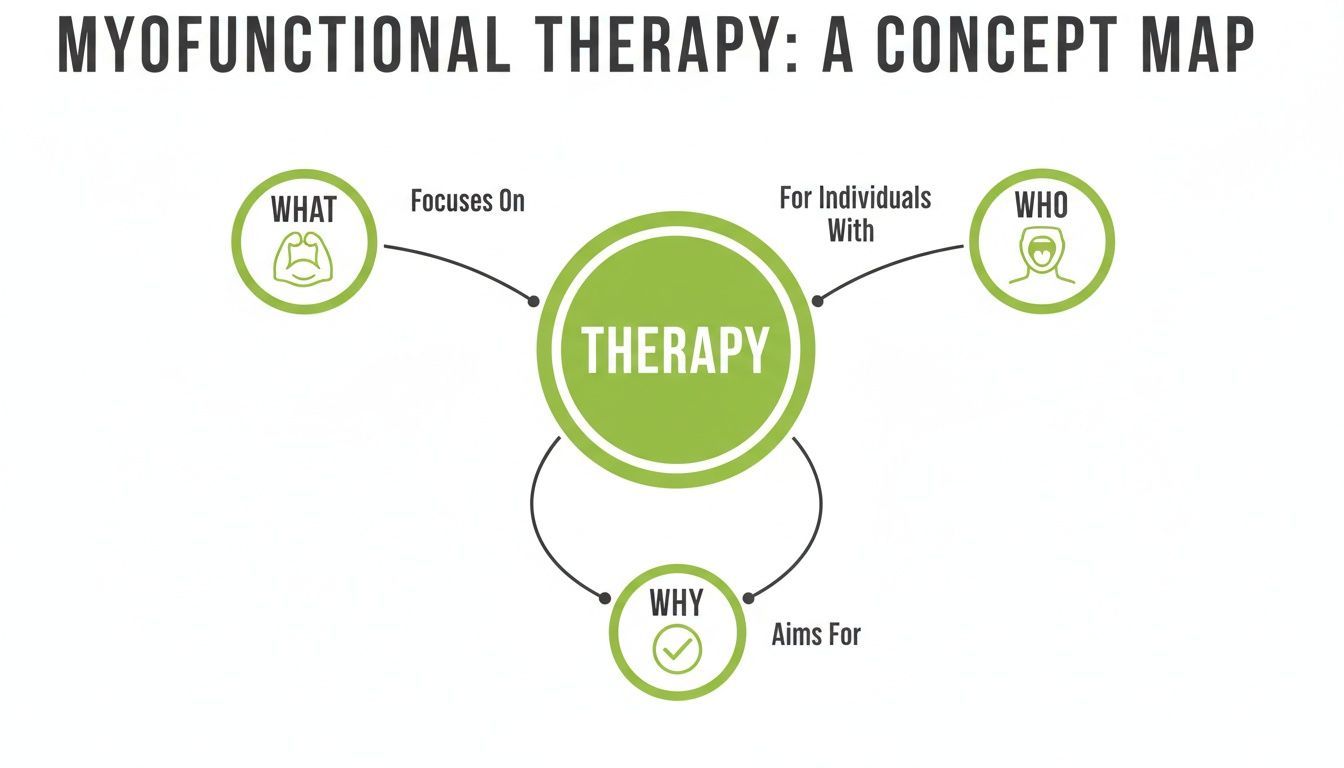
As you can see, the therapy is all about retraining muscles to create a lasting, natural solution for better breathing.
Strengthening Muscles for a Stable Airway
Myofunctional therapy isn’t just about the tongue; it’s a coordinated effort to retrain the entire system of muscles in your mouth, face, and throat. The exercises are designed with a few key goals in mind, all of which work together to create a more open and stable airway during sleep.
The core objectives are:
- Toning the Tongue: Exercises strengthen the tongue and teach it to maintain its proper resting posture against the roof of the mouth (the palate). A toned tongue is far less likely to relax and fall back into the throat.
- Firming the Soft Palate: The soft palate—that fleshy tissue at the back of your mouth—can vibrate and sag, causing snoring and contributing to obstruction. Targeted exercises help firm up this tissue, reducing vibrations and collapse.
- Improving Muscle Coordination: The therapy re-establishes correct patterns for breathing, chewing, and swallowing. This improves how all the parts of your airway work together, ensuring they function as a team to stay open.
By addressing these foundational muscular issues, myofunctional therapy can produce clinically significant improvements. It’s a proactive treatment that empowers you to physically change the way your airway functions.
This isn't just theory; the results are backed by solid research. A major 2020 meta-analysis confirmed that myofunctional therapy led to a large reduction in the apnea-hypopnea index (AHI), the main measurement of sleep apnea severity. Patients experienced an average AHI reduction of over 13 points, highlighting a powerful, evidence-based path to better sleep. You can explore the full research about these clinical findings to learn more.
Could Myofunctional Therapy Be Right for You?
Figuring out the right treatment for sleep apnea can feel like putting together a complicated puzzle. While CPAP is the most common solution, myofunctional therapy for sleep apnea offers a completely different approach—it's an exercise-based program that can be incredibly effective for the right person.
The real key is figuring out if your specific symptoms and diagnosis line up with what this therapy is designed to fix. It’s not a one-size-fits-all solution. Instead, it’s a specialized program that gets the best results for people with a certain profile. If you find yourself nodding along with the following descriptions, it’s a good sign this approach could be a game-changer for your sleep.
Who Is an Ideal Candidate?
Myofunctional therapy works best when sleep apnea is caused by poor muscle tone and function, not by a major anatomical blockage. Think of it like this: if the problem is that your airway muscles are weak and uncoordinated, a fitness program designed specifically for those muscles just makes sense.
You might be a strong candidate if you:
- Have Mild to Moderate OSA: Your sleep study shows an apnea-hypopnea index (AHI) in the mild to moderate range. In these cases, strengthening the airway muscles can often make a huge difference.
- Struggle with CPAP Intolerance: A lot of people find CPAP machines uncomfortable, loud, or claustrophobic. Myofunctional therapy gives you a non-invasive alternative that lets you treat the problem without having to rely on nightly equipment.
- Experience Persistent Snoring: Even if you don't have a formal OSA diagnosis, loud, consistent snoring is a clear sign of airway vibration and instability. Strengthening the soft palate and throat muscles can quiet things down significantly.
Beyond these primary signs, certain physical clues can also point to underlying muscle dysfunction that this therapy targets directly.
Myofunctional therapy is designed for those whose airway issues stem from how their muscles function, not just how their anatomy is structured. It’s about retraining the system for better performance.
Physical Signs and Habits to Look For
Sometimes, the best clues are hiding in plain sight—in your daily habits or even the structure of your mouth. These signs often show that the muscles of your face, mouth, and throat aren't working the way they should be.
Common indicators include:
- Mouth Breathing: If you habitually breathe through your mouth (day or night), it's a major red flag for poor tongue posture and potential nasal obstruction.
- Scalloped Tongue: Look at your tongue in the mirror. If you see wavy indentations along the sides, it often means your tongue is pushing against your teeth because it doesn't have enough space or proper muscle tone.
- Tongue-Tie: A restricted lingual frenulum (the tissue under your tongue) can keep the tongue from resting properly on the roof of the mouth, which directly contributes to airway collapse during sleep.
The clinical evidence backs this up, especially for people who haven't had luck with other treatments. Studies show that for adults who found CPAP unmanageable, myofunctional therapy led to real improvements. In one analysis, after 90 sessions, patients' AHI scores dropped from an average of 32.97 to 21.9 events per hour. You can learn more about these myofunctional therapy findings and see the data for yourself.
It’s important to remember, though, that this therapy isn't for everyone. If you have severe OSA caused by major structural issues, like significantly enlarged tonsils or a severely recessed jaw, you may need surgical or other medical treatments first. The goal is always to match the treatment to the root cause of the problem.
Your Personalized Myofunctional Therapy Journey
Starting myofunctional therapy for sleep apnea isn't about following a generic script. It’s a highly structured, collaborative process built completely around your unique anatomy and needs. Think of it less like a set of exercises and more like a personal training program for your airway.
This is a true partnership between you and your therapist. The goal is to methodically retrain the very muscles that have contributed to your airway collapse, helping you find a more natural and restful night’s sleep.

The entire process pulls back the curtain on the root causes of your breathing issues. You’ll get the tools and knowledge to take an active role in your own healing by building awareness, strength, and coordination from the ground up.
The Initial Consultation and Assessment
Your journey kicks off with a comprehensive evaluation. This first meeting is so much more than a simple conversation—it's a deep dive into your orofacial health. A trained myofunctional therapist will carefully assess several key factors to build a complete picture of how your muscles are functioning (or not).
During this assessment, the therapist will examine:
- Oral Rest Posture: How do your tongue, lips, and jaw sit when you're not talking or eating? An improper resting position is a major contributor to sleep apnea.
- Breathing Patterns: We’ll observe whether you primarily breathe through your nose or your mouth. Chronic mouth breathing is a huge red flag for airway dysfunction.
- Swallowing Mechanics: An incorrect swallowing pattern, often called a "tongue thrust," points to underlying muscle weakness and poor coordination.
- Muscle Tone and Strength: The therapist evaluates the strength and endurance of your tongue, lips, and soft palate muscles to identify specific areas that need work.
This detailed assessment is the foundation for everything that follows. It allows the therapist to pinpoint the exact functional issues holding you back, ensuring your exercises are targeted and effective.
Creating Your Custom Exercise Plan
With a clear picture from the assessment, your therapist designs a therapy plan specifically for you. This is the opposite of a one-size-fits-all approach. Your program is built around the precise weaknesses and dysfunctional patterns identified during your evaluation. It's just like a personal trainer creating a workout regimen tailored to your specific fitness goals.
Your plan will include a series of exercises designed to progressively retrain your orofacial muscles. While every plan is unique, they generally focus on a few core areas.
Common Exercise Categories:
- Tongue Strengthening: Exercises to build tone in the tongue, helping it maintain its proper resting spot against the roof of the mouth and stopping it from falling back into your airway.
- Lip and Cheek Exercises: These movements improve lip seal, which is crucial for promoting nasal breathing both day and night.
- Soft Palate Exercises: Specific exercises can help firm up the soft palate, reducing the vibrations that cause snoring and preventing tissue from collapsing.
- Swallowing Retraining: You’ll learn how to swallow correctly, using the right muscles in the right sequence to reinforce proper tongue posture and coordination.
You can learn more about the specific types of movements involved by exploring our detailed guide to orofacial myofunctional therapy exercises. These simple yet powerful movements become the building blocks for a stronger, more stable airway.
Setting Realistic Timelines and Expectations
It’s important to understand that myofunctional therapy is a process. It requires consistency and commitment. This isn’t an overnight fix but a structured program of re-education for your muscles. Just like learning a new skill or building strength at the gym, results come from dedicated daily practice.
Myofunctional therapy is about creating new, healthy muscle memory. This takes time, but the results are lasting because you are physically changing the way your airway functions.
Typically, a full course of therapy can last from several months to a year, depending on your individual needs and how consistent you are with the program.
- Initial Phase (First Few Weeks): Here, the focus is on building awareness and mastering the basic exercises. You might start to notice small changes, like how your tongue rests or an increased ability to breathe through your nose.
- Strengthening Phase (Months 1-6): With consistent daily practice (usually 10-15 minutes, twice a day), you'll start building significant muscle strength and endurance. This is when many people begin to see real improvements in their sleep quality and a reduction in snoring.
- Habituation Phase (Months 6+): The goal now is to make the new muscle patterns automatic. Your exercises may become less frequent as your body adopts these healthier habits as its new normal.
Your therapist will guide you every step of the way, adjusting your program as you progress and giving you the support you need to stay motivated and see it through.
Integrating Therapies for Maximum Results
When it comes to treating obstructive sleep apnea, there's rarely a single "magic bullet." The most successful approaches almost always involve combining different treatments to create a powerful, synergistic effect.
Think of myofunctional therapy for sleep apnea not as a standalone option, but as a foundational partner that makes other proven therapies work even better. It strengthens your airway from the inside out, addressing the root cause—weak muscles—that devices and procedures often can’t fix on their own.
By integrating muscle training with other treatments, you’re tackling the problem from multiple angles. This approach leads to more comfortable, sustainable, and effective results. Whether you use a CPAP machine, an oral appliance, or are considering surgery, adding myofunctional therapy can significantly improve your outcomes.

Enhancing CPAP Therapy
Continuous Positive Airway Pressure (CPAP) is the gold standard for treating moderate to severe sleep apnea. The problem? Many people struggle to use it consistently because of discomfort, claustrophobia, or frustrating air leaks. Myofunctional therapy acts as the ultimate CPAP support system.
By strengthening your tongue, soft palate, and throat muscles, the therapy helps your airway naturally resist collapse. This often means you can get the same great results with a lower, more comfortable pressure setting on your CPAP machine. A stronger airway is also less prone to the soft tissue vibrations that cause mask leaks, making your therapy more effective and much easier to tolerate all night.
The data backs this up. A systematic review found that combining myofunctional therapy with CPAP significantly boosts how long patients use their device each night. Since consistency is everything for CPAP success, this is a huge step forward for anyone struggling to adapt. You can discover more insights about these adherence findings and see how this combined approach can make a real difference.
Partnering with Oral Appliance Therapy
Oral appliances are an excellent CPAP alternative, especially for mild to moderate OSA. These devices work by gently repositioning the lower jaw forward to keep the airway open. While effective, they are a passive solution—they hold the airway open but don't actually fix the underlying muscle weakness.
This is where myofunctional therapy creates a perfect pairing. The exercises actively tone and strengthen the very muscles the oral appliance is designed to support, leading to better, more stable results. Strong, well-coordinated orofacial muscles can also help prevent or manage potential side effects of oral appliances, like jaw soreness or bite changes. This connection is why understanding different TMJ treatment options can provide a fuller picture of orofacial wellness.
Myofunctional therapy doesn't compete with other treatments; it completes them. By strengthening the airway's foundation, it helps devices and procedures work more effectively and with greater comfort.
Supporting Surgical Interventions
For some people, anatomical issues like a restricted tongue-tie (ankyloglossia) are a major factor in airway collapse. A frenectomy is a simple surgical procedure that releases this restriction, allowing the tongue to move freely and rest properly against the roof of the mouth.
Myofunctional therapy is an essential part of a successful frenectomy, both before and after the procedure.
- Pre-Surgery: Exercises prepare the tongue muscles for their new range of motion. We’re essentially "waking them up" so they're ready to function correctly once released.
- Post-Surgery: Targeted therapy is crucial for preventing the tissue from reattaching and for training the tongue to use its newfound freedom. This re-education ensures you get the full benefits of the procedure, leading to lasting improvements in breathing, swallowing, and sleep.
By integrating these therapies, we can create a comprehensive care plan that addresses both the structural and functional causes of your sleep apnea, paving the way for more profound and lasting relief.
Common Questions About Myofunctional Therapy
When you're thinking about starting myofunctional therapy for sleep apnea, it's only natural to have a few questions. This isn't a quick fix; it's a commitment to retraining your body for better health, so understanding the day-to-day details is a key part of the journey.
Let's walk through some of the most common questions we hear to give you a clear picture of what to expect.
How Long Until I See Results?
This is usually the first thing people want to know, and the simple answer is that progress comes in stages. Myofunctional therapy is all about building new muscle memory, which takes time and consistent daily effort—think of it more like training for a marathon than a sprint.
You'll likely start to feel subtle improvements in muscle awareness and control within the first few weeks. It might be as simple as noticing your tongue resting naturally on the roof of your mouth or finding it easier to breathe through your nose. These early signs are small but important.
For the big, measurable changes—like a real shift in your sleep quality and a drop in your Apnea-Hypopnea Index (AHI)—you should plan for a longer timeline. Most people see meaningful, lasting improvements after 3 to 6 months of dedicated practice. Patience and consistency are your best friends here, as the goal is to make these healthy new habits completely automatic.
Are the Exercises Difficult to Do?
The word "exercise" might make you think of a strenuous gym workout, but myofunctional therapy is completely different. The movements are gentle, precise, and targeted, focusing on coordination and endurance rather than brute strength. They aren't physically demanding in the traditional sense.
The real challenge isn't the difficulty of the movements themselves, but the commitment to doing them correctly and consistently every day. Your therapy plan will likely ask for about 10 to 15 minutes, twice a day.
The focus of myofunctional therapy is on the quality of the muscle movement, not the quantity of effort. It’s about re-educating your muscles to do their jobs correctly, which requires concentration and precision.
It's a lot like learning a musical instrument. You start by practicing specific scales and movements slowly to build the right muscle memory. Over time, those movements become second nature. Your therapist will guide you every step of the way to make sure you're getting the most out of every exercise.
Is Myofunctional Therapy Covered by Insurance?
Navigating insurance for any specialized medical treatment can be tricky, and myofunctional therapy is no exception. Coverage can vary widely depending on your provider, your specific plan, and even your state.
Some insurance plans may cover a portion of the therapy, particularly if it's deemed medically necessary and prescribed by a physician or dentist. However, it's not always a guaranteed benefit. We always recommend taking these steps to get a clear answer:
- Contact Your Insurance Provider Directly: Call the member services number on your card and ask specifically about coverage for "orofacial myofunctional therapy."
- Request a Pre-authorization: Your therapy provider can often submit a pre-authorization request on your behalf. This helps determine what, if any, portion of the treatment will be covered before you begin.
Because coverage can be unpredictable, many specialized clinics like ours offer flexible payment plans or financing options. Our goal is to make this life-changing care accessible and manageable for your budget.
Can Children Also Benefit from This Therapy?
Absolutely. In fact, myofunctional therapy can be even more impactful for children because it addresses foundational issues during a critical stage of growth. For kids, this therapy isn't just about correcting an existing problem; it’s about guiding proper development to prevent more serious issues down the road.
Many childhood sleep-disordered breathing issues are directly linked to poor oral habits, and this therapy is highly effective at correcting those root causes.
Key areas where therapy helps children:
- Correcting Mouth Breathing: It teaches kids to breathe through their nose, which is crucial for proper facial development, oxygenation, and immune function.
- Establishing Proper Tongue Posture: The therapy trains the tongue to rest on the roof of the mouth, helping guide the forward growth of the upper jaw and ensuring there is enough room for adult teeth.
- Eliminating Harmful Habits: It can help stop habits like thumb sucking or improper swallowing patterns that can negatively affect jaw and tooth alignment.
By intervening early, myofunctional therapy can help set a child up for a lifetime of better breathing, proper facial structure, and healthier sleep.
At Pain and Sleep Therapy Center, we believe in empowering our patients with the knowledge and tools they need to achieve lasting results. Our team of specialists is dedicated to providing personalized care that addresses the root cause of your sleep and pain issues. If you have more questions or are ready to start your journey to better breathing, we're here to help.
Find out how our expert-led programs can make a difference in your life by visiting us at https://pscharlotte.com.