
When that sharp, throbbing jaw pain flares up, your first instinct is probably to do anything to make it stop. The good news is, you can. Simple, effective self-care techniques can calm an angry jaw joint and provide immediate relief, giving it the break it desperately needs to start healing.
Finding Immediate Jaw Pain Relief at Home
A sudden spike in jaw pain can throw your whole day off track, but you have more power to manage it than you might realize. The key is knowing what to do and when. With the right approach, you can turn your home into a first-response recovery zone for your temporomandibular joint (TMJ).

Soothe Pain With Temperature Therapy
One of the oldest tricks in the book is also one of the best for jaw pain: temperature therapy. But knowing whether to grab an ice pack or a warm compress makes all the difference.
-
Cold Therapy: For sharp, acute pain or noticeable swelling, cold is your best friend. Wrap an ice pack in a thin towel and apply it for 10-15 minutes at a time. The cold constricts blood vessels, which helps numb the pain and reduce inflammation. This is the perfect go-to right after an injury or during a bad flare-up.
-
Moist Heat: If you're dealing with a dull, chronic ache or tight, sore muscles, reach for moist heat. A warm, damp cloth or a microwavable heat pack applied for about 15 minutes will increase blood flow, helping to relax those tense muscles. Just be sure to avoid heat if you see significant swelling or suspect an infection.
My rule of thumb for patients? Use ice for the first 24-48 hours of any new, intense pain. After that, switch to moist heat to soothe any lingering muscle tightness.
To help you decide which method is best for your situation, here's a quick comparison of the most common at-home strategies.
Quick Guide to At-Home Jaw Pain Relief Strategies
| Technique | How It Helps | When to Use It | Practical Tip |
|---|---|---|---|
| Cold Therapy | Reduces inflammation, numbs sharp pain | For acute flare-ups, swelling, or the first 24-48 hours of new pain | Wrap an ice pack in a thin towel to protect your skin; never apply directly. |
| Moist Heat | Relaxes tight, sore muscles and improves blood flow | For chronic, dull aches and muscle stiffness (after initial swelling has gone down) | A damp, warm washcloth is often more effective than a dry heating pad. |
| Soft-Food Diet | Reduces mechanical stress on the jaw joint | During any period of pain or discomfort to allow the joint to rest | Think smoothies, soups, scrambled eggs, and mashed potatoes. Avoid anything hard or chewy. |
| Gentle Massage | Releases tension in overworked chewing muscles | Anytime you feel tightness or a dull ache in your cheeks or temples | Gently rub the masseter muscle (in your cheek) in a circular motion for 30-60 seconds. |
Understanding these simple but powerful techniques gives you an immediate action plan the moment jaw pain strikes.
Give Your Jaw a Rest
Just like you’d rest a sprained ankle, an aggravated TMJ needs a break. But "resting your jaw" is about more than just limiting how much you talk. It means actively reducing its workload all day long.
The easiest place to start is your diet. Temporarily switching to soft foods can provide immense relief. That means steering clear of anything hard, chewy, or crunchy—think bagels, steak, raw carrots, and definitely no chewing gum.
Instead, choose options that require minimal effort:
- Smoothies and protein shakes
- Yogurt, pudding, and applesauce
- Soups and broths
- Mashed potatoes or pureed vegetables
- Scrambled eggs and oatmeal
Beyond food, start noticing habits that strain your jaw without you even realizing it. Things like clenching your teeth when you're focused, biting your nails, or resting your chin in your hand all add up. Try to consciously keep your teeth slightly apart and let your tongue rest lightly on the roof of your mouth.
Try Gentle Self-Massage
So much of jaw pain comes directly from overworked facial muscles. A gentle self-massage can work wonders to release that built-up tension. Using your fingertips, apply firm but gentle pressure to the sore spots around your jaw and temples.
Pro Tip: Find the masseter muscle—it’s the big chewing muscle on the side of your face, right in front of your ear. Clench your teeth for a second and you’ll feel it pop out. Now relax, and gently massage that spot in a circular motion for 30-60 seconds. You’ll be surprised how much tension you’re holding there.
While these at-home strategies are fantastic for managing symptoms in the moment, combining them with targeted movements can create even better, more lasting results. For a structured approach, check out our guide to TMJ pain relief exercises. Using both immediate care techniques and gentle exercises will give you a powerful foundation for long-term comfort and help you stop jaw pain before it even gets started.
Uncovering the Root Causes of Your Jaw Pain
To get rid of jaw pain for good, you have to look past the immediate ache and ask the most important question: Why is this happening? Just treating the symptoms might give you some temporary comfort, but digging into the root cause is the only path to lasting relief.
Most people are surprised to learn their jaw discomfort is often part of a much bigger picture, one that involves the mechanics of their jaw, their airway, and even how they sleep.
You've probably heard the term Temporomandibular Disorder (TMD). It’s not a single condition but an umbrella term for a whole host of problems affecting the temporomandibular joint (TMJ) and the muscles that power your chewing. Think of the TMJ as a sophisticated sliding hinge that connects your jaw to your skull. When that hinge gets stressed, inflamed, or out of alignment, pain is the inevitable result.
This isn't a rare problem. The management of TMJ disorders costs the United States around $4 billion a year. In fact, roughly 1 in every 12 Americans is dealing with TMD at any given time, which shows just how widespread this issue is. You can learn more from recent findings published by the American Academy of Family Physicians.
The Critical Airway and Jaw Connection
One of the biggest, and most overlooked, drivers of jaw pain is the link between how you breathe and how your jaw is positioned, especially when you're asleep.
Your body’s number one priority is breathing. If your airway gets narrow or blocked while you're sleeping—a common problem in conditions like sleep apnea or even just loud snoring—your body will do whatever it takes to get air in.
Often, that "whatever it takes" means thrusting your lower jaw forward to open up space in the back of your throat. This unconscious movement puts a tremendous amount of strain on your jaw muscles and joints. As a result, many people with undiagnosed airway issues also suffer from severe nighttime teeth grinding, or bruxism. They wake up with sore teeth, tight facial muscles, and a deep, aching jaw, all without realizing the problem actually started with their breathing.
How Everyday Habits Feed the Pain Cycle
Beyond sleep, there are small, seemingly harmless habits that can create a cycle of chronic muscle tension, leading directly to jaw pain. These are things we often do without a second thought, but their cumulative effect is powerful.
Some of the most common culprits I see include:
- Chronic Mouth Breathing: When you breathe through your mouth instead of your nose, your jaw is forced to hang open in an unnatural position. This makes the muscles work overtime just to hold everything in place, leading to fatigue and strain.
- Improper Tongue Posture: Pay attention to where your tongue rests. Ideally, it should be gently suctioned to the roof of your mouth, right behind your front teeth. If it's just sitting on the bottom of your mouth, it's not supporting the upper jaw, which can throw off your entire muscle balance.
- Poor Head and Neck Posture: That "tech neck" from slouching over a desk or phone is a major contributor. For every inch your head juts forward, you add about 10 pounds of pressure on your neck and upper back. Those muscles are directly connected to your jaw muscles, creating a chain reaction of tension that goes straight to your TMJ.
Recognizing these patterns is the first real step toward breaking the pain cycle. That persistent ache you feel might not just be a "sore jaw"—it could be your body’s alarm bell, signaling a deeper issue with your airway, posture, or sleep.
Once you start understanding these underlying causes, your entire approach to relief changes. You can shift your focus from simply managing pain to actually addressing the source. This means moving beyond temporary fixes and toward making sustainable changes to your breathing, posture, and daily habits. From there, we can build a much more effective, targeted strategy to help you get better.
Gentle Exercises and Stretches for a Healthier Jaw
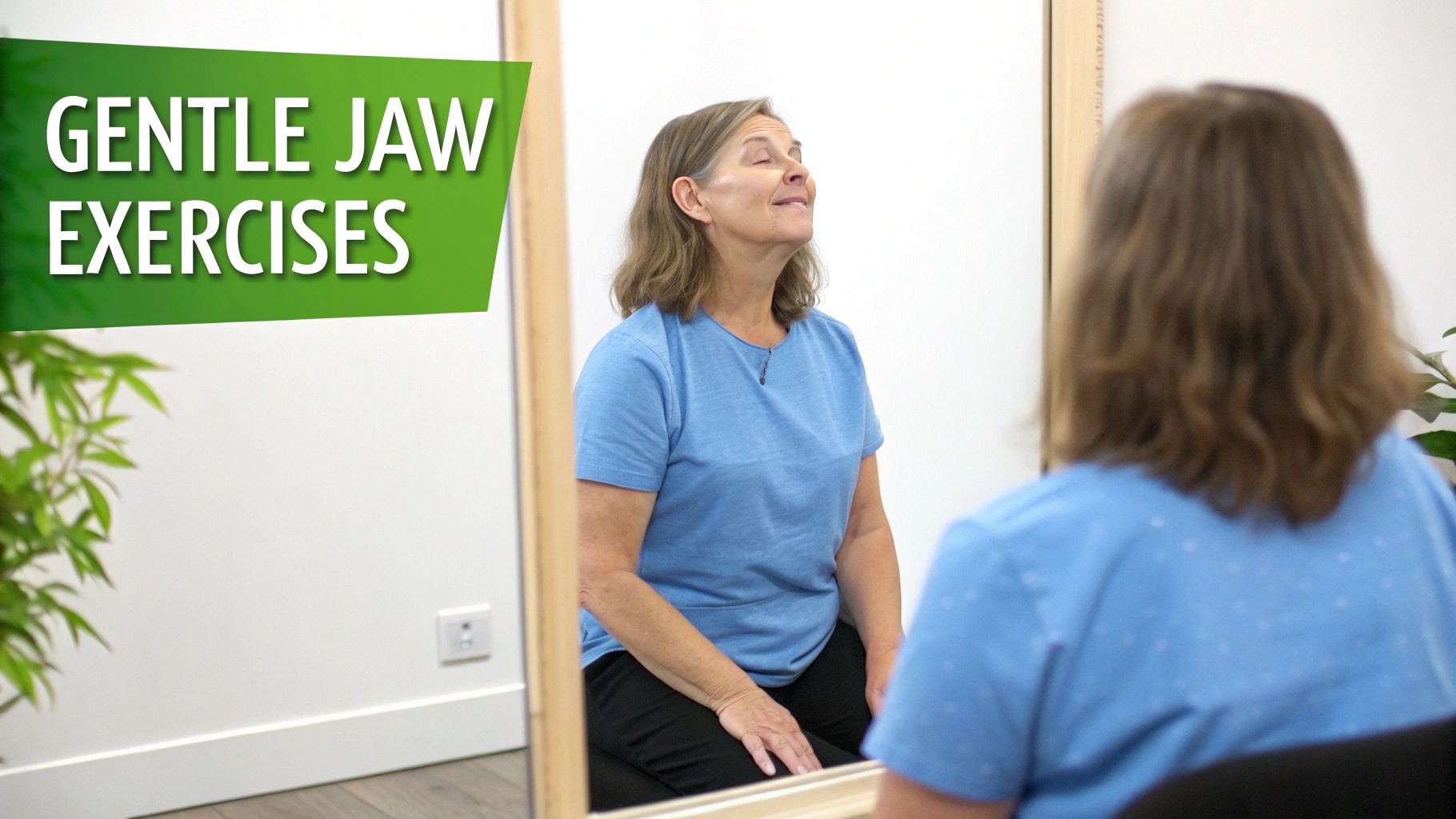
While immediate self-care can calm down a flare-up, gentle movement is your best long-term strategy for building a more resilient, comfortable jaw. Think of it as physical therapy for the crucial muscles you use every single day to talk, chew, and express yourself.
These exercises aren't about pushing through pain or forcing movement. The real goal is to re-educate overworked muscles, improve your range of motion, and gently release tension that's been building up over time. When it comes to jaw health, consistency is far more important than intensity.
The Foundation of Safe Jaw Movement
Before you even start, let's find your jaw's natural resting position. Let your lips gently touch, keep your teeth slightly apart, and rest your tongue lightly on the roof of your mouth, just behind your front teeth. This is your "home base" — the position you should return to after every single repetition.
Always move slowly and deliberately. If you feel any sharp or increasing pain, stop immediately. The goal here is a gentle release, not triggering more discomfort.
Core Jaw Strengthening and Mobility Exercises
These simple, controlled movements are designed to be done daily to improve jaw function and take the strain off the joint. Aim for just a few repetitions of each, focusing on smooth, completely pain-free motion.
1. The Resisted Opening and Closing
This exercise gently strengthens the muscles that help you open and close your mouth, which gives you much better control.
- Place your thumb under your chin to provide gentle upward pressure.
- Slowly open your mouth against that slight resistance, holding for 3-5 seconds.
- Next, place your index finger between your lower lip and chin. Gently close your mouth against that new resistance.
2. The Goldfish Exercise (Partial Opening)
This move gets its name from the gentle motion it creates. It's an excellent way to improve joint mobility without overextending anything.
- Place one index finger on your TMJ (the joint right in front of your ear) and another on your chin.
- Let your lower jaw drop down halfway and then close. You should feel only a slight movement in the joint itself.
- Perform a set of six, once a day.
3. The Goldfish Exercise (Full Opening)
This is the next step up from the partial opening, aiming for a greater range of motion once your jaw is ready for it.
- Keep your fingers in the same position as the partial opening exercise.
- This time, drop your jaw all the way down and then close it completely.
- Repeat for a set of six.
Crucial Tip: Never force your jaw open wider than it can comfortably go. The aim is to gradually improve mobility over weeks, not to achieve a full range of motion in one session. Pushing too hard is a surefire way to cause a flare-up.
Releasing Neck and Shoulder Tension
Your jaw doesn't exist in a bubble. Tension in your neck and shoulders travels directly up into your facial muscles, and it's a huge contributor to jaw pain. A forward head posture, which is so common from all our screen time, can place immense strain on the entire system.
Correcting this involves exercises that specifically target your neck and upper back.
The Chin Tuck
This incredibly simple move is one of the most effective ways to counteract forward head posture and relieve that built-up strain.
- Sit or stand up straight, looking forward with your shoulders back.
- Gently pull your chin straight back, as if you're trying to make a double chin.
- You should feel a nice stretch at the back of your neck. Hold for 3-5 seconds and then release.
- Repeat up to 10 times throughout the day. It's a great reset to do at your desk.
Integrating these simple movements into your daily routine can make a world of difference. For a deeper dive into how targeted exercises can retrain your muscles for optimal function, explore our guide to orofacial myofunctional therapy exercises. This approach can help address the root muscular imbalances contributing to your pain, creating a solid foundation for lasting comfort and helping you learn how to stop jaw pain for good.
Little Habits That Make a Big Difference in Jaw Health
While targeted exercises are great for retraining your muscles, lasting relief really comes down to the small, seemingly insignificant habits you repeat all day, every day. It’s not just about what you do for five minutes; it’s about creating an environment where your jaw can thrive around the clock.
This means paying attention to how you hold your body, how you breathe, and even where your tongue rests in your mouth. These subtle adjustments might feel minor, but they add up, reducing the constant, low-grade strain that leads to chronic pain. Getting these daily patterns right is how you tackle the problem at its source.
Get Your Oral Posture Right
You probably don’t think much about what’s happening inside your mouth when it’s closed, but this is your oral posture—and mastering it is a game-changer.
When your tongue sits low or your lips are slightly parted, your jaw muscles are forced to work constantly, even when you're not eating or talking. It's a low-level strain that builds up over time.
The ideal resting position is simple:
- Lips Together: Gently closed, no straining.
- Teeth Apart: There should be a tiny bit of space between your top and bottom teeth. They should never be touching at rest.
- Tongue Up: The tongue should rest lightly against the roof of your mouth, with the tip just behind your front teeth. This gives your upper jaw natural support.
At first, you’ll have to consciously check in on this. A sticky note on your computer or a reminder on your phone can help. Over time, this relaxed position will become your new normal.
The Overlooked Power of Nasal Breathing
How you breathe has a direct, profound impact on your jaw. If you're a chronic mouth breather, your jaw is constantly in a dropped, open position, which strains the TMJ and surrounding muscles.
Nasal breathing, on the other hand, is how our bodies were designed to function. It automatically encourages correct oral posture, helps stabilize the jaw, and engages your diaphragm for better oxygen exchange. Making the switch can dramatically reduce jaw tension, especially at night when mouth breathing often goes hand-in-hand with snoring and grinding.
Why This Matters: Shifting from mouth breathing to nasal breathing is one of the most impactful changes you can make for your jaw, airway, and sleep. It repositions the jaw naturally and cuts down on the muscle fatigue that comes from holding an open-mouth posture.
If you struggle with congestion, try a saline spray or nasal strips to open things up. The goal is to make breathing through your nose feel easy and automatic, day and night.
Your Body Posture Is Jaw Posture
Your jaw doesn’t exist in a vacuum. It’s directly connected to the chain of muscles and bones running down your neck and spine. That’s why poor body posture—especially the all-too-common forward head posture from staring at screens—is a huge driver of jaw pain.
When your head juts forward, your neck and upper back muscles work overtime just to hold it up. That tension radiates right up into the muscles that control your jaw, often leading to clenching, headaches, and TMJ problems.
Jaw pain has become a massive global health issue. In fact, nearly one-third of the world's population now experiences temporomandibular disorders (TMDs). Interestingly, women are affected at a much higher rate of 36.7% compared to just 26.7% in men, making them 1.75 times more likely to suffer. You can learn more from these global jaw pain statistics.
A few simple tweaks to your workspace can make a world of difference.
Simple Ergonomic Fixes to Try Today
- Raise Your Monitor: Position your screen so the top is at or just below eye level. This simple change stops you from craning your neck downward all day.
- Support Your Back: Use a chair with good lumbar support, or just roll up a small towel and place it behind your lower back to maintain your spine’s natural curve.
- Get Your Feet Flat: Make sure your feet can rest flat on the floor with your knees bent at a comfortable 90-degree angle.
- Take Movement Breaks: Set a timer to get up and stretch every hour. It keeps your muscles from locking into a tensed, static position.
By consciously fixing your oral and body posture and making nasal breathing a priority, you begin to dismantle the very patterns that cause jaw pain in the first place. These lifestyle shifts build a strong foundation, making every other exercise and treatment that much more effective.
Knowing When to See a Professional for Jaw Pain
While at-home strategies and lifestyle changes are powerful tools, they aren't always enough. Recognizing the line between manageable discomfort and a problem that needs a professional eye is the key to protecting your long-term jaw health and finally getting some answers.
Self-care should always be your first line of defense. But if your pain is getting worse, not better, it’s a clear sign that you need to escalate your approach. Ignoring persistent symptoms can allow underlying issues to progress, making them much harder to deal with down the road.
Red Flags That Signal It's Time for an Expert
Certain symptoms go beyond simple muscle tension and should be considered non-negotiable reasons to book an appointment. Think of these as your body’s alarm bells, telling you there might be a more significant mechanical or structural issue with the joint itself.
Pay close attention if you experience any of the following:
- A Locked Jaw: This is when your jaw gets stuck in either an open or closed position. It’s a definitive sign you need an immediate evaluation.
- Painful Clicking or Popping: A little harmless clicking is pretty common, but when that noise comes with pain, it suggests the disc inside your joint may be displaced or damaged.
- Difficulty Chewing or Opening Wide: If pain is making it hard to eat normally or open your mouth comfortably, it's impacting your quality of life and needs to be addressed.
- Pain That Doesn't Improve: If you’ve been consistent with self-care for a week or two and see zero improvement—or the pain is actually getting worse—it’s time for an expert opinion.
This flowchart helps visualize how simple daily habits, like your posture, can either lead your jaw toward relaxation or add to the strain.
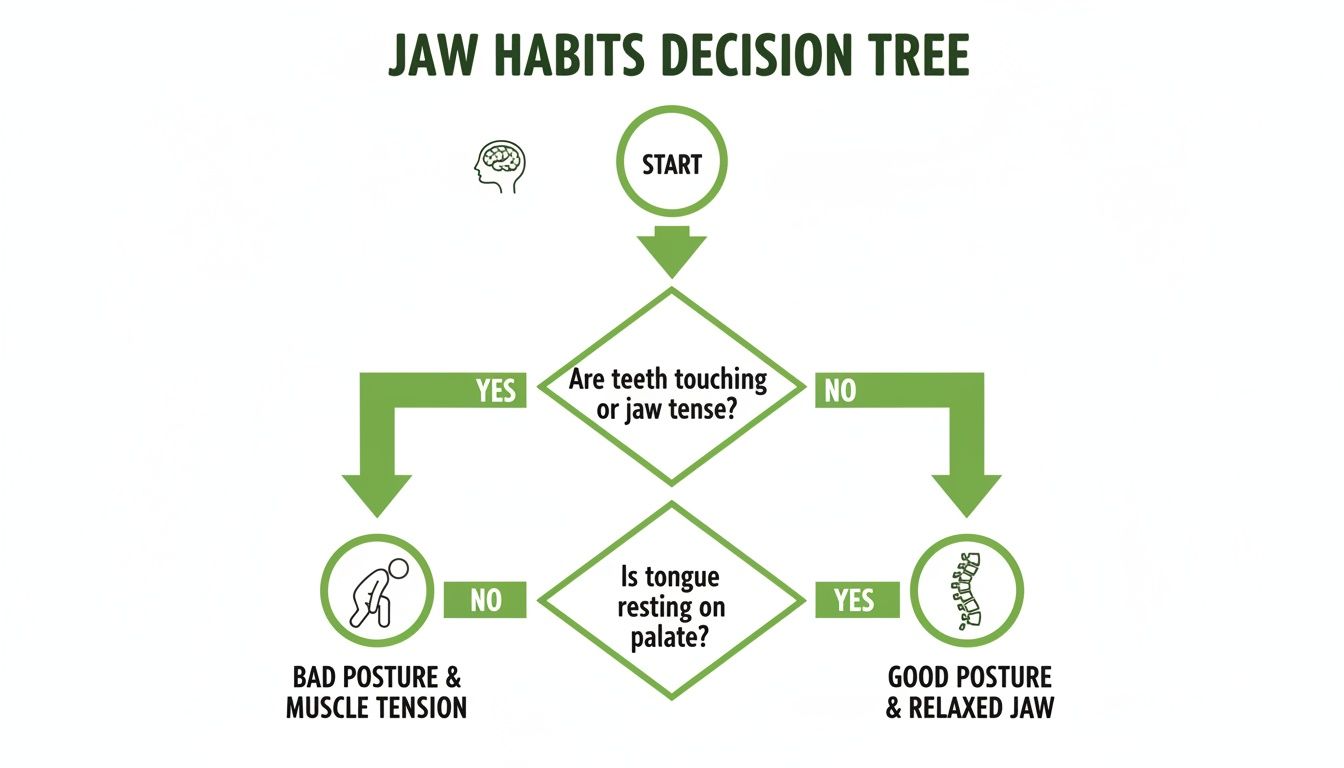
As you can see, something as basic as poor posture directly contributes to muscle strain, which really highlights why being mindful of your body throughout the day is so important.
Assembling Your Jaw Pain Care Team
Figuring out how to stop jaw pain for good often requires a team approach, simply because the root causes can be so varied. Your journey might start with your primary dentist, but depending on how complex your case is, you may get referred to other specialists.
The increasing prevalence of jaw pain is a serious global health concern. Projections show that by 2050, 44% of the world's population—or approximately 4.25 billion people—will be affected by temporomandibular disorders. These escalating numbers highlight the critical need for effective diagnostic and therapeutic strategies.
Experts who frequently collaborate on jaw pain cases include:
- Orofacial Pain Specialists: These are dentists who have advanced training specifically in diagnosing and managing complex pain conditions of the head, neck, face, and jaw.
- Physical Therapists: They are the experts in musculoskeletal function. A good PT can provide hands-on therapy and exercises to correct posture and improve your jaw mechanics.
- Sleep Physicians: If an airway issue like sleep apnea is suspected as the root cause of your grinding and pain, a sleep physician is essential for getting the right diagnosis and treatment.
What to Expect at Your First Visit
A diagnostic visit is all about gathering information. Your specialist will conduct a thorough examination, which usually involves feeling the muscles around your jaw, observing its range of motion, and listening for any joint sounds.
Be ready to talk about your symptoms in detail—when the pain started, what makes it worse, and what you’ve already tried.
Based on this initial assessment, they will develop a personalized plan. This plan almost always starts with conservative, non-invasive therapies. You can learn more about the various non-surgical TMJ treatment options that a specialized clinic can offer. Taking this step is how you move beyond guessing and get on a clear, expert-guided path to relief.
Answering Your Questions About Jaw Pain
Even with a plan in hand, it's natural to have questions. Jaw pain can be confusing, so let’s clear up a few of the most common concerns we hear from patients. Getting straightforward answers is the first step toward feeling confident about your path to recovery.
Is a Clicking or Popping Jaw Always a Sign of a Serious Problem?
Not always, but it's something to pay attention to. Plenty of people have noisy jaw joints that don't cause any pain, and that can be perfectly normal.
The real red flag is when that clicking or popping comes with pain, a locking sensation, or trouble opening your mouth. These symptoms are a clear signal that the joint's mechanics aren't quite right, often pointing to an issue like a displaced articular disc. If you’re hearing noises and feeling discomfort, it’s time to get a professional evaluation to figure out what's going on and prevent it from getting worse.
A noisy jaw isn't always a problem, but a noisy and painful jaw is your cue to get it checked out. Pain is the deciding factor.
How Long Until I Feel Better from Jaw Exercises?
Patience and consistency are your best friends here. While some people notice a bit of relief from muscle tension within a week or two, achieving significant, lasting improvement usually takes several weeks of daily practice.
Think of it like starting a new fitness routine—you wouldn't expect major changes after one trip to the gym. It’s the same principle when retraining your jaw muscles for healthier function. Your personal timeline really depends on a few things: the severity of your condition, how consistently you do the exercises, and whether you're also addressing other contributors like posture and stress.
How Does Stress Make My Jaw Hurt More?
Stress is a huge catalyst for jaw pain. When you're feeling anxious or overwhelmed, your body’s “fight-or-flight” response kicks in, and that often leads to unconscious physical habits. One of the most common is clenching your jaw muscles and grinding your teeth, a condition known as bruxism.
This constant muscle tension—whether you're awake or asleep—is a direct route to muscle fatigue, inflammation, and pain. It's a physical manifestation of your mental state. That’s why learning to manage stress with things like mindfulness, deep breathing, or meditation can directly lead to less tension and pain in your jaw.
Is Surgery My Only Option to Fix Jaw Pain?
Absolutely not. In fact, surgery is a last resort. It's only necessary for a very small minority of jaw pain cases, usually those involving severe joint damage or structural issues that haven't responded to any other treatment.
The good news is that the vast majority of TMD and jaw pain issues can be managed successfully with conservative, non-invasive treatments. Things like physical therapy, custom oral appliances (like splints or night guards), targeted exercises, and lifestyle adjustments are highly effective for most people and should always be the first line of defense. Surgery is rarely the first—or even second—step.
At the Pain and Sleep Therapy Center, we specialize in getting to the root cause of your discomfort to create a personalized, non-surgical treatment plan. If you're ready to find lasting relief from jaw pain, schedule a consultation with our expert team today.